




Once you've switched to using a food processor, you'll never go back. Remember when you used to chop onions by hand? Remember when you grated cheese and carrots using a box grater? Those were dark times, but with the best food processor, you can leave that all behind.
Keeping one of these nifty multitaskers on your kitchen counter will unlock a new level of efficiency that will have you feeling like a chef in a professional kitchen. Food prep is quick and efficient, washing up is painless, and dinner is, crucially, on the table a lot faster.
Our top pick has been in this guide for a few years, but the Cuisinart 14 Cup has genuine icon status in the cooking world. You'll see it on celeb and chef countertops alike, despite a huge range of more modern and attractive options.
On a budget? The Hamilton Beach Bowl Scraper 10 Cup will get the job done, and we loved its scraper attachment which will clear down the side of the bowl without manual intervention.
The best food processors you can buy today
Why you can trust Tom's Guide Our writers and editors spend hours analyzing and reviewing products, services, and apps to help find what's best for you. Find out more about how we test, analyze, and rate.
Best food processor overall


The Cuisinart 14 Cup is the best food processor we tested. While many high-capacity machines are deafening, hands-on testing revealed the Cuisinart reached just 65.2 dB. This makes it significantly more pleasant for long tasks, like pureeing hummus, than its closest high-end rival, the Magimix 14 Cup, which registered a much louder 79.2 dBA.
In our tests, the 720-watt motor proved to be a workhorse. It sliced a whole russet potato in only two seconds and shredded a block of cheddar cheese in 10 seconds with zero excess food caught in the lid; a common issue we ran into when testing other models. It also outperformed other models during the difficult cookie dough test, creaming butter and sugar together more thoroughly than competitors and producing exceptionally light, soft results.
While it offers top-tier performance, its design is simple compared to more recent releases such as the Breville Paradice 9. The design focuses on simplicity and ease of use, featuring two large paddle controls for "On" and "Off/Pulse" that remain easy to toggle with slippery hands. While it lacks the multiple speed settings found on newer models or the built-in scrapers of the Hamilton Beach 10 Cup, its raw power and 14-cup capacity make it more efficient for large families and heavy prep.
Read our full Cuisinart 14 Cup Custom Food Processor review.
Best value food processor


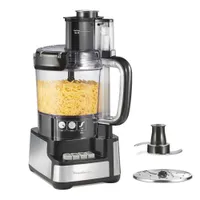
For home cooks who want reliable performance without the premium price tag, the Hamilton Beach Bowl Scraper 10 Cup is an outstanding value option. While high-end icons like the Cuisinart 14 Cup Custom focus on heavy-duty power and quiet operation, this model provides practical innovations on a budget, including its built-in scraper to clear the bowl’s sides during use.
Our tests showed that the limited wattage on offer with the Hamilton Beach doesn't hold it back as much as you might expect. Its 450 watts chopped an onion in just three seconds and grated our block of cheddar cheese in five seconds, making it one of the fastest machines tested. It even handled sticky cookie dough with zero motor strain, though the machine’s lightweight 6.9-pound frame rocked slightly during the process.
You can't compete with more premium models like the Breville Paradice 9 at this price, but we did love the Hamilton Beach's manual bowl scraper, which saves prep time by reducing the need to stop and remove the lid. However, testing revealed a minor flaw: the scraper stops about an inch from the bottom, meaning you’ll still need a spatula for the very base of the bowl. Our tests also found that the Hamilton Beach is exceptionally loud, registering 93.9 dB. Nevertheless, for under $60, its speed and versatility make it a compelling bargain.
Read our full Hamilton Beach Bowl Scraper 10 Cup Food Processor review.
Most versatile food processor


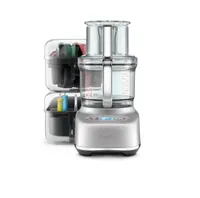
The Breville Paradice 9 (known as the Sage Paradice 9 in the U.K.) is the top pick for versatility, offering premium features typically found in much larger, more expensive machines. Its standout innovation is a space-saving storage system that houses all attachments, including a dicing kit, adjustable slicer, and dough blade, directly inside the main bowl.
We were impressed by the Paradice 9’s ability to handle tough tasks. It successfully blitzed rock-hard dried sourdough into fine breadcrumbs and chopped an entire head of cauliflower into consistent "rice" without turning it into mush. The 4.5-inch feed chute handled large quantities of cabbage for slaw in under a minute, and the dicing attachment — a rarity at this size — made quick work of potatoes and fruit, though it required more effort to clean than simpler blades.
The Paradice 9 is significantly more expensive than budget-friendly models like the Hamilton Beach Bowl Scraper 10 Cup, but it also provides much higher build quality and a far more expansive tool kit. This is the best choice for those who want a single machine to replace multiple kitchen gadgets like mandolines. Looking for something larger? Take a look at the Breville Paradice 16, its more expensive and larger counterpart.
Read our full Breville Paradice 9 review.
Best compact food processor


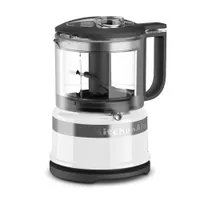
For small kitchens or anyone tired of hunting for a spare power outlet, the KitchenAid Cordless Top Down Food Chopper is the ultimate space-saving solution. While full-sized models like the Cuisinart 14 Cup Custom are countertop fixtures, this 3.5-cup chopper is light, portable, and easily tucked into a drawer.
In our testing, this tiny machine proved remarkably speedy. It prepared a fresh salsa in under 10 seconds with just three pulses. Root vegetables were equally easy; it minced a carrot in seconds, though testing noted that the final chop wasn't perfectly uniform, leaving some larger chunks among the finer bits. While it excels at fast chopping, it struggled with smooth purees. Making hummus required dismantling the motor multiple times to add oil and scrape the sides, and even then, the result remained slightly chunky.
The "Top Down" design is minimalist and incredibly easy to operate via one giant power button on top. Its standout feature is the detachable battery, part of the KitchenAid Go range, which is compatible with other cordless tools like their hand mixer. However, it lacks the ingredient spout found on the corded version of the same product, making liquid-heavy recipes like pesto more tedious. At roughly $99 with a battery, it’s more expensive per cup than the Hamilton Beach Bowl Scraper 10 Cup. But for high-speed food prep without the mess of wires, its convenience is hard to beat.
Read the full KitchenAid Cordless Top Down Food Chopper review.
Most durable food processor


Magimix produced the first domestic food processor in 1971, and it brings that same innovation and quality to the Magimix Food Processor 14 Cup model, the sturdiest food processor we tested. Made in France and designed with professional-grade durability, it is backed by an industry-leading 30-year motor warranty, signaling its place as the most durable machine in the guide.
In hands-on testing, the 950-watt motor demonstrated immense power, handling a full batch of cookie dough with ease to produce a light and airy result. Speed tests showed it can slice a whole russet potato or carrot in just four seconds, and grated our block of cheese in 15 seconds with perfectly clean, consistent results.
A standout feature is the three-bowl system (6, 12, and 14 cups), which allows you to process different parts of a recipe without stopping to wash a single bowl. This innovation offers significantly more flexibility than the Cuisinart 14 Cup Custom, which only provides one bowl. However, at 17 pounds with a separate storage box for attachments, it may be too bulky for smaller kitchens. While its price is a premium over budget options like the Hamilton Beach 10 Cup, its versatility, quiet operation, and built-to-last construction justify the cost for serious cooks.
Read our full Magimix Food Processor 14 Cup review.
Best food processor for slicing


The KitchenAid 13 Cup Food Processor is the top choice for precision prep, earning its title as the "best for slicing" due to its externally adjustable ExactSlice system. This allows users to shift from thick to thin slices by simply sliding a lever, a level of customization not found even in our top pick.
This machine proved to be a time-saver for large-scale slicing. It processed a whole russet potato in just seven seconds with perfectly consistent results. While it excelled at firm vegetables, it did require some pre-cutting for carrots due to an auto-off safety feature that necessitates the chute depressor be fully inserted. It also handled onion chopping in a mere three seconds. However, its performance on sticky tasks like cookie dough and hummus was less impressive; because of the bowl’s large 13-cup capacity, ingredients often migrated to the edges, requiring frequent manual scraping to achieve a uniform blend.
KitchenAid has reimagined the traditional food processor design with a "Snap and Go" bowl and a hinged, locking lid. This eliminates the need to twist the bowl onto the base — a common frustration with models like the Magimix 14 Cup. At 9.7 pounds, it is significantly lighter than the 17-pound Magimix, making it easier to lift in and out of storage. However, its 17.44-inch height is a drawback, as it likely won't fit under standard overhanging kitchen cabinets. For smaller kitchens, the KitchenAid 3.5 Cup Chopper remains a better compact bet, but for those who prioritize effortless, customized slicing, the 13-cup model is unmatched.
Read our full KitchenAid 13 Cup Food Processor review.
Also tested
We've tested lots of food processors over the years, but not all of them can be the very best.
However, after making hundreds of cups of hummus, coleslaw, and salsa, there are some processors that could be right for your kitchen.
We've tried a huge 40-pound processor and a tiny food chopper that could be a better fit than the products above, which are exceptional but might not be the right fit.
Here are some recently-tested processors that are still worth considering.

How we tested the best food processors

Our Managing Editor of Buying Guides, Millie, has been testing food processors for 5 years. Although she's a keen home cook, she's always looking for ways to make mealtime easier and more efficient, and the best food processors tick all of these boxes.
Millie's kitchen at home is quite small, so she regularly uses her five-cup food processor to chop onions or make compound butters for two-person meals.
We put a range of food processors through a variety of demanding tests to evaluate their overall performance, design and quality. To start, we sliced whole potatoes and carrots to assess the performance on hard everyday vegetables, and then we grated a ⅓-pound block of cheese, to see how consistently each grated and how much waste was left behind. We also chopped onions and pureed hummus, to assess the power, and then we mixed a batch of cookie dough in each food processor, which was one of the hardest tests because of its thick, sticky texture.
During each test, we looked for consistency, both in terms of chopping and slicing, and we wanted a thorough blend on the hummus and cookie dough tests. We monitored how easily each machine handled the ingredients, as well as the speed with which they completed the tests. We also made note of any difficulties that we faced.

Next, we filled up each food processor with water and ran it to test for leakage. None of the models we tested had any leaks, which is good news. We also assessed the noise of each while in operation with a sound reader. Finally, we evaluated any additional elements, like how easily the machines can be cleaned and the effectiveness of any accessories that contribute to their performance or versatility.
We also tested some food processors that don't feature in our guide because their performance wasn't on par with the rest of the models we tested. This includes the Oster Total Prep 10 Cup Food Processor and the Black + Decker 8 Cup Food Processor, both of which scored 3 stars in testing.
Food processor results
Product Name |
Dimensions (inches) |
Output (Watts) |
Capacity (Cups) |
|---|---|---|---|
Cuisinart 14 Cup Custom |
11.0 x 7.9 x 14.8 |
720 |
14 |
Hamilton Beach Bowl Scraper 10 Cup |
10.25 x 9.55 x 15.47 |
450 |
10 |
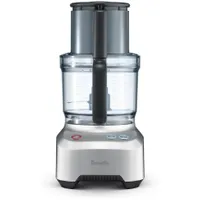
Breville Sous Chef 12 Cup |
17.0 x 10.5 x 8.5 |
1000 |
12 |
KitchenAid 5 Cup Cordless |
10.39 x 6.61 x 5.51 |
N/A (Battery) |
5 |
Magimix Food Processor 14 Cup |
16.7 x 8.3 x 10.2 |
950 |
14 |
KitchenAid 13 Cup Food Processor |
8.7 x 8.75 x 17.44 |
500 |
13 |
Cuisinart Elemental 8 Cup |
7.6 x 9.58 x 13.2 |
350 |
8 |
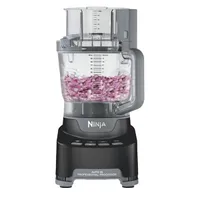
Ninja Professional Food Processor |
7.76 x 9.88 x 16.02 |
850 |
9 |
KitchenAid 3.5 Cup Food Chopper |
8.7 x 5.6 x 5.6 |
240 |
3.5 |
What to look for when buying a food processor
What's the difference between a good food processor and a great one? A quality processor should be able to take on whole fruits and vegetables with ease, without much time expenditure in between items. It should be safe to use and easy to store. Before you pull the trigger on a purchase, here are some features to keep top of mind.
Budget: This is always a good place to start, but remember, it's a wide range. Expect to spend anywhere from $20 to $50 on the low end for simple chopping machines and $200 to $400 — and up — for professional-grade devices. You get what you pay for, and that's not always a bad thing.
Size and type: Food processors come in a variety of styles but can generally be categorized as mini, compact or full size. Miniprocessors (i.e., "choppers") are adequate for dicing up one or two small items at a time and are easy to clean, but their usefulness is limited. The larger the food processor, the more versatile its capabilities. Premium processors come with larger storage containers, too, making them better for family-size meals.
Power: Again, it's a wide range. From 200 watts on the low end to 1,200 watts for premium models, larger machines draw the most juice. If you're shopping for a full-size machine, 500 watts or more should be enough to power through most food-processing jobs without a fuss. Weaker motors don't do a good job at uniform chopping/mixing, and they run the risk of burning out when overloaded.
Controls: While pricier machines may include LCD displays; countdown timers; and dedicated buttons for slicing/shredding, pureeing/mixing and pulsing, budget models offer less customization. If your food-processing needs are modest, though, one or two speeds is all you need.
Blade performance: Sharp blades are important, because they affect how evenly food is chopped, and some of them are reversible, increasing their functionality. Quality blades and grating disks should be super-sharp right out of the box and remain sharp for years to come.
Attachments: This is where you really need to pay attention. Different brands and models come with myriad attachments and accessories, but you're unlikely to use all of them all the time. Pick a food processor with a set of accessories that fits your lifestyle. That being said, here are a few useful add-ons we like:
Warranty: The more you spend, the longer the warranty should be. Expect one year for less expensive models and upward of three years for premium machines.

