What’s the best way to fight against malicious AI? With more AI. Computer security company McAfee has just announced an AI-powered deepfake audio detector called Project Mockingbird. Its purpose is to defend users from cybercriminals using fabricated AI-generated audio in videos to scam and rob people of money or from being manipulated by a fake recording of a public person.
McAfee’s Project Mockingbird, that’s being unveiled at CES 2024, uses a combination of AI-powered contextual, behavioural, and categorical detection models to identify whether the audio in a video is likely AI-generated. It listens to a video and flags the parts it believes are deep fakes.
While generative AI tools are helping us create apps or organize our lives, cybercriminals are using them to create highly convincing scams. Many of us have learnt to ignore those emails or pop-ups that seem too good to be true. But what if it’s a call from a loved one in need? One mother was in for a shock when scammers called her using the cloned voice of her 15-year-old daughter last year.
On the phone, she could hear her ‘daughter’ begging for help as an unknown person threatened to kill her unless he received $1 million dollars. Thankfully her real daughter was fine and no money was lost.
“It was completely her voice. It was her inflection. It was the way she would have cried,” she said. “I never doubted for one second it was her. That’s the freaky part that really got me to my core,” the mom said.
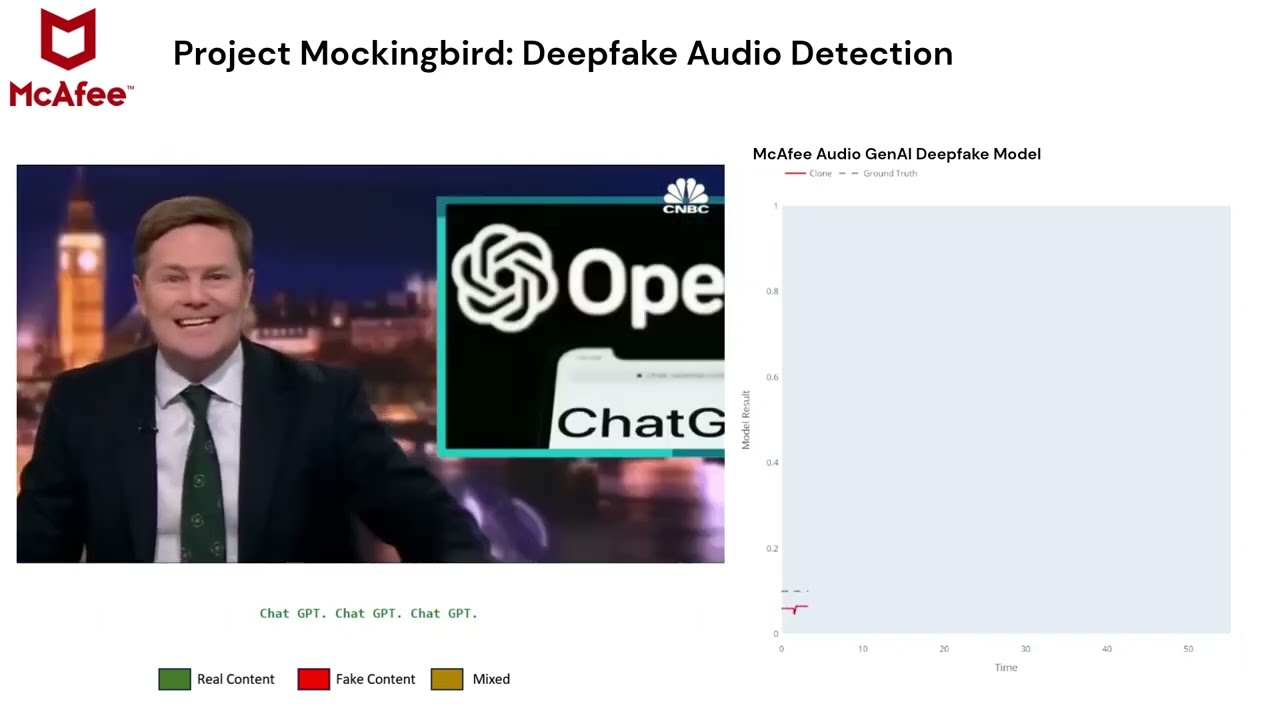
Such distressing calls are exactly the kind of thing Project Mockingbird is meant to guard against. It also works against so-called “cheapfakes” which may involve manipulating authentic videos, like newscasts or celebrity interviews, by splicing in fake audio to change the words coming out of someone’s mouth; this makes it appear that a trusted or known figure has said something different than what was originally said.
With 2024 set to be a big year for elections around the world, including the upcoming US presidential election, Project Mockingbird has its work cut out for it.
McAfee claims its AI detection tech operates at 90% accuracy.
“So, much like a weather forecast indicating a 70% chance of rain helps you plan your day, our technology equips you with insights to make educated decisions about whether content is what it appears to be,” said McAfee CTO Steve Grobman in a statement.
So many folks thought this image of the pope wearing a puffer jacket was real.It wasn't...it was created in Midjourney.We're going to have significant issues in our next presidential election if we don't have ways to authenticate images/videos/text. pic.twitter.com/mtnXGW6zLDMarch 27, 2023
The technology will help users know instantaneously if a video from a celebrity pushing a deal or a presidential candidate is real or AI-generated for malicious purposes.
McAfee is hosting the first public demos of Project Mockingbird at CES in Las Vegas. The company said the name of its new product was inspired by mockingbirds, a group of birds known for mimicking (or ‘mocking’) the songs of other birds.
Check out our CES 2024 hub for all the latest news from the show as it happens. Follow the Tom’s Guide team in Las Vegas as we cover everything AI, as well as the best new TVs, laptops, fitness gear, wearables and smart home gadgets at the show.
And be sure to check out the Tom's Guide TikTok channel for all the newest videos from CES!
More from Tom's Guide
- Samsung TV lineup 2024: All the new QLED and OLED TVs announced at CES
- Oppo Find X7 Ultra is here with an impressive camera upgrade — but there's the same old catch
- 2024 is the year AI eclipses hardware in smartphones — is this a good thing?