Although I’m a huge fan of mobility routines, there’s a time and place to wind down and find length and strength with a relaxing stretching routine instead. This one takes less than 15 minutes and includes five exercises.
I recommend saving static stretches for the end of a workout, as you’re cooling down, to help release tension in tight muscles and provide a temporary boost in flexibility.
Stretching can help reduce next-day DOMS associated with a challenging workout (in some people), improving blood flow and releasing tightness; studies suggest it doesn't speed up muscle repair significantly, though. Exercise stimulates muscle breakdown, whereas rest and recovery signal to the body to rebuild. This is a simplified version of how muscle growth takes place.
But it's not just about recovery; stretching can also help you relax, unwind and feel a little more pliable. If you're ready to take it down a notch and get bendy, roll out one of the best yoga mats and move gently through the five exercises below, targeting problem areas such as the shoulders, hips, back, groin and hamstrings.
Watch: 5-move stretching routine you can try anywhere
I recommend watching the video so that you can follow along anywhere. Hold each stretch for 45 to 60 seconds per side (and stretch) and try to relax into your breathing with a long inhale and exhale.
Stop if you experience pain, and if you are currently pregnant, post-natal, injured, or dealing with a health condition or illness, seek professional advice before trying this routine for the first time.
1. Reclined butterfly
The butterfly sit involves placing the soles of the feet together and opening the knees to the sides, stretching the groin, hips and inner thighs. To open the hips further and stretch out the spine, I like to perform this exercise lying on my back. You could even extend your arms behind your head to lengthen your back, neck, arms and shoulders.
If you choose to lie down, try to avoid excessively arching your lower back or flaring your ribcage. It's unlikely your lower back will press down fully onto the mat, but your spine should be supported and your pelvis tucked slightly toward you to help with more neutral alignment. Place your hands by your sides or on your hips if you prefer, and tuck your chin under.
- How to perform the seated butterfly sit
2. Frog pose
Frog pose mimics how a frog sits when relaxing (do frogs really relax?), using the same position of the legs. Many people find this helps relieve symptoms of sciatica, as it stretches the lower back, hips, groin and adductors, as well as adding a secondary stretch to the glutes.
You can scale this exercise by drawing your heels closer together to make the exercise easier; the harder variation involves aligning your heels more with your knees. Always rest on the inner sides of your feet and knees, never placing undue pressure on your knee joints. You can sit tall and relax into this stretch to target your back more or lower onto your elbows or chest for a deeper hip stretch.
This pose gets the nickname “The Pelvis Breaker” for a reason — not because it’s bad for you, but because it feels intense; try to breathe into the discomfort rather than sit holding tension. The more you breathe, the more you can melt into this stretch.
3. Modified supported fish pose
In yoga, the fish pose, or Matsyasana in Sanskrit, is a backbend. The supported variation requires a bolster, yoga block, or cushion to support the spine. I’m not a yoga teacher, so instead, I modify it. I would always recommend checking in with a yoga teacher if you want to practice backbends, and stop immediately if you feel pain.
When performed correctly, you’ll feel a deep stretch in your upper body, including your chest and back, but ensure the crown of your head is supported on the mat. If using a bolster, ensure it supports your entire spine; if using a block, choose a height setting that works for you, then align it with your spine, with the bottom of the block sitting between the lower shoulder blades.
I like to cactus my arms to the sides and open the fronts of my shoulders or stretch my arms overhead to release my upper back, arms and lats. You can extend your legs down your mat, bend your knees and place both feet on the mat, or follow the butterfly pose above.
4. Incline puppy
Incline puppy involves resting both hands on a block or cushion in front of you. It's a deep chest opener which also opens the shoulders and stretches the arms and abdomen.
Gently press both hands into your prop and focus on lowering your heart and forehead toward the mat beneath you. Take long, deep breaths and focus on keeping your hips elevated over your knees; this isn't a child's pose, so your hips should always stay high.
Think about how a dog looks when they stretch their front paws out, except you're on your knees instead. It's one of the most powerful torso stretches I have done, and I can't get enough of how stretchy and loose it makes me feel.
5. Pyramid
The pyramid is a hamstring stretch that relies on a hip hinge to strengthen the muscles along the back of the body, including the lower back and glutes, known as the posterior chain.
The key to this stretch is focusing on the hip hinge rather than collapsing your chest down your leading thigh. First, imagine you are balancing a glass of wine on your spine and keep your back flat so your chest is parallel to the ground, placing your hands on your hips.
If you can fold your chest to your thigh, do so with control and without hunching over. Keep your hips square; if your left leg is leading, pull your left hip back slightly so that it doesn't sit further forward than your right side.
You could wrap a band around your front foot and grip with both hands to deepen the stretch.
Stretching vs mobility
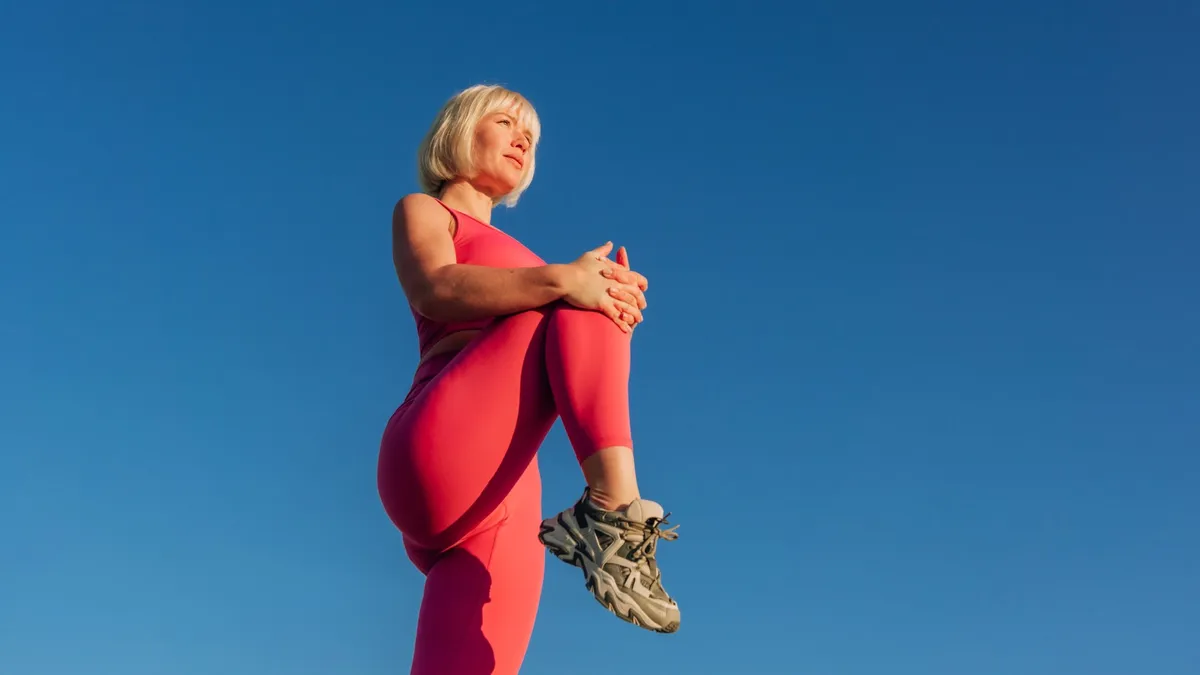
Muscles take a little longer to release before you can stretch deeper, which is your body’s way of protecting itself from stretching too far and causing injury. There are two processes worth knowing about if you plan to stretch often: the stretch reflex and the inverse stretch reflex, or Golgi tendon reflex, as it’s also known.
The easiest way to think about the stretch reflex is a knee-jerk reaction. When there’s a sudden muscular stretch, a signal is sent via your nervous system to contract the stretched muscle and relax the opposing muscle to protect it. Hence, your leg shoots out when someone taps hard on your upper knee.
However, the inverse reflex works differently by triggering the stretched muscle under tension to relax — in this case, the Golgi tension organs (GTOs) signal to your spinal cord to reduce activity in response to force — this high tension can be either a strong contraction or a stretch that’s held for a prolonged period, roughly 30 seconds or more. The opposing muscles, this time, will contract, allowing your stretched muscle to relax.
That's partly why it takes a while to fully relax into a stretch and feel more open and flexible. Over time, you can build flexibility with stretching, but you'll find the biggest impact immediately after feels short-lived.
Mobility, on the otherhand, combines strength, control and motion to improve the range of motion in your joints. Think knee circles or shoulder rolls. I save these activities for before a workout, and consistently performing a mobility routine will benefit you and your joints long-term.
Learn the difference between stretching vs mobility.

Follow Tom's Guide on Google News and add us as a preferred source to get our up-to-date news, analysis, and reviews in your feeds.
More from Tom's Guide