Prices are absurd wherever you look, especially when many of the best electric cars I’ve tested easily start at around $50,000. Sub-$30,000 new cars are few and far between these days, but they still exist — and the Chevrolet Trax and Hyundai Venue are proof.
Subcompact SUVs remain some of the most affordable options on the market, combining the efficiency of smaller sedans with the utility that makes crossovers so appealing. I spent a week with both the 2026 Chevrolet Trax 1LT and the 2026 Hyundai Venue SEL, which carry as-tested prices of $27,975 and $24,440, respectively.
While I’ve already pitted the Hyundai Venue against the Subaru Crosstrek, it faces an even tougher challenger in the sportier Chevrolet Trax. After putting them both to the test, here’s the subcompact SUV I recommend if you want to spend as little as possible on your next vehicle purchase.
Chevrolet Trax vs. Hyundai Venue: Specifications
| Header Cell - Column 0 | 2026 Chevrolet Trax 1LT |
2026 Hyundai Venue SEL w/2-Tone Roof |
|---|---|---|
Price Tested |
$27,975 |
$24,440 |
Fuel Economy |
28 mpg city / 32 mpg highway / 30 mpg combined |
29 mpg city / 33 mpg highway / 31 mpg combined |
Engine |
ECOTEC 1.2L TURBO Engine |
1.6L DOHC 4-Cylinder Engine |
Fuel Tank Capacity |
13.2 gallons |
11.9 gallons |
Horsepower |
137 hp |
121 hp |
Wheels |
17-inches |
17-inches |
MSRP |
$23,200 |
$22,600 |
Chevrolet Trax vs. Hyundai Venue: Design


Thankfully neither of these vehicles look boring, which is a welcome relief because when you get to prices this low, automakers aren’t inclined to focus on them as much. While they’re similar in price, they take drastically different approaches with their aesthetics.
For starters, I really love how the Hyundai Venue takes a page out of Mini Cooper’s playbook by designing the Venue with a bit of flair that makes it look better in my opinion over its sibling in the Hyundai Kona. Even though it has a boxier, more upright proportion, small details like its contrast two-tone roof give it a stylish look that I don’t expect to find in this bracket.


Meanwhile, the Chevrolet Trax goes in the opposite direction with its sleeker roofline and athletic styling that catches my attention. In fact, it reminds me a lot of the larger Chevrolet Blazer with its lower stance and wider body – giving it an almost rugged, outdoor-ready stance. Throw in the sculpted body lines, slim LED daytime running lights, and subtle rear spoiler, the Trax certainly has the more commanding presence on the road.
Winner: Chevrolet Trax
Chevrolet Trax vs. Hyundai Venue: Fuel economy
| Header Cell - Column 0 | 2026 Chevrolet Trax 1LT |
2026 Hyundai Venue SEL w/2-Tone Roof |
|---|---|---|
Total Miles Driven |
161 miles |
133.1 miles |
Average Fuel Economy |
34.8 mpg |
37.8 mpg |
Best short distance fuel economy |
28.3 mpg |
49.6 mpg |
Best long distance fuel economy |
38.4 mpg |
40.6 mpg |
As much as I prefer hybrids for their superior gas savings over conventional ICE (Internal Combustion Engine) vehicles, the Trax and Venue promise sedan-like fuel economy. On paper, it looks like an even matchup, with the Venue rated at 31 mpg combined and the Trax right behind it at 30 mpg.
However, I’m happy to report that both exceeded those expectations in my real-world driving tests. Over 133.1 miles of mixed driving, the Venue averaged an astonishing 37.8 mpg — nearly 7 mpg above its EPA combined rating. Just as convincing was the Trax’s impressive 34.8 mpg over 161 miles, which is outstanding for a non-hybrid, but still a smidge short of the Venue’s superior efficiency.
Things get even more interesting when looking at their performance across highway stretches and local trips. Thanks to its lightweight footprint and 1.6-liter inline-four engine, the Venue clocked a staggering short-distance peak of 49.6 mpg, leaving the Trax’s 28.3 mpg in the dust. On longer highway drives, both crossovers excelled, but the Venue still took the crown with a best long-distance run of 40.6 mpg versus 38.4 mpg for the Trax.
Neither is classified as a hybrid, but the Venue absolutely makes a case for itself with its stellar efficiency.
Winner: Hyundai Venue
Chevrolet Trax vs. Hyundai Venue: Driving performance


Although both subcompact SUVs are easy to drive due to their small footprints and tight turning radii, there’s one that delivers a noticeably more engaging experience behind the wheel: the Chevy Trax.
That’s because the Trax is powered by an Ecotec 1.2-liter turbocharged three-cylinder engine delivering 137 horsepower and a much meatier 162 lb-ft of torque. That turbo makes all the difference, which translates to a zippier drive on the road that gets it moving in a quick manner. Paired with its wider stance and longer wheelbase, the Trax feels far more composed when carving through turns and cruising at highway speeds.


In contrast, the 2026 Hyundai Venue SEL achieves its superior fuel economy with a smaller-output 1.6-liter inline-four engine producing 121 horsepower and 113 lb-ft of torque. It still drives with confidence during routine neighborhood errands, but it feels lethargic when merging onto fast-moving freeways.
Winner: Chevrolet Trax
Chevrolet Trax vs. Hyundai Venue: Comfort


The biggest compromise I tend to see among budget-conscious vehicles is how they shortchange the comforts and features, often omitting anything beyond the absolute basics.
That compromise is immediately evident in the Venue. Sitting inside feels like a throwback due to the heavy use of hard plastic across the dashboard and a tiny main display that easily washes out in direct sunlight. Unfortunately, its slick exterior styling simply doesn't carry over into the cabin.
While the denim cloth and leatherette seats in the Venue offer decent support for extended drives, I can’t say the same for anyone riding in the back. With just 34.3 inches of rear legroom, taller adults will struggle to sit comfortably without their knees pressing into the front seats. Cargo capacity is similarly pinched at 18.7 cubic feet of trunk space, requiring careful planning to fit larger packages or bulky luggage.


The 2026 Chevrolet Trax 1LT, on the other hand, delivers a sportier aesthetic that appeals to me far more, complete with jet engine-inspired air vents and vibrant yellow contrast stitching across the cabin. More importantly, practical passenger comfort is vastly superior thanks to its expansive 38.7 inches of rear legroom and generous 25.6 cubic feet of cargo volume behind the seats. All told, the Trax takes a decisive win by pairing genuine passenger comfort with unmatched day-to-day utility.
Winner: Chevrolet Trax
Chevrolet Trax vs. Hyundai Venue: Value


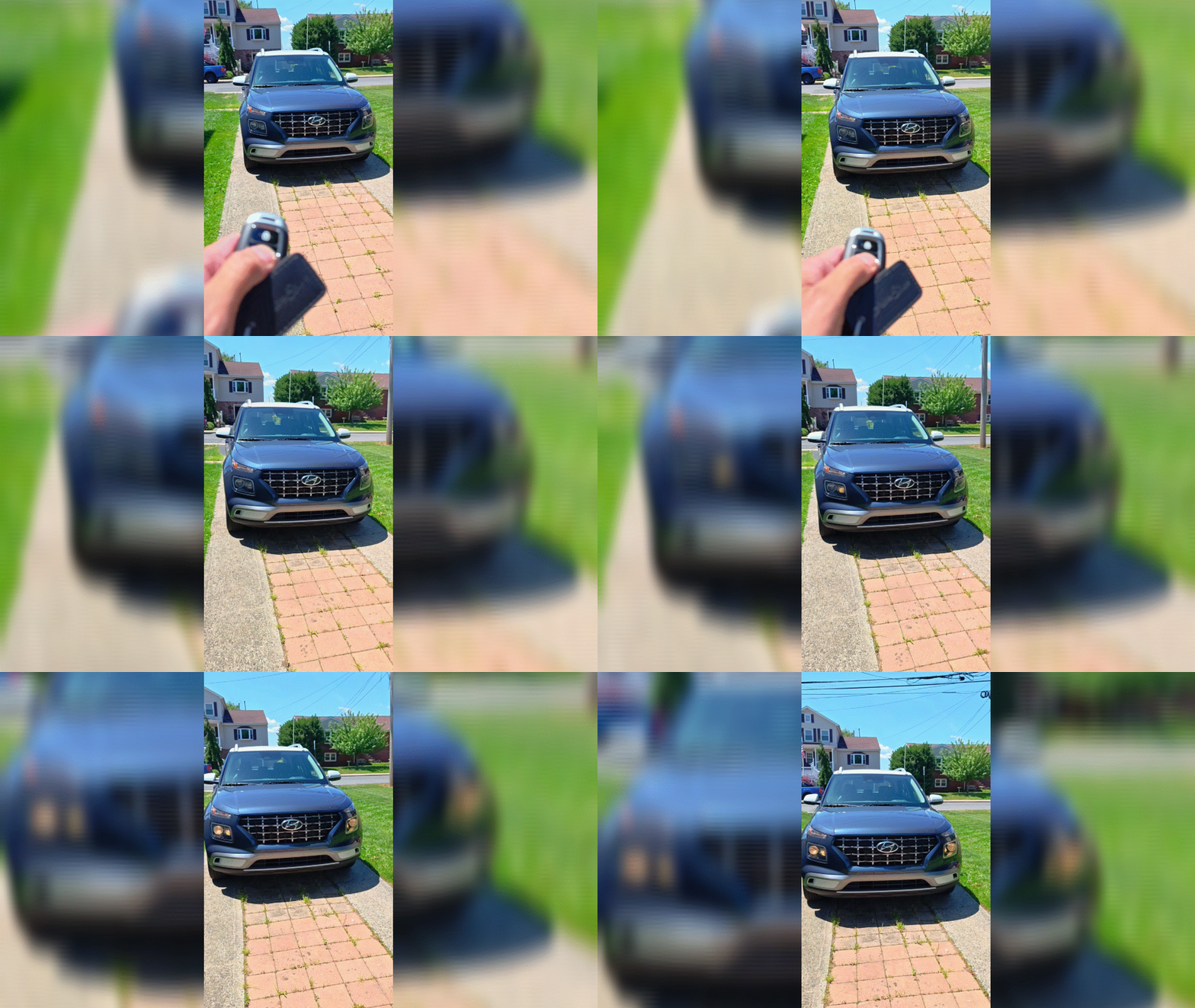
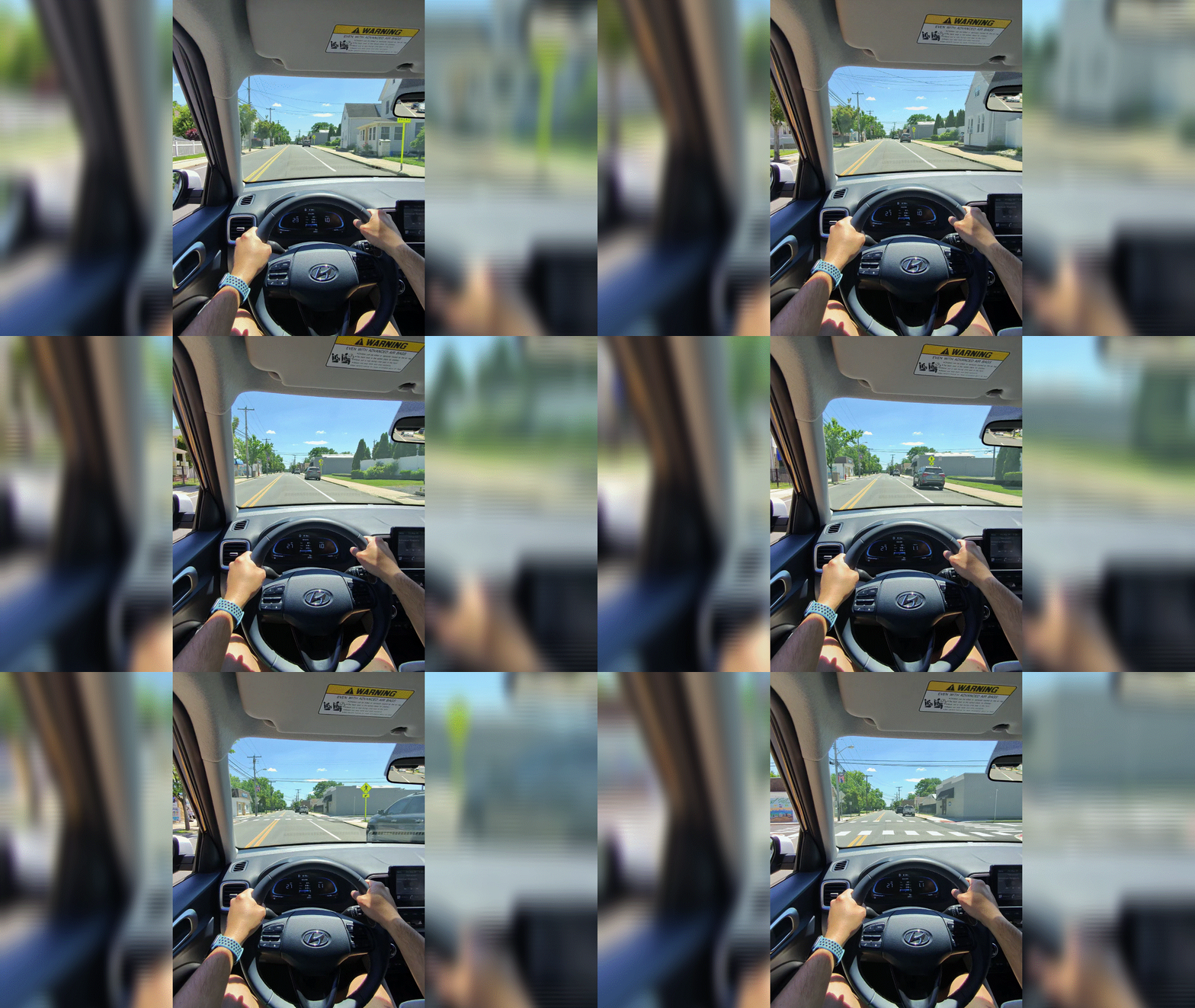


Separated by a little over $3,500, the $24,440 as-tested Venue certainly grabs attention with its lower out-of-pocket cost — but I can’t stress enough just how many essential extras come loaded on the Trax.
There’s not a whole lot that accompanies the Venue, which is about as basic as they come. You still get standard equipment like a wireless phone charger, heated front seats, blind-spot collision warning, and rear cross-traffic alert. Bolstering all of that is Hyundai's generous 10-year/100,000-mile powertrain warranty, offering long-term coverage that Chevy simply can’t match.


However, Chevrolet packs in more than enough extra equipment to justify its slightly higher price tag. This $27,975 priced Trax 1LT I tested came with options like a power sunroof, heated steering wheel, heated front seats, and, most importantly, adaptive cruise control.
That means the Trax can actively maintain its following distance and manage acceleration and braking in traffic, rather than relying on standard cruise control like the Venue. That driver-assist feature alone adds tremendous everyday value, especially if you face long highway stretches during your daily commute.
Winner: Chevrolet Trax
Chevrolet Trax vs. Hyundai Venue: Verdict


At a time when new car prices are super high, it’s refreshing to find viable options under $30,000. Both subcompacts make a compelling case for budget-conscious drivers who want to keep out-of-pocket costs low without sacrificing everyday ease of driving. What surprised me most is how both vehicles maximize efficiency without carrying the typical hybrid price premium.
| Header Cell - Column 0 | 2026 Chevrolet Trax 1LT |
2026 Hyundai Venue SEL w/2-Tone Roof |
|---|---|---|
Design |
X |
Row 0 - Cell 2 |
Fuel Economy |
Row 1 - Cell 1 | X |
Driving Performance |
X |
Row 2 - Cell 2 |
Comfort |
X |
Row 3 - Cell 2 |
Value |
X |
Row 4 - Cell 2 |
Total |
4 |
1 |
I give the 2026 Hyundai Venue SEL credit for its lower price tag and for crushing its EPA estimates with an impressive 37.8 mpg average in my testing. But the 2026 Chevrolet Trax 1LT earns my recommendation as the vehicle I’d buy with my own money.
Between its punchier turbocharged acceleration, expansive rear legroom, vastly larger cargo hold, and modern tech the Venue simply lacks, the Trax justifies every cent. Separated by only about $3,500, the Trax delivers the superior blend of space, comfort, and driving refinement.
Chevrolet Trax vs. Hyundai Venue: Pros and cons

2026 Chevrolet Trax
Pros
- Good size
- Zippy acceleration
- Excellent rear legroom
- Large trunk space
- Sporty aesthetic inside and out
- Adaptive cruise control
Cons
- Soft backup camera
- Suspension feels a smidge stiff

2026 Hyundai Venue
Pros
- Two-tone design
- Attractive low starting cost
- Impressive fuel efficiency
Cons
- Bland interior design
- Tight legroom
- Sluggish acceleration

Follow Tom's Guide on Google News and add us as a preferred source to get our up-to-date news, analysis, and reviews in your feeds.
More from Tom's Guide
- I'm not anxious that it's getting darker earlier with this thermal camera for my car — here's why
- I just test drove the new Nissan Leaf — and it's irresistible at under $30,000
- CrabWalking with the GMC Sierra EV is the weirdest thing I’ve ever done with a car — and it’s actually pretty useful