Tom's Guide Verdict
The Helix Cooling Memory Foam Pillow lived up to its name during our testing period, which happened to coincide with a heatwave. Okay, it wasn't ice cold all night long but it warmed to a neutral feel and stayed that way, even when the rest of the bedroom was uncomfortably hot. And it does all that while hugging your head with exceptional pressure relief. It's competitively priced at $93 and the dense, heavy build suggests good durability.
Reasons to buy
- +
Stays a neutral feel even on very hot nights, preventing overheating
- +
Heaps of pressure relief to prevent ear and jaw ache
- +
High-quality build suggests good durability
- +
Comes in two lofts to suit more sleep needs
Reasons to avoid
- -
Very hot sleepers might need something more breathable
Why you can trust Tom's Guide Our writers and editors spend hours analyzing and reviewing products, services, and apps to help find what's best for you. Find out more about how we test, analyze, and rate.
Helix Cooling Memory Foam Pillow: Review in brief

In a brutally hot summer the average memory foam pillow turns into a sweat sponge. Not so the Helix Cooling Memory Foam Pillow, which uses a GlacioTex cover and gel memory foam insert to prevent heat build up.
After putting it to the test for two weeks, we think the Helix Cooling Memory Foam Pillow rivals the best pillows we've tried. I slept on the low loft version and found it buttery soft but still supportive for back and stomach sleeping. (A high loft version is available for side sleepers.)
What's more, I used the Helix foam pillow during a scorching heatwave and the cool-to-the-touch feel made climbing into bed refreshing. Admittedly, it warms to neutral within a few minutes but that's where it stops. No heat pooling, no excessive stuffiness.
It's not cheap with a price around $93 in the sale but the durable build should last for a fair few heatwaves, so you sleep comfortably even if your AC's on the fritz.
Helix Cooling Memory Foam Pillow: Price & deals
The Helix Cooling Memory Foam Pillow has an MSRP of $124 for a standard size in high or low loft. That's pricey, but you'll never actually pay that much. A year-round Helix mattress sale knocks 20% off, which means you're most likely to pay around $100. (A king has an MSRP of $161 and typically sells for around $129.)
Even in the sale, this isn't cheap but it's competitive for a memory foam pillow. In comparison, the Tempur-Cloud pillow is $84 at Tempur-Pedic (without cooling tech) while Casper's Hybrid Snow Pillow is around $143.20.
If you do want to save a little more, Helix often launches 25% and 27% off sales. This won't bring a huge price cut but it's a good way to save extra. (And speaking of saving extra, Helix provides free delivery to mainland US.)
Helix offers a 30-night trial and one-year warranty. We might expect slightly better benefits but as some brands offer no trial or warranty with their pillows, it's not awful.
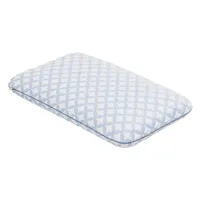
Helix Cooling Memory Foam Pillow: Design & Materials
The Helix GlactioTex Cooling Memory Foam Pillow is what it says on the tin: a memory foam pillow in a GlacioTex cover. But if that sounds like a load of buzzwords, I'll break it down for you.
At the core of the pillow is a block of ultra-dense memory foam. It's soft, squidgy and slow moving. On one side, this foam is topped with a layer of gel foam, to improve cooling.


The cover is made from Helix's GlacioTex fabric. Consisting of polyester and polyethylene, it's designed to draw heat away quickly. The cover is quilted but not particularly soft (I'll explain more below).
There's one more thing to note: the pillow loft. The Helix Cooling Memory Foam pillow is available in a low loft (4") and a high loft (5.1"). We recommend low loft for back and stomach sleepers, high loft for side sleepers.
Helix Cooling Memory Foam Pillow: Performance
I slept on the Helix Cooling Memory Foam Pillow for two weeks and performed a series of objective and subjective tests, following our pillow testing methodology.
Set up
There's no set up required with the Helix Memory Foam Pillow. it's delivered flat so all you have to do is take it out of the packaging, put on your pillow cover, and start sleeping on it.

There was some off-gassing but it was mild. Off-gassing is the chemical scent associated with polyurethane foams and while harmless, it can irritate sensitive noses. If that's you, leave the pillow to breathe in a well-ventilated room for a few hours.
Score: 4 out of 5
Comfort & Support
There's a real 'ahh' moment when you first lie on the Helix Memory Foam Pillow. The foams immediately yield to accommodate your head and neck, with a buttery feel that means no pressure build-up at the ear.
I'm a stomach sleeper so I opted for the low loft. This holds my head in line with my spine, without pushing my neck up. Add on the contouring and in the month of testing, I've yet to wake up with neck pain. It's also comfortable for back sleepers (who have much the same pillow needs as front sleepers.)


The low loft model is too thin for side sleepers but Helix has a solution — the high loft model. I've not tested this version but the added inch should provide the support side sleepers need.
Overall, the feel is medium-soft. Its a pillow you sink into but it doesn't have 'melt' of something like the Tempur-Pedic Tempur-Cloud pillow.
My subjective tests confirmed this. On the Helix Memory Foam, my 10lb weight sank about an inch into the surface and then hit the supportive core. The Tempur-Cloud's Tempur foams pretty much ate the weight up.


You can also see the difference once the weight is removed. On the Tempur-Cloud, it took around seven seconds for the foams to bounce back from the pressure. On the Helix Memory Foam pillow, this was around four seconds. Still slow moving but more responsive.
This means when you shift in the night, the pillow takes a few seconds to conform to your new position. But it gets there eventually. (In comparison, the Helix Talalay Pillow bounced back instantly.)
The quilted cover adds to this spongy feel but the GlacioTex fiber gives it a slight roughness. Once wrapped in the cover, this was no problem. But for the silky soft touch of a hotel-style pillow though, try the Birch Organic Pillow.
Score: 4.5 out of 5
Temperature control
Cooling is, literally, the name of the game here. But can the Helix Memory Foam Pillow live up to its icy promises?
In my experience, yes... with a but.
The GlacioTex cover feels cool to the touch at first but warms to neutral quickly. But then it stays neutral throughout the night. No excess heat gathering, no uncomfortably warm patches.
What it didn't do was maintain a chill feel all night long. You'll still need to flip it if you've looking for the 'cool side'. And I highly recommend choosing a breathable pillow cover to ensure the heat can escape properly (I used percale cotton).

However, considering how dense the foam is, and knowing memory foam's reputation for trapping heat, I was impressed. I previously tested the Tempur-Pedic Tempur-Cloud memory foam pillow and while I loved the soft feel, on a hot nights it became an oven. Not a problem on the Helix Pillow.
Together, GlacioTex and gel foams help wick away heat. However, the design isn't particularly breathable. Those with night sweats might prefer the superior airflow of a natural pillow like the Birch Organic or the Saatva Latex pillow.
Finally, it's worth noting I tested the Helix Memory Foam Pillow during a brutal heatwave. And I was still happy with the feel.
Score: 4.5 out of 5
Helix Cooling Memory Foam Pillow: Durability & Care
You should replace your pillows roughly every two years but some pillows turn to pancakes after just a few weeks of testing. Durability and easy care allows you to get the most from your pillow investment.
Build quality
Both the cover and core of the Helix Cooling Memory Foam pillow have a high quality and durable feel.
It's also weighty. Helix claims the low loft standard size weighs 3.3 lbs, the exact same weight it gives the Talalay Latex Pillow. But the Cooling Memory Foam Pillow feels much heavier to my arms.
To put this into subjective terms, when I drop the Talalay pillow, it lands with a 'thud'. When I drop the Helix Memory Foam pillow, it hits the ground with a 'THWACK".

This is the opposite of a problem, as it implies the memory foam is dense and dense foams tend to have better durability. However, if you knock your pillow to the floor in the night, the quake might wake you.
Score: 4.5 out of 5
Care and maintenance
With a removable and machine washable cover, the Helix GlacioTex Memory Foam pillow is easy to care for. The interior is spot clean only but that's common for memory foam pillows.
Plus, the cover is so thick it's hard to imagine much will get past it to the core itself.
Score: 4.5 out of 5
Should you buy the Helix Cooling Memory Foam Pillow?
'Memory foam' and 'cooling' are often at odds but not when it comes to the Helix Cooling Memory Foam Pillow.
During a heatwave, the Helix Cooling Memory Foam Pillow stayed comfortably neutral, even if it lost its chill feel within a few minutes. In comparison, last summer I slept on the Tempur-Cloud pillow and while it delivered the soft feel I wanted, it warmed up in seconds.

The dense foam core also contours to the head to reduce pressure build-up. I never felt pain at the jaw or ear. And the two lofts gives the Helix Memory Foam pillow versatility, with an option for most sleep styles.
It's $93 but we predict good longevity, so you should get a lot of use for the money. And if you want the feel of memory foam that you can use even on the hottest summer nights, the Helix Cooling Memory Foam Pillow might be your best option.
Buy the Helix Cooling Memory Foam Pillow if...
✅ You want marshmallow-like cushioning: The plush, sink-in foams yield under weight to prevent soreness at the ear and jaw.
✅ You want sink-in pressure relief without the heat build-up: Memory foam can sleep warm but the Helix Cooling Pillow uses a combo of GlacioTex fibers and gel foams to kick out heat. It stays neutral even on very warm nights.
✅ You want to invest in quality: At close to $100 the Helix Cooling Memory Foam Pillow is a bit of an investment, but the dense foams should provide great longevity.
Don't buy the Helix Cooling Memory Foam Pillow if...
❌ You sleep very hot: Those who experience night sweats might prefer a pillow with a more breathable build, like a latex or feather design.
❌ You move around a lot in the night: The slow-moving foams take a second to catch up when you shift position. A more responsive pillow, like the Helix Talalay Latex, is better if you want non-stop support on restless nights.
Helix Cooling Memory Foam Pillow: Alternatives

Follow Tom's Guide on Google News and add us as a preferred source to get our up-to-date news, analysis, and reviews in your feeds.