If you’ve any prior knowledge of keyboards, you’ll know about the Keychron K2 HE. It’s one of the best keyboards out there right now — a glorious combination of gaming performance, type feel and looks, all at an affordable price. I reviewed the Keychron K2 HE when it first came out, and honestly, there wasn’t really anything to improve on (which is why I awarded it 4.5 stars and our Editor’s Choice badge, and why I still own and use the deck now).
Apparently, though, there was still work to do on the K2 HE. And whoever was doing said work was either very bored, or sitting by a window overlooking a construction site. Or both. Definitely both.
Yep. Keychron’s latest update to the K2 HE has been to craft the damn thing out of concrete, keeping almost everything else (the mount, switches, keycaps, poll rate) the same, and raising the price to $199. To my knowledge, this is the only concrete keyboard out there… which seems kinda obvious, right? After all, why would anyone make a concrete keyboard?
Anyway, I’ve managed to get my hands on one of these special edition concrete keyboards — released alongside a slightly more normal-looking resin edition — to find out whether it’s worth the extra $60 over the base K2 HE Rosewood, or whether it’s just a gimmick.
Desk monolith

I’ll be upfront: I’m a concrete lover. The look and feel of smooth concrete just gets me. I take photos of brutalist concrete buildings in my spare time. I stroke the pillars in underground IKEA parking lots. For me, it’s the sensory equivalent of ASMR. It must run in the family, too — cement in the veins or something — as my sister is a concrete-loving architect.
I’m also a Keychron K2 lover. My first ever mechanical keyboard was a Keychron K2 — it’s the board that started the buzz. And at home, I’ve had the K2 HE as a regular part of my keyboard rotation (when you own over 30 boards, you need a rota) ever since reviewing it.

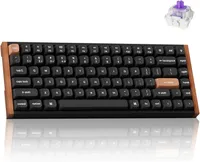
As such, you’ll understand I bloody love having this keyboard on my desk. It’s not quite as drop-dead gorgeous as the Lofree ZERO ARTZ terrazzo keyboard. But nevertheless, the concrete K2 looks fantastic. Its case is made from a single piece of concrete, giving it a monolithic, minimalistic look. It’s like something you’d see in one of Optimum Tech’s über-slick setups.
I didn’t think Keychron could improve on the Rosewood K2 HE, with its wooden side panels; then it released the full Rosewood K2 HE, with an entirely wooden case. Now this. I’m here for it.
More wackiness, please, Keychron
It’s also great to see Keychron finally dabbling in some experimentation. Don’t get me wrong, Keychron is a manufacturer I love. I think it’s doing great things for the industry, giving the market excellent, reliable and modifiable keyboards en masse.

It’s gotta be said, though: Keychron basically re-releases the same decks — with similar designs, switches and keycaps — over and over again. They’re all mostly fantastic, but design-wise, at least, it’s just been getting a little dull (I’m sorry, Keychron, you know I love ya!)
Now, I know Keychron hasn’t been lazing around on its backside. I appreciate the constant pushing of new tech like magnetic switches, easy to customize firmware, higher polling rates. But the new tech is almost always wrapped in the same shell.
Compare that to NuPhy, which is constantly messing around with avante garde ideas: boards that can swap between low- and standard-profile like the NuPhy Kick75; low profile switches that behave like standard-profile switches, as on the NuPhy Air75 V3; new design features like the touchbar-equipped NuPhy Node75; and radical shifts away from core brand design values, like the NuPhy Field75 HE and NuPhy Nos75.
All this is to say, it’s nice to see Keychron doing something fun and a bit silly for once. Although I wish the brand would take it further, and start releasing even wackier designs with more than just a different case material. I just want more.
Solid core performance

The K2 HE concrete, aside from its stone case, is the same as the base K2 HE Rosewood. Same keycap profile, same switches (Gateron Double-Rail Magnetic Nebula), same tray mount, etc. And that’s all a good thing. This is a fantastic keyboard.
I first drafted this article on the K2 HE concrete, and it still types like a dream. You can adjust the actuation distance of keys in the Keychron Launcher companion app, and I get the best results with the actuation backed out to 2.6mm.
Keyboard |
Words per minute |
Typing accuracy |
|---|---|---|
Keychron K2 HE (1.6mm actuation) |
95 |
85.64% |
Keychron K2 HE (2.6mm actuation) |
106 |
93.97% |
Pete's rolling averages (all keyboards) |
94.28 |
87.67% |
And when you want to game, the K2 HE has you covered. While the board serves as a hybrid productivity/gaming deck, with those magnetic switches, it’s fundamentally a gaming board at heart. Adjustable actuation, rapid trigger, last key prioritization (A.K.A ‘Snap Tap’), this thing can do it all.

Sure, it polls at 1K, not 8K, but that doesn’t matter. 8K is mostly a marketing gimmick anyway. Do you really think you’re going to notice a difference between something happening 1,000 times per second and 8,000 times per second? You might think so because keyboard manufacturers have told you that you will, but trust me, you won’t.
All this is to say that, underneath the arguably-gimmicky concrete shell, there’s a fantastic deck that will live up to your needs.
The obvious reason why not
But it obviously ain’t perfect. As you can imagine, there’s a reason why other manufacturers haven’t made concrete keyboards — even the terrazzo-inspired Lofree ZERO ARTZ is merely “inspired” by stone, and actually made from ABS plastic. Adding a load of rock and metal to a keyboard makes it really rather cumbersome. A mobster could tie this thing to your feet and dispose of you in the Hudson, no bother.

Admittedly, it isn’t quite as heavy as I thought it would be, but if I wanted to take this thing home from the office, I’d be literally adding a slab of concrete to my bag. I’ve carried the lightweight K2 HE Rosewood to work and back many times, but there’s no way I’d do so with the concrete version — it’s a permanent desk ornament. On that note, though, the concrete K2 is very liable to scratch up your desk. It has rubber feet to stop this (and slippage), but it’s easy to accidentally push a corner of the case into your nice wooden desk surface, grinding away a chunk. Admittedly, you could do the same with a metal deck.
Adding a load of concrete hasn’t done the acoustics any favors, either. The K2 HE wasn’t the best sounding board to begin with. The Gateron magnetic switches sound fairly boring, and the keyboard simply wasn’t an acoustically-minded deck to begin with — more time and effort was put into function, rather than refining the sound. I’d describe the base K2 HE sound as a loud (thanks to the tray mount) and inoffensive but uninspiring clack. The concrete version’s sound is more of a loud thud. As someone used to the addictive sounds of the NuPhy Halo75 V2 and Wobkey Rainy 75, a thud ain’t doing it for me.
So, is it a gimmick?
Of course it is. But it’s a good gimmick. It’s a pricey gimmick, too, for sure — at $199, the concrete K2 HE is $60 pricier than the Rosewood K2 HE. So, you’ll have to weigh up (get it?) whether covering a $139 keyboard in concrete makes it worth that much more.
Personally, I think it does. The concrete K2 HE feels like something a little special. It’s gorgeous to look at, and sits as a statement piece on your desk. I haven’t yet tired of the looks on peoples’ faces when I tell them I have a concrete keyboard, either. And besides, it’s nice to finally see Keychron having a bit of fun.
You can buy the Keychron K2 HE Concrete direct from Keychron.

Follow Tom's Guide on Google News and add us as a preferred source to get our up-to-date news, analysis, and reviews in your feeds.
More from Tom's Guide