
You don't have to be in real estate to have heard of Ryan Serhant. With millions of followers, a number one show on Netflix and the author of several books, Ryan is a force to be reckoned with. Arguably, one of the best agents in the country, certainly the most creative, his philosophy of "expansion in all ways, always" has intrigued me.
As someone who covers AI for a living, I spend a lot of time asking ChatGPT to help me optimize things like my workflow, my schedule, my writing process, even my grocery list. But somewhere between deadlines, routines and trying to stay productive, I realized I spend a lot of time in maintenance mode. That is, keeping everything running, rather than expanding my capabilities.
That’s when I started thinking about the philosophy Ryan has written about in books like "Sell it Like Serhant." and "Big Money Energy."
These books are best sellers for a reason. And while I've read them, I decided to lean on ChatGPT to personalize what Ryan's mindset would look like for me. The AI's response did not disappoint.
The exact prompt I used
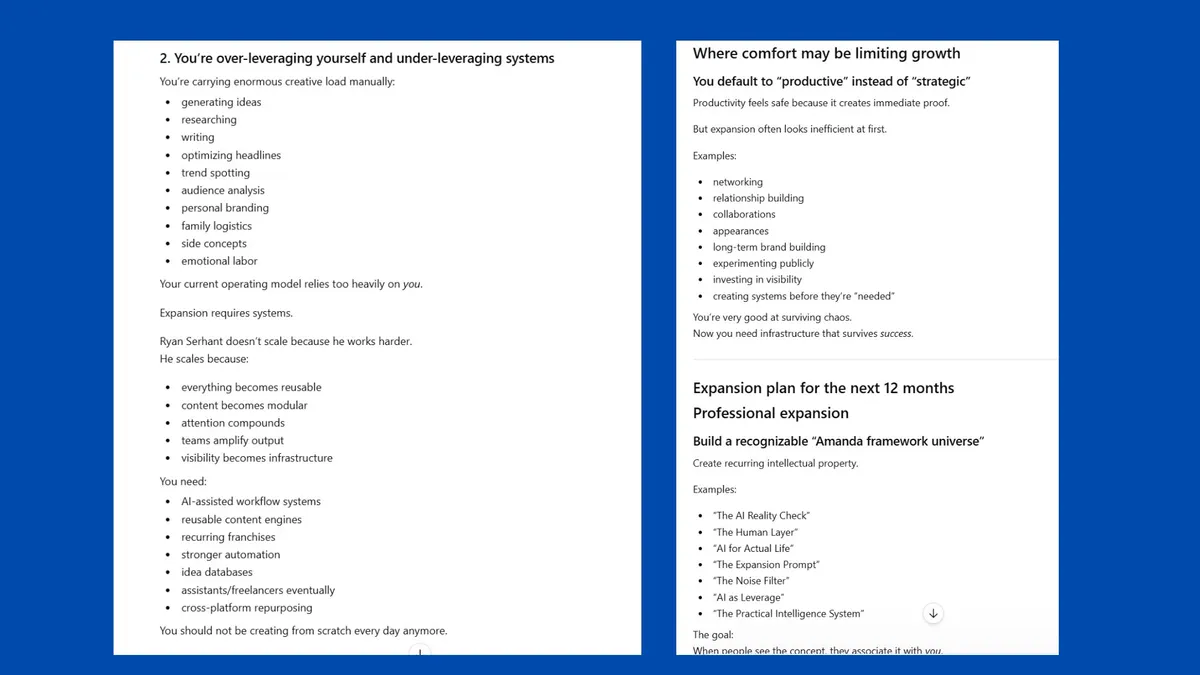
Here’s the exact prompt I gave ChatGPT: “Act as a strategic growth coach inspired by Ryan Serhant’s ‘expansion in all ways’ mindset. Analyze my current projects, habits, routines and goals. Identify areas where I may be thinking too small, staying overly comfortable or limiting my long-term growth. Then suggest practical ways to expand professionally, creatively, financially and personally over the next year. Focus on leverage, visibility, relationships, systems and opportunities instead of just productivity.”
Within seconds, the conversation shifted from task management into something much bigger that I may not have been able to come up with myself (at least, not as quickly). It instantly spotted where I was stuck.
One of the first things ChatGPT pointed out was that most of my energy was going toward sustaining existing responsibilities instead of creating future opportunities. I even remember Ryan making a point about that on his show one time, but I shot it down in my head, believing he had more opportunities as a celebrity than me.
But honestly I think a lot of ambitious people fall into this trap without realizing it. You become incredibly efficient at managing the life you already have, but you stop building the next version of it.
Instead of simply helping me complete more tasks, ChatGPT started asking questions like:
- What projects have the highest long-term upside?
- Where am I underestimating my own expertise?
- What opportunities am I avoiding because they feel too ambitious?
- What systems could create growth even when I’m offline?
- What parts of my work are scalable?
Thinking like a multi-millionaire
That subtle shift in perspective completely changed the tone of the experiment becuase it pushed me to think beyond daily productivity. Expansion thinking is different. It's so much more than optimizing a to-do list. Instead, ChatGPT started helping me think about more writing opportunities, growing my Instagram and Substack accounts, future-proofing my career and scaling projects beyond my daily features.
And get this, AI even suggested spending less time obsessing over low-value busywork and more time developing ideas with long-term leverage. That alone felt like a strategic career planner and frankly, life coach.
Listen, I'm not going to completely change overnight. I'm a mom with three kids and very little downtime to make changes and "think bigger." Plus, I heard from his instagram that Ryan Serhant wakes up at 4:30 a.m. which is completely out of the question for me. However, the mindset shift that happened after several days of using this prompt was very real.
I noticed I started approaching decisions differently. Instead of asking: “How do I get through this week?” I started asking: “Does this expand my future in any meaningful way?”
And while that sounds ridiculously simple, it did change how I evaluated the tasks I was doing, including my work habits, creative risks and networking opportunities.
The prompt helped pull me out of short-term tunnel vision and reconnect with bigger goals I had quietly pushed aside while focusing on day-to-day responsibilities.
The prompt made me uncomfortable in a good way
The most effective AI prompts usually expose something you were already avoiding.In my case, ChatGPT repeatedly pointed toward areas where I was playing it safe like sticking with familiar workflows and a routine, underestimating certain skills, delaying bigger ideas, focusing too heavily on immediate outcomes and spending way too much energy reacting instead of creating.
At one point, it even suggested that constant optimization can sometimes become a form of fear. If you’re endlessly refining the present, you never have to risk building something larger.
That one stayed with me. So much so that I finally signed a contract to be part of a book fair this fall for NYC metro authors. That's something I may not have even considered a week ago because of imposter syndrome.
A few final thoughts
Ryan Serhant's success did not come from an AI prompt. He spent years perfecting his brand through long hours and hard work. Relying on ChatGPT to help to grasp his mindset is a quick exercise in seeing what's possible, especially if you feel like you're stuck in a rut.
I will say, that despite testing hundreds of ChatGPT prompts over the past year, this was one of the few that genuinely changed how I think about my future. And, at a time when many feel stuck in routines, burned out or unsure about their next step, that mindset shift can make a world of difference.
Give it a try and let me know in the comments what you think.

Follow Tom's Guide on Google News and add us as a preferred source to get our up-to-date news, analysis, and reviews in your feeds. Subscribe to Tom's Guide on YouTube and follow us on TikTok. Finally, you can visit our dedicated Tom's Guide Savings Squad hub for expert help on getting the best products for less.
More from Tom's Guide