The rise of humanoid robots is taking shape as countries make a concerted effort to develop and deploy them across different corners of society.
Recently, Japan announced plans to create and deploy approximately 10 million humanoid robots nationwide by 2040, aiming to integrate them across 18 job sectors and address workforce shortages. China, South Korea, Singapore and a slew of other nations have also announced plans to research, invest and possibly deploy humanoid robots across the many physical labor jobs that may require them in the near/far future.
One job sector that may utilize the assistance of humanoid robots sooner rather than later is the medical field. In a groundbreaking world-first moment, two humanoid robots participated in two surgeries.
Here’s why this monumental moment could prove to be a medical breakthrough that we may look back on for years to come.
Humanoid robots and human doctors working side by side
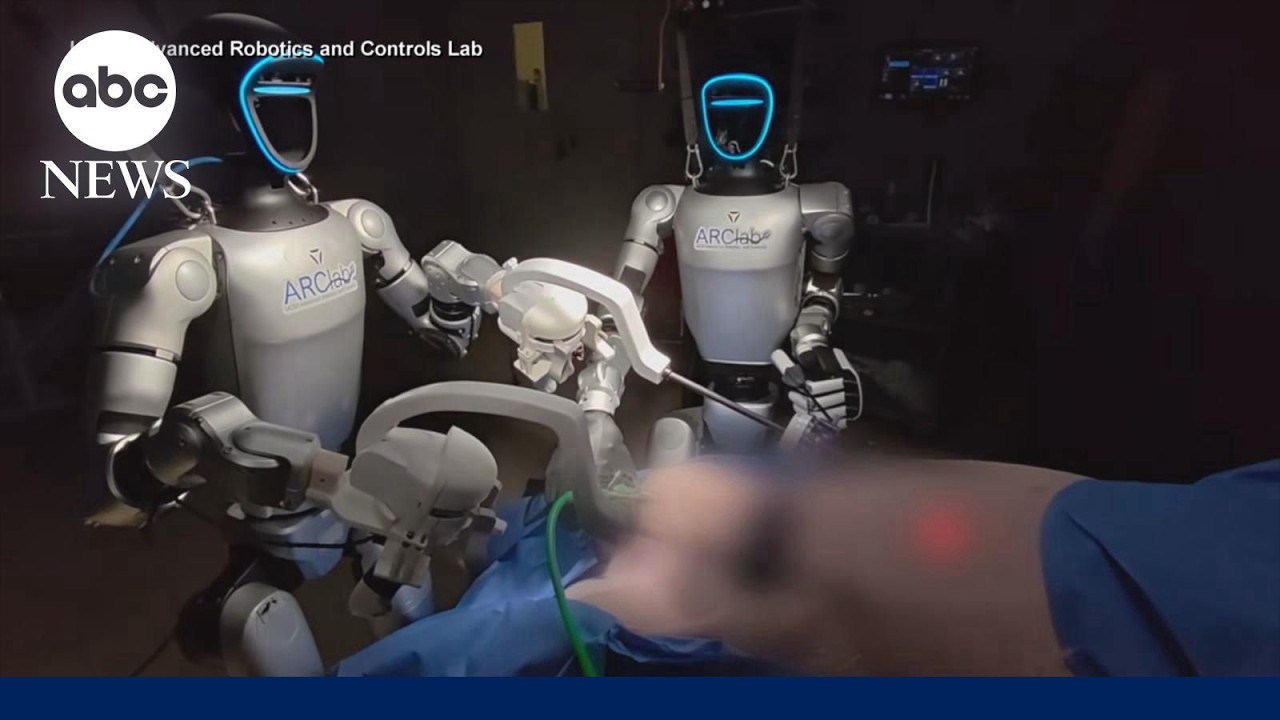
A team of engineers and surgeons from the University of California San Diego carried out two surgeries with humanoid robots in the mix.
One surgery saw a human surgeon and a humanoid robot successfully carry out a gallbladder removal, while the other medical operation saw two humanoid robots work together to handle a laparoscopic gallbladder removal. Both of these surgeries were conducted as proof-of-concept experiments that were safely performed on non-primate mammals.
A research paper posted on Nature alluded to these operations as an important milestone that could improve how surgeries are done. Michael Yip, one of the research paper’s authors and a faculty member who works within the University of San Diego’s Department of Electrical and Computer Engineering, exclaimed his excitement over it. “This study shows that humanoid robots have a viable future in the field of surgery,” he stated.
“Remotely operated and autonomous humanoid robots have real potential for amplifying access to critical surgeries to which patients would otherwise not have access. This can help address the healthcare crisis not only in the United States, but also worldwide.”
Many of the benefits that come with humanoid robots, such as the cheap price attached to their production, the easy deployment that comes with injecting them into remote locations and the versatility of their skills when it comes to performing various tasks, were brought up by the researchers behind this major medical development.
Even though the humanoid robot-assisted surgeries were successfully performed, a few issues still occurred. Both robots had to be recalibrated several times, which made the procedures take a bit longer than expected. Here’s hoping future experiments knock out all the kinks associated with humanoid robots and result in a flawless experience during medical procedures.
A 2025 study done by the American College of Surgeons pointed to a nationwide surgeon shortage. The data it obtained from the Association of American Medical Colleges showed that 21 states have fewer than the necessary number of general surgeons. That data also predicted a shortage of 13.500 to 86,000 physicians by 2036.
Judging by that last stat, it sounds like humanoid robots may be called upon to fill in for the lack of surgeons and work alongside the remaining human physicians by that time.
The takeaway
Looking at the historic moments that saw robots become a part of surgeries is noteworthy thanks to their successes.
In 1983, Anthrobot (the first surgical robot) assisted surgeons during an arthroscopic knee surgery. In 1985, the PUMA 560 robotic system did the same while participating in a CT-guided brain biopsy. And in 1992, the image-guided ROBODOC made history as it became the first robotic system to operate on a human as it prepared a femur for a prosthetic hip replacement.
And now, we’ve just witnessed a pair of humanoid robots work alongside human surgeons and amongst each other to successfully perform two surgeries. This moment paints a bright future where humanoid robots are used en masse as they assist experienced medical professionals with all sorts of crucial operations. And with further developments in the field of AI, that could result in humanoid robots acting independently during surgical procedures.

Follow Tom's Guide on Google News and add us as a preferred source to get our up-to-date news, analysis, and reviews in your feeds. Subscribe to Tom's Guide on YouTube and follow us on TikTok.
More from Tom’s Guide
- From hidden menus to frustrating trade-offs, our complete comparison of major AI chatbot privacy controls shows exactly how ChatGPT, Google Gemini, and others track your chats and what you can do to stop them
- Google AI just proved Meta can't fix smart glasses privacy — it's time for 'peeping tom' laws to enter the digital age
- 'We can find what Claude is thinking, but not telling us': Anthropic's AI has created its own brain space that emerged on its own without programming