







Google Search used to feel like opening a door to the internet. There was a time when we could type something in the Search bar, hit enter and disappear down a rabbit hole of websites, forums and Reddit threads. We'd see random YouTube videos and blogs made by people who we truly wanted to know. The pure serendipity of the experience was fun and interesting.
My sister actually met her husband that way. She Googled "Mr.Show" 20 years ago and stumbled upon her now husband's website about the sketch comedy show starring Bob Odenkirk and David Cross. I still love hearing them tell that story.
Now, after Google’s latest AI search updates, the internet increasingly feels like something else entirely: one giant conversation happening inside a single AI response box.
Google's AI-powered vision for Search

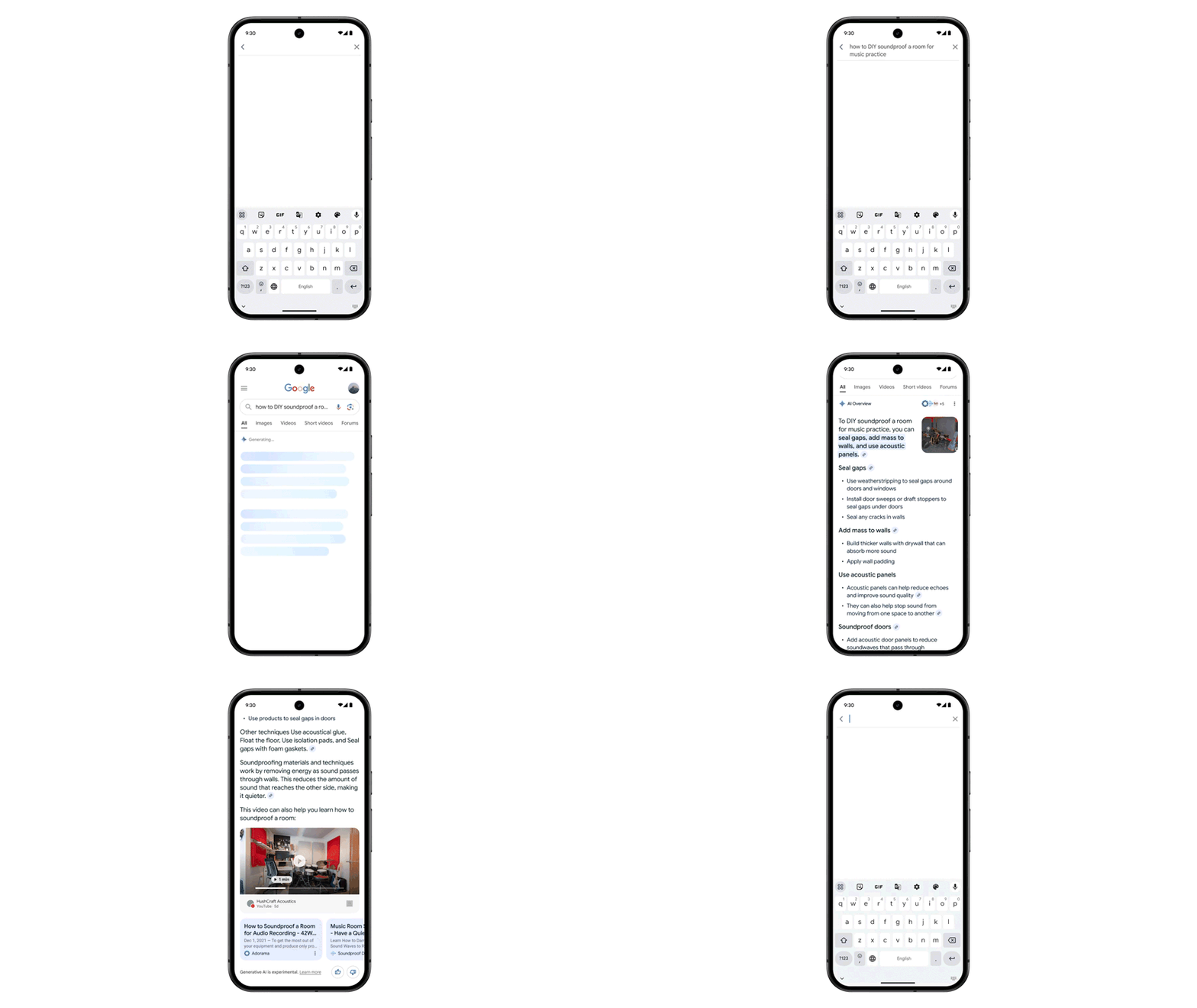
At Google I/O 2026, Google doubled down on its AI-powered vision for Search with expanded AI Mode features, conversational follow-ups, synthesized answers and tools designed to keep users interacting with Google’s AI instead of bouncing between websites. The experience looks fairly smooth and easier to digest than the traditional wall of links.
The more AI summarizes the web, the more the web itself risks losing its personality.
Instead of opening 15 tabs to compare information yourself, Google increasingly does the comparison for you. Now, rather than hunting for the best answer, Google just generates one. In other words, the days of "surfing the web" are over.
That's a shift I know I'm not ready for. But, I've been Googling long enough to know that Google Search has never been ideal. For years, people complained about results crowded with SEO spam, low-quality affiliate content, endless recipe backstories and websites clearly written more for algorithms than humans. And while AI search solves a lot of that, it's forced discovery and curiosity out of the picture almost entirely.
A decade ago we weren’t consuming content at the rapid pace we do now, we were exploring spaces created by actual humans. Now AI increasingly compresses all of those voices into one unified response. The more AI summarizes the web, the more the web itself risks losing its personality. That’s where the “group chat” feeling starts creeping in.
AI controls the conversation

In a group chat, information moves fast. As a mom in a group chat with 14 other moms, I know just how hard it is to keep up. Everyone talks over each other even if they don't mean to, context gets compressed, the loudest voices dominate and most people don’t leave the conversation to independently explore sources. That’s increasingly what AI-powered search feels like.
The internet used to feel expansive — now, it feels summarized. The irony, of course, is that AI-generated answers still rely heavily on websites. Publishers, creators, journalists, bloggers, reviewers and independent writers are still doing the work of reporting, testing, researching and publishing original information. AI simply reorganizes it into a cleaner conversational layer.
Unfortunately, users may never actually visit the sources anymore. If Google becomes the destination instead of the gateway, the entire relationship between websites and readers changes.
And honestly, users may not even notice it happening because the new experience feels so much easier. And that's the tradeoff at the center of this AI era. Convenience, speed and summarizations trump exploration, discovery and individual voices.
The walled-garden paradox
Statistically speaking, you probably didn't type "tomsguide.com" into a browser bar to find this page. You likely found it because an algorithm — quite possibly Google Discover or a personalized Google feed — served it up to you on your phone based on your reading habits.
This highlights the bizarre paradox of the internet today. To read a critique about Google enclosing the open web into a walled garden, you have to pass through the gates of that very same walled garden.
We are relying on the gatekeeper to show us the article complaining about the gatekeeper. Right now, that system still works in a fragile sort of harmony: Google’s feed sends you to our website, you read our writers and we get the support needed to keep reporting.
Final thoughts
Maybe this is inevitable. Maybe AI assistants replacing traditional browsing is simply the next phase of the internet, the same way streaming replaced video stores and TikTok replaced cable TV for an entire generation.
But something undeniably feels different now. The internet used to feel like a giant world waiting to be explored. Now I just feel like I'm chatting with AI.
And websites like this one? Well, they’re at risk of becoming background characters in a chat they helped create. So if you enjoyed this article, I hope you come back to the site. Bookmark the page and comment. Remind us journalists that we still matter in a sea of AI.

Follow Tom's Guide on Google News and add us as a preferred source to get our up-to-date news, analysis, and reviews in your feeds. Subscribe to Tom's Guide on YouTube and follow us on TikTok.
More from Tom’s Guide

