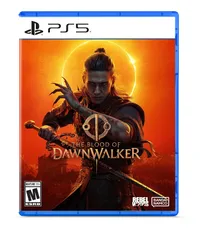
Since The Blood of Dawnwalker launched last week (Sept. 3), the online conversation has centered on one subject: its time limit. In this new RPG from debut studio Rebel Wolves, which boasts several developers who worked on The Witcher 3: Wild Hunt, you play human-vampire hybrid Coen, and you have exactly 30 days and 30 nights to save your family.
Unlike many other RPGs, where the story revolves around a deadline but players are free to get distracted for hours without consequences, in The Blood of Dawnwalker, most actions take up a “chunk” of time. There are eight chunks during the day and eight at night. While there’s no ticking clock, most tasks, from leveling up skills to completing quests, will take up anywhere from 1-3 chunks, so time is a constant presence.
This core pillar of the game has proven divisive. Arguably, even controversial. Shortly after the game’s launch, the most downloaded game mod on Nexus Mods was “Better Story Timer.” This PC mod lets you have as many days as you wish, or even remove the time limit. As of writing, it’s got more than 177,000 downloads, showing the strength of player feeling.
On my own social feeds, I’ve seen several people claim they’re not buying the game, citing the time limit as the reason. But I’m here to tell you, not only is the time limit far from a dealbreaker, it’s The Blood of the Dawnwalker’s biggest strength. It's undoubtedly the primary reason I’m currently absorbed in this compelling fantasy role-play experience.
Dawnwalker makes every moment matter

In The Blood of Dawnwalker, because time is essentially a virtual currency, you’re constantly thinking about how to spend it.
The system makes you think before committing to an action. Even though 30 days and 30 nights is a pretty generous allotment — and a lot more than you need to beat the main quest — it’s still not an infinite supply.
The prologue teaches you that you can’t do everything. You’re given a few hours to fill, and your map is dotted with more quests than you can actually complete. I know for completionists that sounds like a nightmare, but it forced me to consider which quests interested me the most.

Did I really want to waste a portion of my precious time allowance helping a farmer find his missing pig, when there was a local mystery to solve? Did I want to spend the additional time playing tag with Coen’s siblings when that would cost me an hour I could use to complete another quest?
Even when the full game opens up, these choices continue. My focus is on spending time strategically to get the best return. Every time I’m notified that an action will advance time, I pause and think, “Do I want to use my time on this?” It adds an extra dimension to the experience and a real feeling of importance to even small decisions.

Leveling up is a great example of the mechanic’s effectiveness. Early skills come at no time cost, but later ones require a skill point and time to learn. In more conventional RPGs, I might be a bit careless with my skill points, but in The Blood of Dawnwalker, I’m really thinking about what abilities I’ll actually use. Because if I unlock a skill and then don’t use it, it’s cost me a skill point and valuable time I could have used elsewhere.
Again, to reiterate, for those still unconvinced about the system, time only moves forward when you choose to spend it. Unlike a title like Dead Rising, you’re not on a literal clock, so while there’s a degree of pressure when making choices, it doesn’t become overwhelming and suffocating.
The time limit fixes a major issue with RPGs

The system is compelling not only from a design standpoint, but also from a narrative one. I’ve long felt that many RPGs struggle to pair together the freedom their worlds offer with the larger stories they’re trying to tell.
Take The Witcher 3, The Blood of Dawnwalker’s spiritual sibling, as an example. In that game’s story, Geralt of Rivia is desperately searching for his surrogate daughter Ciri before the eponymous Wild Hunt finds her. Yet, in my playthrough, Geralt spent dozens of hours roaming the land for odd jobs, neglecting to locate his ward. That creates narrative dissonance.
The same is true of CD Projekt Red’s other much-heralded RPG, Cyberpunk 2077. In that game, your character, V, is literally dying and on a desperate mission to save themselves before it’s too late. Yet, under my control, V spent countless hours just cruising the streets of Night City.

To be clear, I still enjoy those RPGs (I need The Witcher 4 like now), and this disconnect is something I generally accept in big open-world games, where you can ignore the main storyline for hours on end. However, I love that in The Blood of Dawnwalker, the deadline to save your family from a sinister vampire lord is an ever-present part of the experience.
So, if The Blood of Dawnwalker’s time limit has you reconsidering playing, I encourage you to see it as a valuable part of the experience, rather than as a harsh restriction. And if you’re playing on PC, resist the temptation to download a mod to remove the time limit. The game is entirely designed around the system, and I truly think that without it, it would be a lesser RPG.

Follow Tom's Guide on Google News and add us as a preferred source to get our up-to-date news, analysis, and reviews in your feeds.
More from Tom's Guide