AmneziaVPN isn't a "big" VPN player. Founded by Russian internet activists in 2020, it's still a relatively new, and relatively small VPN.
But it's a VPN with a clear focus – fighting internet censorship. AmneziaVPN has two VPN products, AmneziaVPN Premium and AmneziaVPN Free, as well as its own VPN protocol and the option to self-host your own VPN server.
At this stage, AmneziaVPN can't compete with the best VPNs when it comes to scope and features – but I don't think it's trying to.
If you're not someone facing internet censorship, and are perhaps more interested in a VPN for streaming and daily privacy, AmneziaVPN isn't for you. However, for those living under the most extreme internet restrictions, AmneziaVPN is a lifeline.
The VPN's power lies in its obfuscation abilities. The AmneziaWG protocol is highly effective at bypassing network filters, and we have seen reports of success in China and Russia – countries with some of the strictest internet restrictions.
Obfuscation, paired with decent speeds and strong privacy credentials, make AmneziaVPN an interesting prospect.
So, I decided to spend a week using the VPN. Here's how I got on.
Simple but effective
If you're looking for a VPN packed full of extra features, AmneziaVPN isn't it. There's a kill switch, app- and site-based split tunneling, and the option to use custom DNS servers and self-hosted VPN servers. That's pretty much it.
However, AmneziaVPN isn't trying to match the giants of the VPN world. It's not positioning itself as a complete cybersecurity package or privacy suite. It's dedicated to fighting internet censorship, and thanks to the AmneziaWG protocol, it does that well.
Logging in was straightforward. No email address or username was required, as I used the subscription key generated following plan purchase. Up to seven devices can be protected with one plan, and you can pay via credit card or cryptocurrency.
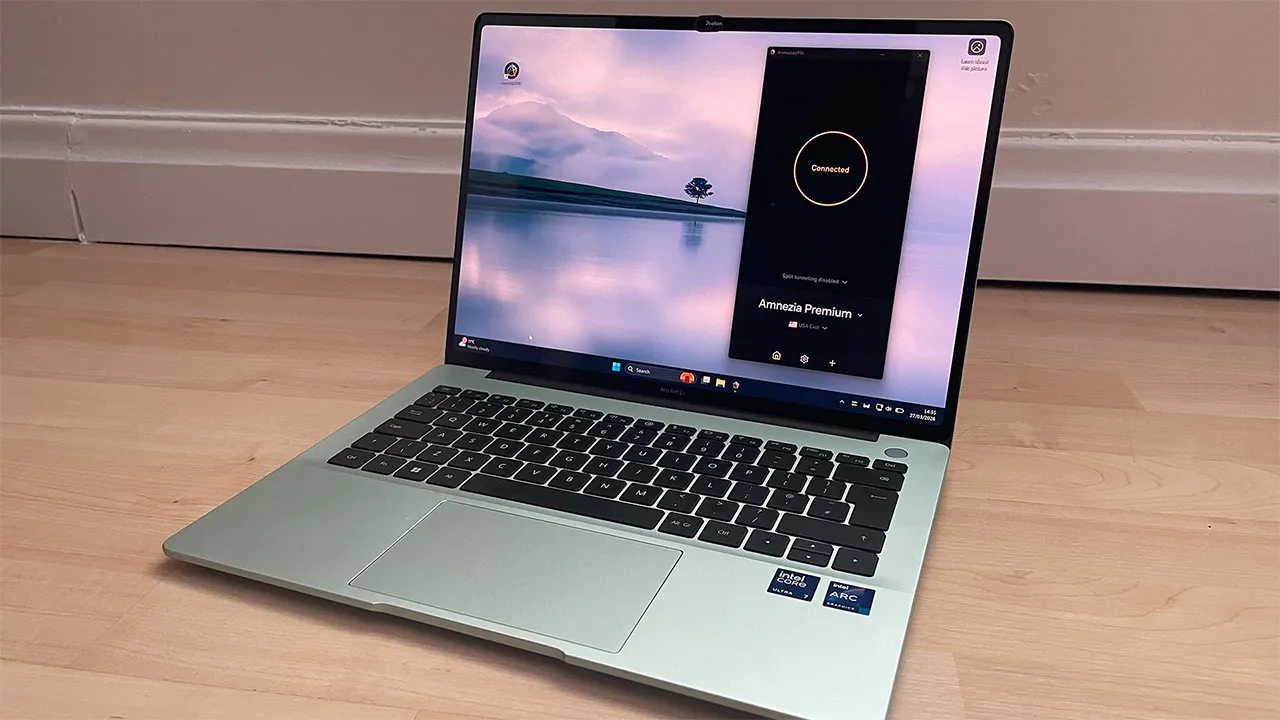
The app design is simple, and certainly doesn't waste any time or space on flashy bells and whistles. You're greeted by a large "connect" button, in a "pop-up" window similar to that of ExpressVPN, CyberGhost, and Private Internet Access (PIA). I'm not a fan of this style of window, I prefer a full screen. But that's just my personal preference and it doesn't make AmneziaVPN any more difficult to navigate.
I tested the app on Windows and iOS, and the UI is identical on both platforms.

There are three icons located at the base of the window – Home, Settings, and a "+" symbol. The home icon takes you back to the app's main dashboard, where the connection button is located.
Settings, unsurprisingly, takes you to the VPN's settings. Here you'll find connection, DNS, and split tunneling settings, as well as the kill switch. There are also application settings, and links to AmneziaVPN's website, GitHub, privacy policy, Telegram group, and support email.

AmneziaVPN allows you to use its proprietary protocol, AmneziaWG, to self-host your own VPN server. Clicking the + icon brings up the window to do this. You can insert a key and add your configuration, as well as being able to connect to AmneziaVPN's regular app.
Configuring your own self-hosted VPN server isn't a necessity. Less tech-savvy users can connect and go. But if you have the desire and expertise to set up your own VPN server, it's a nice option to have.
AmneziaWG 2.0 has recently been released and its obfuscation capabilities have been significantly upgraded. It's not yet available within the regular AmneziaVPN app, but it's coming soon.

AmneziaVPN is known to be effective in highly restricted internet environments, notably Russia and China. Its obfuscating protocol, AmneziaWG, is open-source and fully audited. As mentioned above, it's had an upgrade to boost its obfuscating power.
Being based in the UK, I'm unable to test the protocol's capabilities first-hand. But various reports suggest the protocol is effective and is a reliable option for evading internet censorship.
Limited server locations
Oddly, I couldn't choose the server I connected to on my first connection. This may have been a bug but I had to accept this "random" connection, disconnect, and then choose my preferred server. This wasn't a huge problem for me, but if you're connecting to the VPN in restrictive internet conditions, this could be a more serious issue.
Connecting to a server wasn't the quickest I've ever experienced. Time taken to establish a connection ranged between 5-10 seconds, for both UK and US servers. In the grand scheme of things, this isn't "slow." But I'm spoiled by the almost instantaneous connection times of the more established VPN names, so AmneziaVPN's delay is noticeable.

There are 20 countries to choose from, and AmneziaVPN doesn't list its total number of servers. There only appears to be one location for each country, and no way of knowing the exact server you're connecting to. Kazakhstan is an unexpected location, and Russia is also an option – unsurprising given AmneziaVPN was developed by Russian internet activists back in 2020.
A majority of AmneziaVPN's locations are European, followed by Asia. The lack of African and South American locations is disappointing, and overall AmneziaVPN's server spread leaves a lot to be desired.
AmneziaVPN's server locations:
- Europe: Estonia, Finland, France, Germany, Netherlands, Poland, Portugal, Sweden, Switzerland (P2P), UK
- Asia-Pacific: Australia, Japan, Kazakhstan, Russia, Singapore, South Korea, Turkey
- Middle East: UAE
- North America: Canada, USA (East)
Speeds and streaming
Due to its focus on obfuscation, AmneziaVPN's speeds and streaming power aren't on a par with the fastest VPNs and best streaming VPNs we've tested. However, my home Wi-Fi connection measured at 276 Mbps, and I saw impressive speeds of 251 Mbps when connected to a UK server with AmneziaVPN.
Speeds dropped off a little when connecting to locations further afield. 169 Mbps when connected to USA (East) and 156 Mbps when connected to Kazakhstan. For everyday browsing, this is more than fast enough, and there wasn't a noticeable difference in loading times while browsing.
To be fair to AmneziaVPN, it openly advertises its servers are only capable of 200 Mbps speeds. It doesn't claim to be the fastest VPN out there, and my testing found this to be accurate.
Streaming is a different story. If this is your primary reason for subscribing to a VPN, I'd avoid AmneziaVPN. It was detected by BBC iPlayer, even when connected to a UK server, and it also failed to pass the – admittedly tricky – F1 YouTube test. I didn't subject it to a full streaming test, so you may find some success here and there. But overall, it's certainly not a VPN designed for powerful streaming unblocking.

Server locations raise eyebrows
I did notice some irregularities with where AmneziaVPN's servers are physically located. Again, this wasn't a thorough test, and it's something we will investigate further – but it's worth noting here.
When conducting my speed tests, the USA (East) and Canada servers were listed as being hosted in Amsterdam, the Netherlands. It's quite unusual for a VPN to have no physical infrastructure in North America. The UK server did appear to be coming from the UK.
What was most interesting to me, is the fact that both AmneziaVPN's Kazakhstan and Russia servers appeared to be physically located in both countries. My Kazakhstan speed test showed my server located in Almaty, the country's largest city. Likewise, when conducting speed tests for the Russian connection, Moscow was the server location.

Considering AmneziaVPN's background, I don't think it's shocking to assume it has physical infrastructure in Central Asia and Eastern Europe. However, having physical servers located in Russia does raise eyebrows given the country's attempts to restrict VPNs, collect user data, and impose strict internet censorship.
I reached out to AmneziaVPN to share my findings and it confirmed it does operate physical servers in Kazakhstan and Russia.
It stressed that these servers are RAM-only, meaning all data stored on them is wiped after shutdown. AmneziaVPN said "each authentication request is processed through backend infrastructure in-memory, and information is not retained on the nodes."
Russia has strict data laws and requires the sharing of information. However if AmneziaVPN doesn't store any user data, it can't hand anything over.
According to AmneziaVPN, physical presence in Russia is "a direct response to user demand." They are specifically designed to cater to Russian expats who may still need to securely access Russian websites and region-restricted services, such as Russian government platforms and banking systems.
Addressing the potential risks, AmneziaVPN said users are "typically making a conscious choice for specific purposes." It added that the servers don't need to be used by those living in Russia looking to bypass restrictions.
Bottom line
Overall, AmneziaVPN is a somewhat niche, but effective VPN. If it's privacy and obfuscation you're after, it's well worth checking out. If you want a heap of extra features, super fast speeds, and powerful streaming unblocking, I'd recommend looking elsewhere.
Its apps can be downloaded on Windows, Mac, iOS, Android, and Linux. A one-year plan cost $4 per month ($48 upfront) and the six-month plan costs ~$4.66 per month ($28 upfront). Both come with a 7-day money-back guarantee.
There is also a free plan, AmneziaVPN Free, with unlimited data and no registration required. This is only available to users in certain regions facing internet censorship. These are: Africa, Brazil, Cuba, India, Myanmar, Nepal, Pakistan, Russia, Turkey, Venezuela, Vietnam, and the UK.
We test and review VPN services in the context of legal recreational uses. For example: 1. Accessing a service from another country (subject to the terms and conditions of that service). 2. Protecting your online security and strengthening your online privacy when abroad. We do not support or condone the illegal or malicious use of VPN services. Consuming pirated content that is paid-for is neither endorsed nor approved by Future Publishing.