When looking for the best TVs for your living room, there's two obvious considerations you need to make: How a TV looks when it's turned on (i.e. picture quality) and how a TV looks when it's turned off (i.e. design).
While there are a few new QLED TVs that have a sleek design to match their cutting-edge picture quality — Samsung The Frame comes to mind — OLED TVs are the de facto choice for folks looking for the slimmest TV with the best picture quality.
OLED TVs are the de facto choice for folks looking for the slimmest TV with the best picture quality.
That's a reputation OLED TVs gained when LG famously released its LG W7 OLED “Wallpaper TV” back in 2017 that mounted flush to the wall and measured in at 4mm thick. While LG started the trend, non-LG OLED TVs have gotten impressively thin too — including the likes of the Samsung S95D, which, like the Wallpaper TV, puts the guts of the TV in a box that can be placed separate from the display itself to really accent the thinness of the screen.
But could these TVs get even thinner? We asked Dr. Mike Hack, Vice President of Business Development at Universal Display Corporation. Dr. Hack has even served on the board of the U.S. OLED Lighting Coalition. According to him, thinner OLED displays may be right around the corner.
A bit of background on OLED
Before diving into whether or not OLED TVs will get thinner than they already are, it’s perhaps a good idea to go over why they’re so thin in the first place. The reason is actually pretty simple: Organic Light Emitting Diodes (OLEDs) themselves are light emitting — they’re essentially organic materials that glow when electricity is applied to them, and the more electricity you apply, the brighter they glow.
“One of the reasons OLED displays are inherently thin is that they do not need a backlight. Also, the OLED and the controlling thin-film circuitry can all be deposited on a single substrate, with suitable thin film encapsulation and a protective cover,” said Hack in an interview with Tom’s Guide.
Newer OLED TVs attempt to replace even more layers of an image with slimmer materials that help push them to be even thinner. Notably, QD-OLED TVs replace the color filter layer with a different layer that helps produce colors — a layer of quantum dots. Quantum dots produce more vibrant colors, a higher level of brightness and are themselves extremely then — a matter of micrometers.
“There are no fundamental performance trade-offs in making OLED devices thinner," continued Hack. “The main issue is to ensure that the OLED display is mechanically robust and is not easily damaged or breakable under impact. Technology improvements are ensuring that OLED displays are constantly improving their performance — in particular their efficiency — and advances in manufacturing processes are allowing for reduced display thickness.”
Here's how it's going to happen
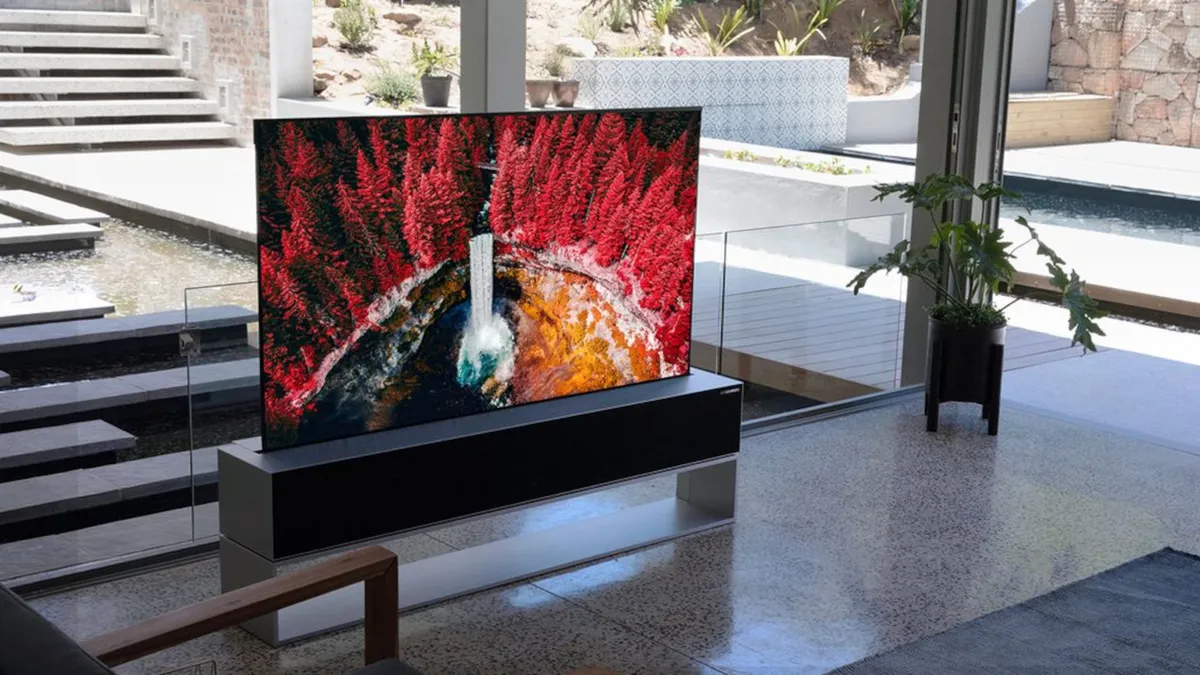
OLED TVs could get even thinner though — especially depending on the avenues of technological development that manufacturers follow.
For example, there has been a push for flexible displays in the TV world, which could flip the idea of wanting a thin TV completely on its head. A good example of this is LG’s “rollable TV,” which had a flexible display that rolled into a box. At that point, of course, thinness probably isn’t that important considering the fact that the display itself will be hidden away when it’s not in use — though of course, thinness is required for the flexibility in the first place.
While the LG rollable TV might be officially dead, other companies like Universal Display Corporation are continuing to research new materials to find a new way to shave down an OLED TV's depth.
"UDC's energy-efficient phosphorescent OLED materials and technologies also decrease the amount of heat management in an OLED TV, reducing mechanical issues and enabling even thinner displays."
Dr. Mike Hack
“OLEDs are 1/1000th the thickness of a strand of hair and are inherently foldable, rollable, and conformable,” said Hack. “UDC's energy-efficient phosphorescent OLED materials and technologies also decrease the amount of heat management in an OLED TV, reducing mechanical issues and enabling even thinner displays.”
The question isn't 'if' OLEDs will get smaller, it's 'when'

So how soon will these wafer-thin OLED TVs come to market? Well, that's the part that's up for debate.
LG Display is currently working on improving its new META 2.0 panels with micro lens arrays, and Samsung Display is currently working on improved QD-OLED architecture. Neither of these projects' aims are to reduce the size of OLED panels, but rather increase brightness and longevity of organic materials.
That's not to say there's no work being done on thinner OLEDs — UDC is certainly interested in that area, for example — but the odds of getting a paper-thin OLED in the next two or three years is pretty unlikely.
In the meantime, thankfully, you need look no further than our list of best OLED TVs for models that offer both a fantastic picture quality and slim design.