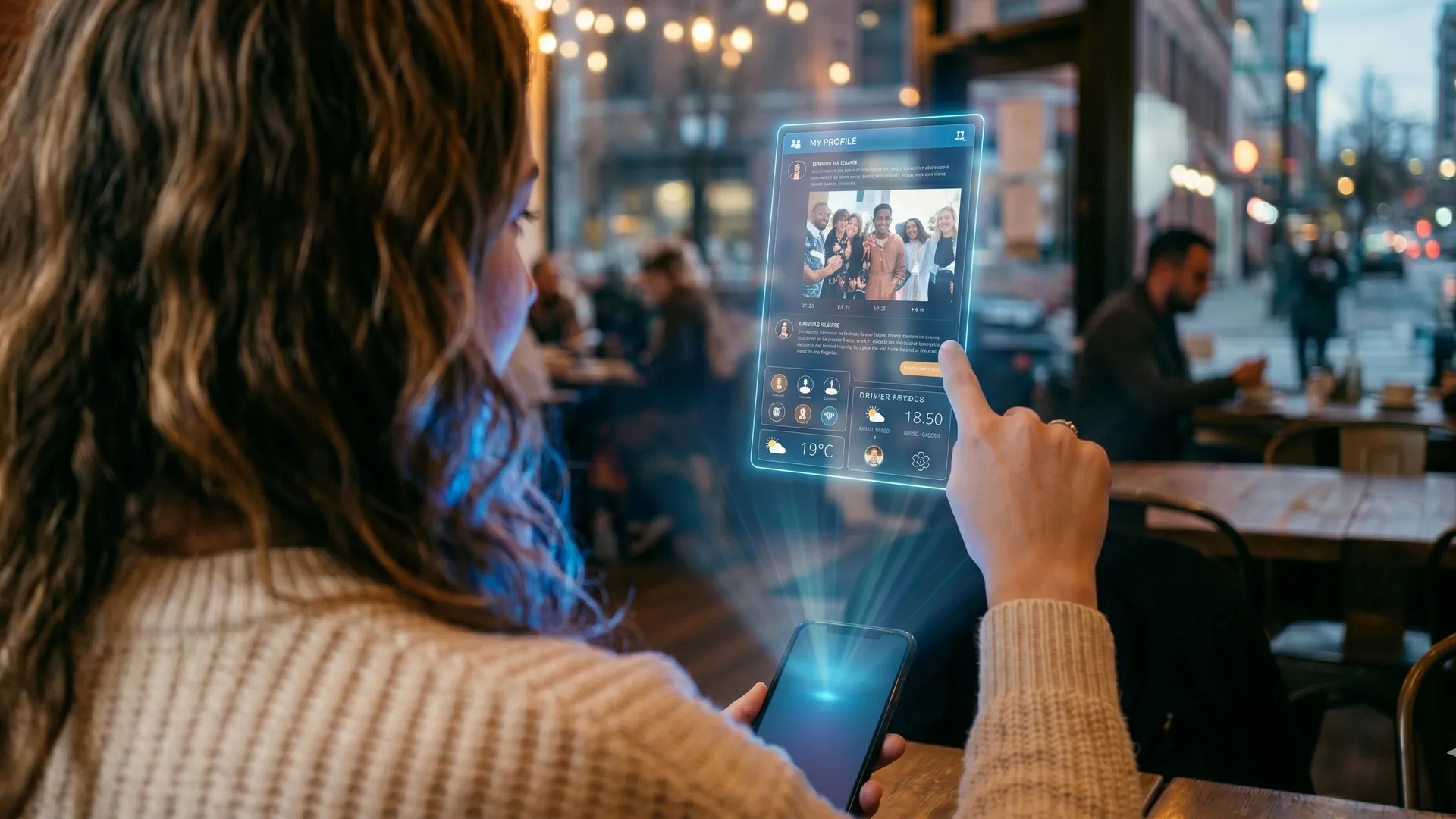
A new report claims Samsung is developing a holographic smartphone display that could be used in a future spatial phone. The claims from the leaker Schrödinger on X span a series of posts that assert Samsung is "moving its 3D plate tech to mobile."
They shared screenshots of texts with someone alleged to be a supply chain insider familiar with Samsung's operations.
The rumored display, codenamed MH1 or H1, is not a "revival of the 3D displays" from a decade ago. Apparently, the H1 combines eye-tracking with "diffractive beam-steering," which is supposed to allow the holographic images to dynamically react to your position.
This would allow a holographic layer in the display to create depth that "appears to extend beyond the screen." It would do this without the need for glasses.
Per the unnamed insider, Samsung has patented algorithms that allow users to "tilt" the phone to see around objects in a video, a la spatial displays.
In a follow-up blog post, Schrödinger notes that the project remains in phase one of research and development. He suggests that 2030 could see the debut of holographic phones, but time will tell how accurate that prediction is.
The "secret insider" claimed there are supply-chain rumors about an Apple spatial iPhone. Samsung's push into spatial mobile is a head start for the company, but Apple is clearly interested in spatial computing and is working on ways to use the tech.
Not entirely new

Samsung has potentially been working on it for more than a decade. The company published academic work regarding holographic displays in 2020.
That report detailed eight years of trials using steering-backlight units to increase viewing angles for holographic videos, a major obstacle in getting the technology into small mobile devices.
“While a conventional display depicts images based on light intensity, holograms control not just the intensity of light but also its phase to produce images that appear three-dimensional," Hong-Seok Lee of the Samsung Advanced Institute of Technology said at the time.
Samsung patented a phone display that displays holograms as early as 2018.
Samsung isn't alone, as Apple has various patents going back years surrounding holograms. As we await the rumored Apple Glasses, in 2019, Apple received patents for holographic tech that could appear in glasses. MacRumors reported in 2008 that Apple held a patent for glasses-free autostereoscopic displays capable of delivering a personalized 3D image.
Last month, incoming CEO John Ternus and Apple SVP Greg 'Joz' Joswiak described spatial computing as "inevitable" and in the "early innings" in our interview with them.
“There's some inevitability to combining the digital and physical world,” said Joz. "That's what spatial computing was all about. I can't give you a timeline for when spatial becomes anything else, but you know it's an inevitability. Of digital and physical worlds coming together.”

Follow Tom's Guide on Google News and add us as a preferred source to get our up-to-date news, analysis, and reviews in your feeds. Subscribe to Tom's Guide on YouTube and follow us on TikTok.
More from Tom's Guide