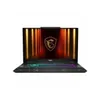
I’m a completionist, so after testing the desktop RTX 5060, you know I had to find a chance to put its gaming laptop counterpart through its paces at Computex 2025.
And oh boy did I find a chance — using two of my favorite gaming laptops announced at the show: the refreshed Asus TUF Gaming A14 and the Acer Predator Helios Neo 14 AI. But while I’m excited, that doesn’t mean I’m naive about the limitations made to keep the costs down.
So let’s talk about them. Let’s talk about my time playing games on these and why the numbers make me optimistic that outside the PC elite noise, laptops sporting these GPUs are going to be more than great for most of you reading this.
By the numbers
So let’s go through the testing we did (well, what I can actually tell you about right now). We’ve got two games — Cyberpunk 2077 and the soon-to-be-released FBC Firebreak. Complete sidenote, Firebreak is awesome — think Left 4 Dead.
These were with settings turned to max at 1080p.


Lapping up the frame rate

So of course, bear in mind that this is an early test of RTX 5060 laptops on two games picked by Nvidia. It’s very much in their wheelhouse, and I didn’t get to put something more taxing towards it.
That being said, though, we can get some interesting tidbits from this:
- DLSS 4 is needed: I’m sure if you tweak settings a little, you could get good frame rates. But to enjoy the full graphical fidelity of a game, the AI stuff is needed. In a laptop of this price, that’s not a bad thing. In fact, seeing nearly 200 FPS in Cyberpunk is, frankly, mindblowing for something that is just over $1,000 MSRP.
- VRAM is precious: That massive increase in latency when DLSS is turned off (133 ms vs 58 ms with DLSS on) is a strong indicator that the 8GB of on-board video memory can be consumed quite quickly by visually demanding games.
- DLSS is heading in the right direction: I mean there’s a reason why AMD has fallen in line with AI-driven frame generation with the RX 9060 XT launch. The boost moving from the old convolutional neural network model to increase frames to the ChatGPT-esque transformer model is showing significant gains.
And it must be said again — you’re getting these significant increases in a gaming laptop that barely costs over $1,000. That is a huge value proposition.
Enough is enough

DLSS is more than just an optional feature now — it’s become the core focal point of Nvidia’s entire RTX 50-series. In something more expensive like the MSI Titan 18 HX with RTX 5090, you’d rather want that $7,000 laptop to be able to run your games super smoothly without trickery. Understandably, you’d be annoyed!
But in something cheaper like RTX 5060, Nvidia’s AI tech becomes the whole point. It’s the bridge over the performance gap, and it achieves unheard of frame rates. Is it done through smoke and mirrors? Sure. Do most people care? No. They just want most of their games to run well.
Give or take a few games that are unseasonably demanding of the video memory (though that list is growing over time), you get enough in the 5060 portable package to handle pretty much every AAA title.
More from Tom's Guide
- 5 gadgets from Computex Day 1 that impressed us most — gaming handhelds, smart rings and more
- I saw a 500Hz QD-OLED monitor in action — and it was as fast as it was colorful
- I tried the updated Zotac Zone handheld and one big change makes it a true Steam Deck rival