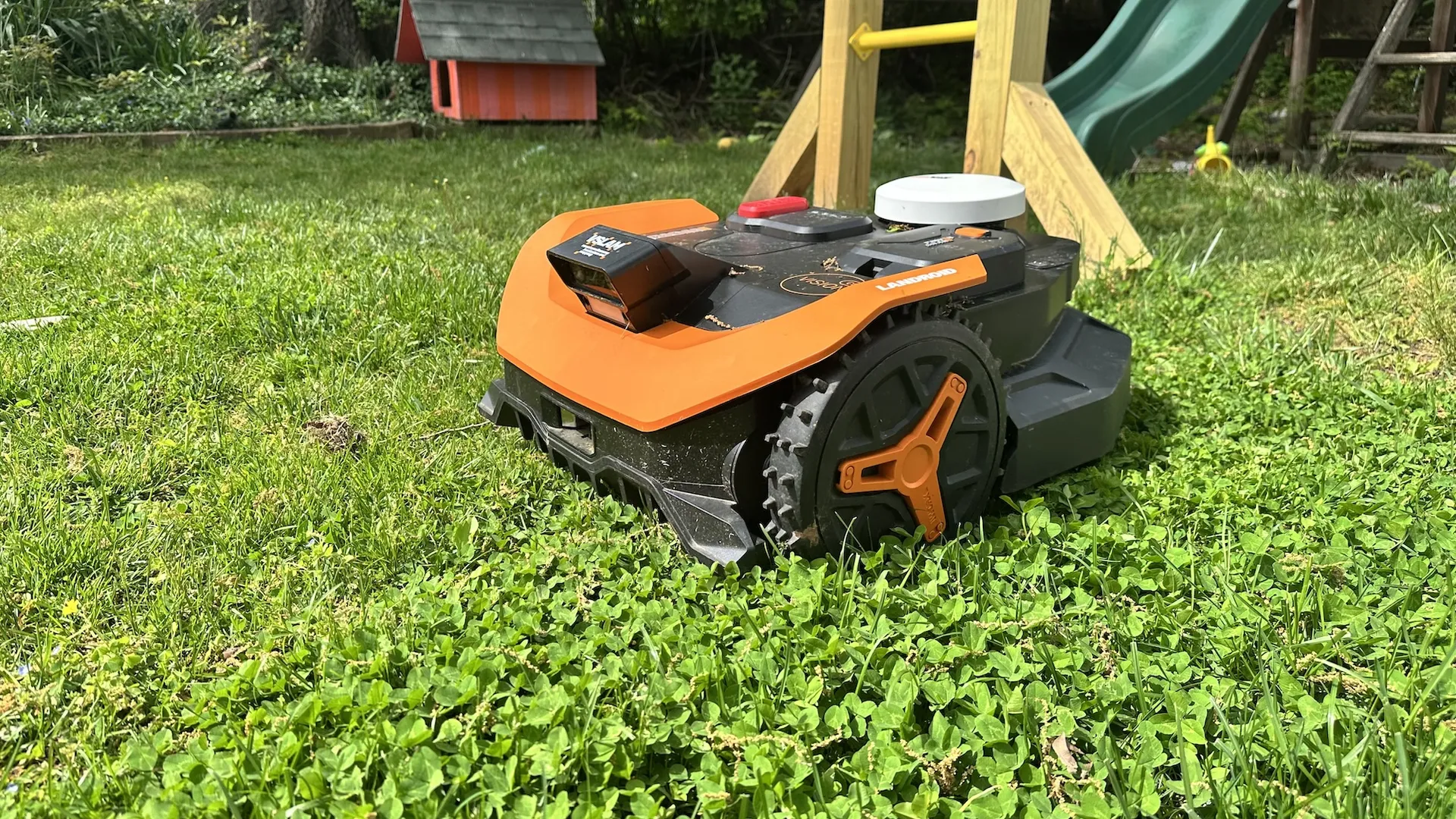
I don’t mind mowing my backyard; it’s small, level, and is more or less a rectangle.
My front yard is another story. Despite it being half the size, it’s on a hill — about 20 degrees — and in order to get to it, I have to carry a lawnmower up several steps. So it’s been with great relish that I’ve been able to test robot lawnmowers for the past few years. It’s certainly saved me time and aggravation.
But it hasn’t all been easy. There have been plenty of issues I’ve encountered during the setup process and while using robot lawnmowers that had me wondering if I should just go back to mowing my yard myself.
Having tested several models over the past five years ranging from $1,000 to more than $2,500 (and edited reviews of several others), there’s a few pieces of advice I’ve picked up that should help you make a more informed decision when buying and using your first robot lawnmower.
Know your yard

I'm the guy with the 20-foot inflatable skeleton at Halloween, the guy with the robot lawnmower prowling his yard, and the guy who made a lightsaber out of hardware store parts.
This column is going to take a look at tech, tools and tips for your kids, your pets, and anything else that could make your house more fun and functional.
There’s no point in getting a robot lawnmower that’s overbuilt for your yard, and in fact, may work to your detriment — and your wallet.
Find out the square footage of your yard, and then find a robot lawnmower that fits those dimensions. If you get a mega-sized lawnmower but have a postage stamp for a yard, the larger mower may actually have trouble mapping everything properly.
In fact, I was testing the $2,500 Segway Navimow X4 — which to be sure is really cool — but ironically, it couldn't effectively get to all of my small yard. Segway replaced it with the $1,399 Navimow i215 LiDAR, which may not look like something out of a science fiction movie, but costs half as much, and is actually able to mow my whole lawn. (Stay tuned for my full review.)
Yes, there are some truly impressive mega-robots, like the Yarbo, but there’s no sense spending upwards of $2,000 for a lawnmower when something half the price will do.
At the same time, you’ll also want to take into account if your yard has any steep dropoffs or angles, and look for a robot lawnmower that can handle those inclines. There’s been a couple of lawnmowers that worked perfectly well in my backyard, but struggled on the incline in the front, digging divots into the ground.
Boundary wires are so three years ago

Sunseeker S4 ★★★★☆
Worx Landroid ★★★★☆
Lymow One Plus ★★★★1/2
Eufy E15 ★★★1/2
Anthbot Genie 3000 ★★★★☆
Segway Navimow i110 ★★★★1/2
When robot lawnmowers first arrived, you had to install a boundary wire around your yard; the lawnmower would then randomly bounce around inside the border until everything was mowed, not unlike the original robot vacuums. It was a real pain, especially when the mower would accidentally run over the wire and slice it in two.
The newest models do away with all that. Using a combination of GPS, Real-Time Kinematic (RTK) and cameras, robot lawnmowers can now accurately map your yard without that time-consuming step. Now, the bot can autonomously map your lawn, or you can just drive it around the edges.
So, look for a robot lawnmower that uses RTK; it’ll cost a little more than the older boundary wire models, but this is definitely worth the added convenience. Plus, the newer models also have more advanced features like obstacle avoidance.
They’re not set-and-forget
As smart as robot lawnmowers have become, they’re still not all that intelligent. Even if they manage to do a good job of autonomously mapping your yard, you’ll still most likely have to tweak the maps they create to ensure they’re mowing everything properly, and not running over your prized petunias.
Case in point: My front yard is bisected by a walkway with a few landings and stairs, as well as a few dropoffs on the sides. Despite me manually mapping the yard each time, almost every robot lawnmower I’ve tested will manage to take a tumble down a step or two, or manage to get itself stuck on a ledge. Fortunately, all of the robot lawnmowing apps I’ve used let you tweak the boundaries fairly easily.
You’re still going to have to do some work around the edges

Sorry to say, but a robot lawnmower isn’t going to magically eliminate all your yardwork. While they’re getting pretty good at edging, I still have to go and use my string trimmer to touch up areas around the borders, as well as the strip of grass between the sidewalk and the street.
And, unless you get the aforementioned Yarbo and all its attachments, you’ll still need to rake the leaves from your yard in the fall (or you could opt to leave them in place).
Your neighbors are going to stare
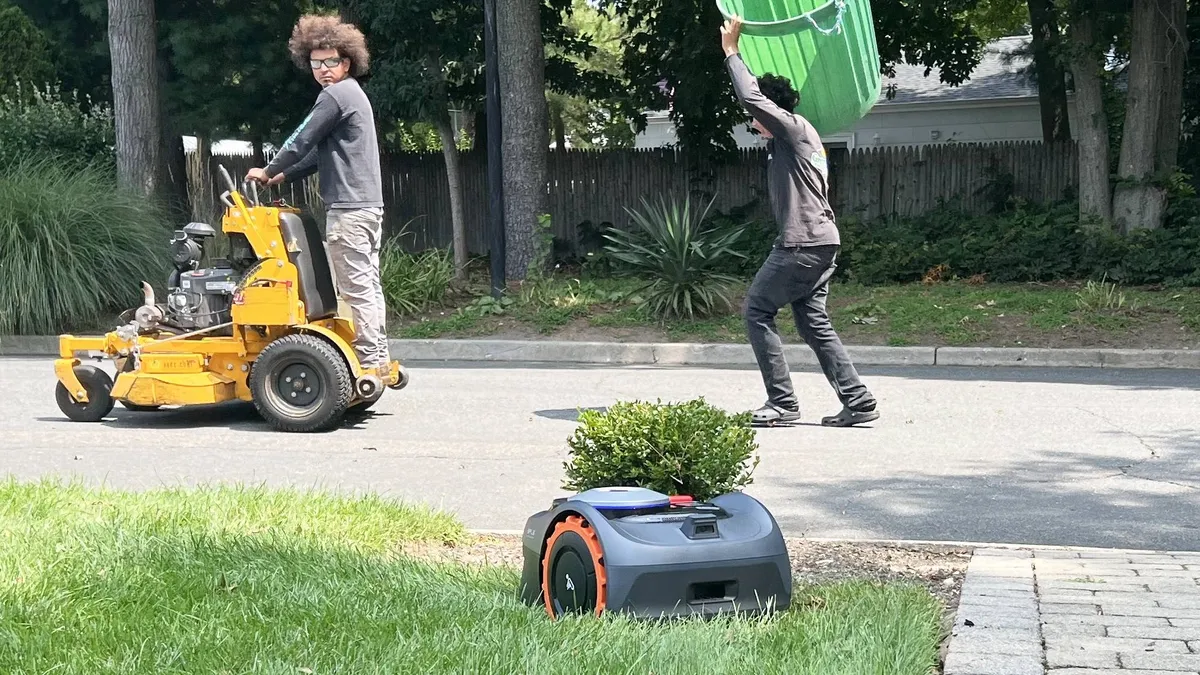
While robot lawnmowers are fairly common in Europe, they’re still a novelty in the U.S., so every time my mower is out doing its rounds, passers-by almost always stop to watch it mowing. It becomes a bit of a conversation piece if I happen to be outside at the time, so it’s a good way to chat with your neighbors and get to know them better.
Do you own a robot lawnmower? If so, how long have you had it, and what sort of things have you experienced? Let me know in the comments.
Follow Tom's Guide on Google News and add us as a preferred source to get our up-to-date news, analysis, and reviews in your feeds.

More from Tom's Guide