In the world of high-end audio, things get very expensive, very fast. Hi-fi headphones go into four figures before you even know it, with speakers getting into the tens of thousands of dollars equally as easily.
I’m lucky that I get to test a fair bit of the pricey stuff for my job. But alas, I don’t really get to keep much of it, and I know most people can’t afford to drop thousands on their audio gear, either.
I decided to put together my real-world critical listening setup, a set of open back headphones and a DAC, on a real world budget of $500. Less than a set of mainstream ANC cans like the $549 Apple AirPods Max 2.
Reddit had a couple of obvious suggestions, of course, namely the Sennheiser HD 650 or, for sheer budget, the HIFIMAN Sundara. But I chose to ignore both of those (sorry Reddit). Here’s what I got instead, and why.
Hot Meze, anyone?

As I mentioned above, it would’ve been easy to go down the well-trodden route of the HIFIMAN Sundara or Sennheiser HD 650. They're the darlings of r/audiophile and r/headphones (and, to be fair, for good reason).
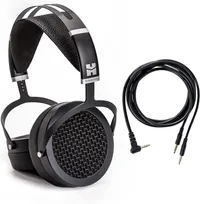
We use a set of Sundara for comparison testing at work. They sound great: spacious, with excellent bass response thanks to their planar drivers. They’re easy to drive and cheap too. But they’re cheap for a reason: the build quality is poor. Our pair sit on a shelf and suffer not the rigors of daily use, but there are many reports online of the headband breaking, and Amazon flags them as a “frequently returned product.”

So what about the Sennheiser HD 650? These are commonly recommended online for a reason: they sound fantastic, with a warm-ish neutral tune that’s ideal for detail listening. The thing is, I’m a motorcyclist and audio tester, so my ears don’t have an easy life. For personal headphones I prefer a warmer and slightly darker tune to avoid treble fatigue — easier-listening, so to speak.
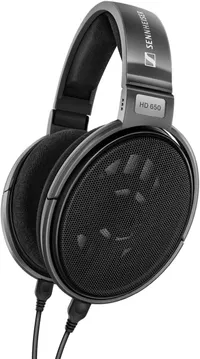
The HD 650 can be very pricey, too. I’ve even seen them go above the $500 mark in the U.S. And finally, while not horrendously tricky to drive, the HD 650 aren’t exactly easy. While writing this, one of my colleagues had to borrow one of our powerful test DACs to drive his newly purchased pair of HD 650. Nice timing!
I was also considering the HD 550, but again I wanted that warmer, tad darker tune. Plus, to me, the HD 550 resemble a particular anatomical diagram from biology class…

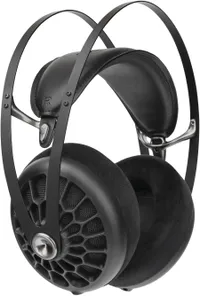
Anyway, instead I looked towards Romania, and Meze Audio. Specifically, the Meze Audio 105 AER. At their $399 MSRP, these cans are fairly pricey, but attainable. As I write this, they’ve been selling at $299 for several weeks at Amazon. At that price, I think these are an absolute steal, and some of the best value for money in the audiophile world.
Genuine all-day comfort

The Meze 105 AER are utterly beautiful, with bags of Romanian Art Deco flair — pizzazz you definitely won’t get from the likes of Sennheiser. They’re vastly superior in build quality to the HIFIMAN Sundara (it’s actually crazy that at times the two pairs of headphones only sit as little as $120 apart). The 105 AER feel like much, much more expensive headphones. And with the gorgeous suspended headband and vegan velour pads, the 105 AER are comfortable for hours on end, too.
In fact, the headband deserves its own shout out. You don’t need to adjust the 105 AER, as the headband is perfectly sprung. And I mean “perfectly” quite literally: it adjusts to your head as you pull the headphones on, applying juuuust enough clamping pressure to override the spring and keep the cans sitting securely. It’s. Utterly. Glorious.

I don’t like to parrot brands’ marketing, but Meze claims that you’ll forget the 105 AER are on your head, and they’re genuinely correct there. Partly that’s to do with the headband and earcups, but it’s also thanks to the extremely liveble sound profile…
Warm, easy-listening sound

Most importantly, the 105 AER boast stunning sound. The tuning is fairly warm, but strikes a nice balance between easy- and critical-listening, which I love. It’s not too clinical.
Bass is prominent and silky smooth. The 105 AER aren’t as subby as the Sundara with their planar drivers, and yeah, sometimes I miss that: Sohn’s Antigravity, for example, concludes with an enormous roll of sub bass that should be felt tingling in the temples. But I’ve got a trick up my sleeve to help with that in the DAC section below.
The 105 AER mid-range is the star of the show in my opinion. There’s so much steely texture to the distorted guitars in Metallica’s Seek & Destroy and The Smashing Pumpkins’ Siva. Vocals, meanwhile, also sound fantastic, with the 105 AER perfectly relaying the organic timbre of John Fogerty’s howling in CCR’s Fortunate Son — I could hear the rasps and crackles of his vocal cords as he roared in righteous indignation.

Admittedly, treble isn’t the brightest, so you’re missing out on the sheer top-end resolution you’d get from something like the Sennheisers — there’s not quite the same level of crispness and detail to cymbals in Fortunate Son, or the shimmering backing effects in Ikigai. That said, they’re not dark enough for things to sound stifled or distant. The roll off also makes the 105 AER supremely easy to listen to for extended periods. They don’t give me cymbal fatigue, something I often get when listening to Copeland’s drumming throughout The Police’s Outlandos D’Amour album.
The 105 AER are also effortlessly spacious, which in fairness can be said about the HIFIMAN and Sennheiser too, as they’re all open back. Sohn’s Antigravity begins with super spatial percussion springing inward and out on the horizontal plane — imaged impressively by the Mezes.
Listen along to my testing playlist on Qobuz, in our eyes the best music streaming service for audiophiles.
But how to drive them?
As well as a set of headphones, I was also after a new DAC. The Meze 105 AER are passive headphones, so they need to be powered. They aren’t difficult to drive, with an impedance of 42Ω and a sensitivity rating of 112 dB/mW — in other words, they get pretty loud without much power. You can run them from your smartphone or laptop and they won’t be too quiet.

But just because they can be driven from your phone or laptop, that doesn’t mean they’ll sound their best that way. Often, you’ll get better sound using a dedicated DAC/Amp, which can feed headphones more power.
On passive headphones with low impedance (electrical resistance) a stable, quality power source like a dedicated amp will help keep the sound in check and free from distortion — without one, power fluctuations mean drivers can struggle to start and stop as sharply as they otherwise might. There’s technically the added sweetener of more accurate digital to analog signal conversion, too.
With $200 to spare, there were options. The FiiO KA13 would be my choice on a lower budget. It offers FiiO’s typical transparency (so you’re hearing the tune of the headphones, not the profile of the DAC), plenty of power, a compact footprint and an equally small $79 price tag. But the KA13 lacks any hardware EQ or digital filters (unless using the god-awful FiiO app), which I like, as they let me play around with sound.

I also considered the $179 FiiO K11 R2R, which I’ve tested previously in the office. It’s also a transparent DAC, offers bags of power for trickier-to-drive upgrades in the future, and even has an upsampling mode, which can help give an airier sound. It’s a desktop DAC, though, so needs plugging in, which I find annoying.
In the end, I went for the $199 iFi hip dac 3, for one primary reason: subby stuff. While it lacks the K11’s advanced features, the hip dac 3 has an Xbass mode that gives up to +6dB amplification in the 20-30Hz region. Remember that temple-shaking sub bass I said I enjoy in certain songs? Xbass delivers it at the push of a button, only when you want or need it.
The hip dac 3 is also plenty powerful and compact enough to fit into my pocket — it’s shaped like a hip flask, hence the name. As a Brit, I like that buying it supports a British company, too (although, to be fair, the DAC itself is unsurprisingly still made in China).
Total spend: $498

I’m really happy with this setup. I don’t think the Meze 105 AER will please fans of that clinical, reference sound. These are decidedly warm with some treble roll-off backing off the volume of high frequencies. Personally, though, I think the balance is ideal for daily use.
The slightly darker tune isn’t to the complete detriment of top end detail or space, yet makes them a very liveable set of cans day in, day out, all day while working. You get the picture. And best of all, even with my powerful little iFi DAC included, my setup still comes in cheaper than a set of AirPods Max 2!
Let me know in the comments below - what's your favorite setup? Which cans do you wear every day? What's on your wishlist?

Follow Tom's Guide on Google News and add us as a preferred source to get our up-to-date news, analysis, and reviews in your feeds.
More from Tom's Guide