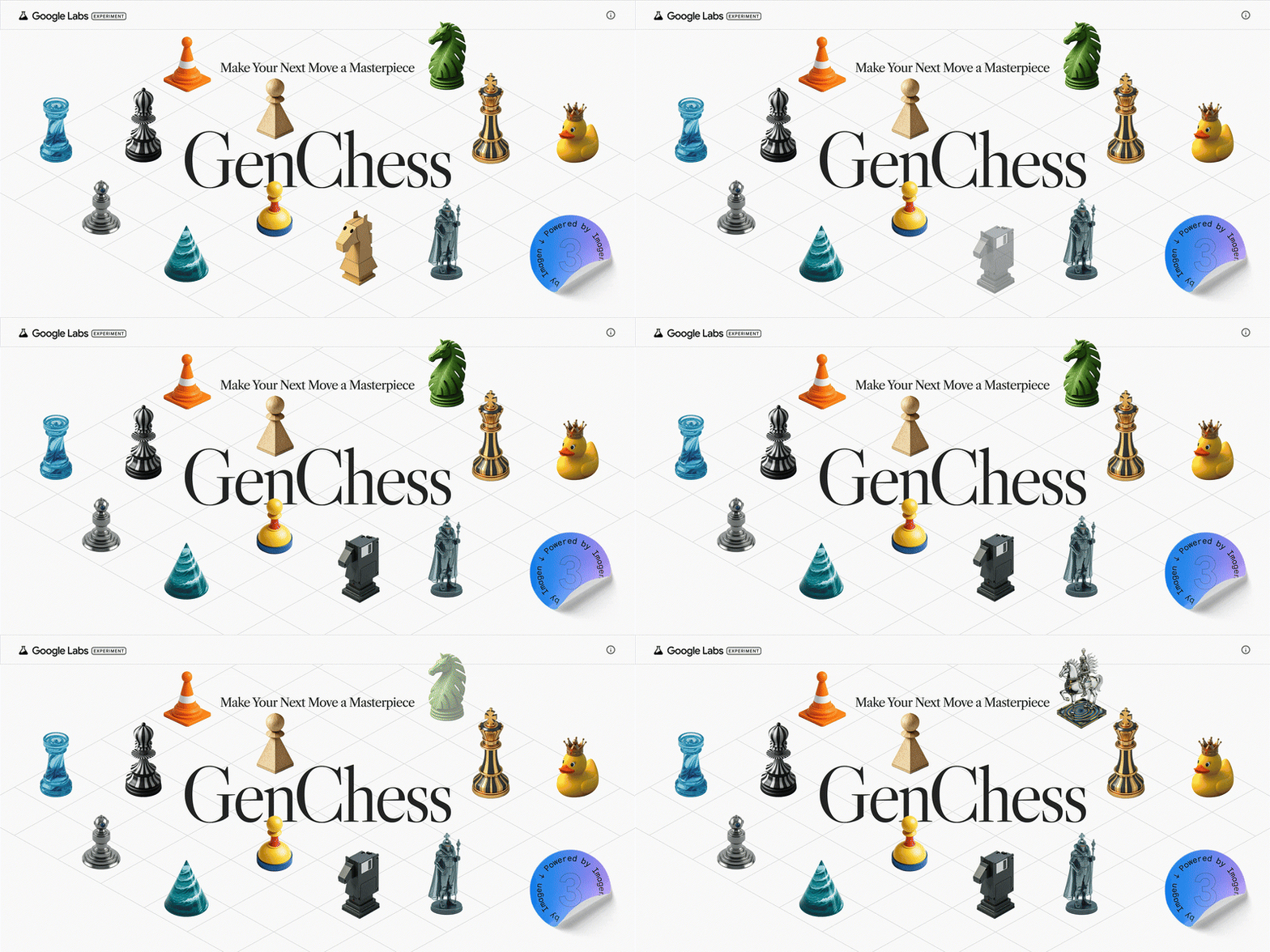
Google gets weird with chess — I love this new AI experiment that lets you create your own custom pieces
A nerdy millennial dream

Here at Tom’s Guide our expert editors are committed to bringing you the best news, reviews and guides to help you stay informed and ahead of the curve!
You are now subscribed
Your newsletter sign-up was successful
Want to add more newsletters?
Daily (Mon-Sun)
Tom's Guide Daily
Sign up to get the latest updates on all of your favorite content! From cutting-edge tech news and the hottest streaming buzz to unbeatable deals on the best products and in-depth reviews, we’ve got you covered.
Weekly on Thursday
Tom's AI Guide
Be AI savvy with your weekly newsletter summing up all the biggest AI news you need to know. Plus, analysis from our AI editor and tips on how to use the latest AI tools!
Weekly on Friday
Tom's iGuide
Unlock the vast world of Apple news straight to your inbox. With coverage on everything from exciting product launches to essential software updates, this is your go-to source for the latest updates on all the best Apple content.
Weekly on Monday
Tom's Streaming Guide
Our weekly newsletter is expertly crafted to immerse you in the world of streaming. Stay updated on the latest releases and our top recommendations across your favorite streaming platforms.
Join the club
Get full access to premium articles, exclusive features and a growing list of member rewards.
Google likes to experiment with artificial intelligence. We’ve had live DJ tools, podcast creators and a way to create custom lettering. Now its engineers have turned their sights to the world of chess with GenChess, a new experiment that lets you design custom pieces using the Imagen model.
GenChess is built on top of the Imagen 3 artificial intelligence image generation model from Google DeepMind. This also powers the ImageFX experiment and image creation in the Gemini chatbot. It is a very impressive model that can create everything from photorealism to design.
You can create either a classical chess set that adheres more to the original shapes, or a creative one that is a little more experimental in design. After you create your own the AI will come up with a suitable competitor set and you can play a timed game.
How does GenChess work?
GenChess uses AI to personalize the 1,500-year-old game by giving you a simple way to create custom sets. You can then play against the computer.
It uses the Imagen 3 AI image generation model and some clever prompting techniques to customize the set. The initial prompt is fairly restrictive. Google provides the bulk of the prompt but you can switch between classic and creative, and add a descriptor at the end.
My favorite part is that it also tries to create a matching opponent. When I gave it Mars as a prompt, it generated an opponent set that reflected Venus. When I gave it dogs on the beach, it gave me cats on a catwalk as the opponent.
As both a millennial and someone in the chess club at school, I couldn't resist creating a set made to look like avocado toast. Google gave me bacon and eggs as an opponent. I lost the game.
Get instant access to breaking news, the hottest reviews, great deals and helpful tips.
More from Tom's Guide
- ChatGPT will soon be able to see your Mac apps and provide real-time advice
- I asked ChatGPT to solve today's difficult Wordle, and it's worse than I am
- I created Genmoji with Apple Intelligence — here's my favorite prompt

Ryan Morrison, a stalwart in the realm of tech journalism, possesses a sterling track record that spans over two decades, though he'd much rather let his insightful articles on AI and technology speak for him than engage in this self-aggrandising exercise. As the former AI Editor for Tom's Guide, Ryan wields his vast industry experience with a mix of scepticism and enthusiasm, unpacking the complexities of AI in a way that could almost make you forget about the impending robot takeover.
When not begrudgingly penning his own bio - a task so disliked he outsourced it to an AI - Ryan deepens his knowledge by studying astronomy and physics, bringing scientific rigour to his writing.