




Crunches and sit-ups remain some of the most popular core exercises out there. But despite what social media might tell you, they won't burn belly fat or magically reveal a six-pack, and they're not always the most functional way to train your abs. In fact, if you struggle with back pain or tight hip flexors, they can sometimes do more harm than good.
As someone who runs the equivalent of a marathon a week (that's 26.2 miles spread across seven days before you gasp) and has rebuilt my core after two pregnancies (think diastasis recti, also known as abdominal separation), I've learned that the most effective core exercises aren't always the ones that isolate your abs and leave your mid-section and hip flexors burning.
Instead, they're the exercises that train your core the way we actually use it and teach your body to stabilize, balance and resist movement. That's why I'm a huge fan of the bear plank pull-through. If you're looking to get the best results from your core workouts, I'd choose this exercise over crunches every single time.
Read on to find out how to do the bear plank pull-through and why it's one of the most functional core exercises you can add to your workout routine.
What are bear plank pull-throughs, and how do you do them?
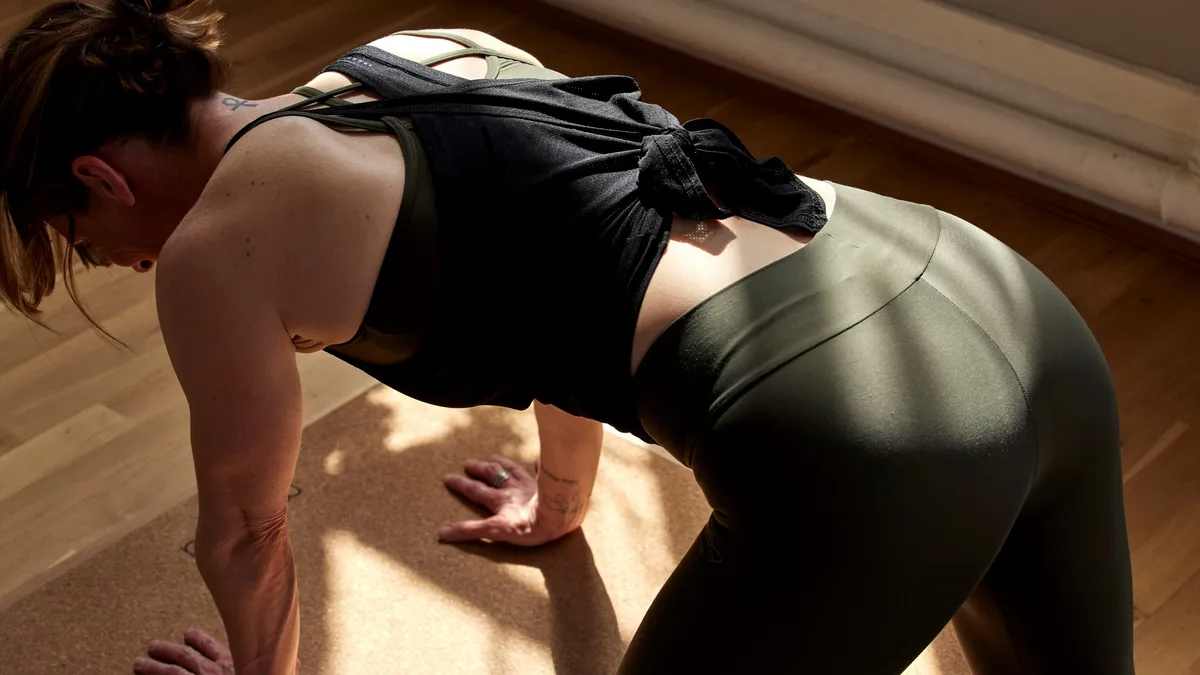
Think of this exercise as a cross between a bear plank hold and a plank dumbbell pull-through. You'll start in a tabletop position with your knees hovering an inch or two above the floor and a dumbbell or kettlebell placed beside one hand.
From here, the goal is to reach underneath your body and pull the weight across to the opposite side without letting your hips sway from side to side or your knees creep up. It sounds simple, but keeping your body stable while balancing on three points of contact will challenge your entire core.
As you perform the move, focus on keeping your knees low to the floor, your hips level and your belly button pulled towards your spine. Your glutes, shoulders and deep core muscles should also all be working to keep you balanced and prevent your body from toppling over.
Here's how to do bear plank pull-throughs with good form:
- Place a dumbbell or kettlebell on the floor just outside your right hand. Get into a bear hold position with your hands directly beneath your shoulders and your knees beneath your hips.
- Lift your knees an inch or two off the floor and push the ground away with your palms.
- Once stable, brace your core and reach underneath your body with your left hand. Drag the weight across to the left side and place it on the floor with control.
- Reset your position, making sure your hips remain level, and your core stays engaged.
- Reach under your body with your right hand and drag the weight back to the opposite side.
- Continue alternating sides for the desired time or number of repetitions.
- The goal is to keep your spine neutral and your body as still as possible throughout the exercise. If your hips are rocking and your knees lifting, try slowing the movement down or using a lighter weight until you've mastered the technique.
How many shall I do?
Start with three sets of 30 seconds, focusing on keeping your hips stable and your core engaged throughout the movement. As you get stronger, gradually increase your working time to 45 seconds and then 60 seconds.
I do mine with a 7.5kg dumbbell, but choose a weight that feels good for you while allowing you to maintain good form. Remember, this exercise is more about control and coordination rather than lifting heavy.
Once you've mastered the movement, try performing it with a kettlebell, which can be a little trickier to pull across the floor due to its shape. For an extra challenge, place a Pilates ball between your knees and gently squeeze it throughout the exercise.
Not only will this switch on your adductors (the muscles of your inner thighs), but it'll also make your core work even harder to keep you stable.
What are the benefits?
Unlike crunches, which mainly train your abs to flex your spine, bear plank pull-throughs teach your core to resist movement. Think shoulders over wrists, knees under hips and hovering just off the ground, while maintaining a neutral spine.
As you reach beneath your body to drag the weight across, your deep core muscles have to work hard to stop your hips from twisting or rocking from side to side. At the same time, your obliques and shoulders are working overtime to keep you stable.
This is known as anti-rotation training, and it's much harder than it looks. In fact, it's one of the most functional ways to strengthen your core. In everyday life, your core's job isn't to crunch; it's to stabilize your pelvis, protect your spine, and transfer force between your upper and lower body as you move.
You'll also get a lot more than a core workout. Because you're supporting your body weight throughout the exercise, your shoulders, glutes, hips and quads all have to work hard to keep you balanced. The result is a full-body exercise that challenges your coordination and stability.
As a runner, this is one of the reasons I love the bear plank pull-through. A strong core helps you maintain good running form when fatigue starts to set in, allowing you to stay stable and efficient as you tick off the miles. The exercise also teaches your body to stabilize while your arms and legs are moving: exactly what happens when you run.
For women in particular, exercises like this can be a great alternative to endless crunches. By training the deep core muscles and encouraging better pelvic stability, you can build strength that carries over into everyday activities as well as lifting weights in the gym. It's also a great option for anyone rebuilding core strength after pregnancy, surgery, or an injury.
So, if you're bored with crunches or simply want a more functional way to train your core, give the bear plank pull-through a try. Don't be surprised if it leaves your abs and quads shaking after just a few reps.
Follow Tom's Guide fitness on Instagram for more workouts, routines, tips, and tricks.

Follow Tom's Guide on Google News and add us as a preferred source to get our up-to-date news, analysis, and reviews in your feeds.
More from Tom's Guide
- Not sit-ups, planks, or crunches: I do this simple Pilates exercise every single day to build a strong and stable core and work on my hip flexor mobility
- Not sit-ups or lunges — I use this simple Pilates exercise to sculpt strong obliques, inner thighs and hip stabilizers
- 'I’m a Pilates instructor, and I recommend these 5 core exercises to help older clients build strength and improve posture'

