




Beyond security and privacy, speed is one of the most important things to consider when choosing a VPN. If you want a smooth, stable connection while gaming, streaming, torrenting or anything else, then you'll need one of the fastest VPNs.
Many of the best VPNs (and some not-so-good VPNs) all claim to be the fastest VPN on the market – in fact there's even one that calls itself FastestVPN – but cutting through the marketing fluff can be tricky. To help you do that, we conduct a barrage of VPN speed tests to determine the real speeds VPNs can deliver on a range of connections.
We'll go into the top 5 fastest VPNs below, but if time is of the essence, check out the top 3 fast VPNs below – Proton VPN, ExpressVPN, and NordVPN.
The 3 fastest VPNs at a glance



How we chose the fastest VPNs
Why you can trust Tom's Guide Our writers and editors spend hours analyzing and reviewing products, services, and apps to help find what's best for you. Find out more about how we test, analyze, and rate.
You may think choosing the fastest VPN is easy – just a speed test, and the one with the quickest speed wins, right? It's actually a lot more complicated than that.
We test all the VPNs multiple times on an uncontested 10 Gbps network, morning and evening, to check the fastest possible speeds they can deliver. We first do this from an Eastern USA location to the nearest server, and then from East US to the UK. This also lets us measure their latency and jitter, which gives us a better idea of how stable the connection is.
That's not all, though. VPNs offer a number of different encryption protocols. Some have proprietary options that promise superior speed and security. So, we repeat the same tests when using WireGuard (an encryption protocol known for its speed), OpenVPN (an encryption protocol that tends to be slower but more secure), and any proprietary protocols.
In preparation for writing this article, I also conducted speed tests while connected to my (generally slow) domestic Wi-Fi. This helps give a more realistic idea of the impact each VPN has on domestic networks.
I also took into consideration what platforms these speeds were available on. For example, if a VPN had super-fast speeds when using an encryption protocol only available on a specific platform, this counted against it in the ranking.
This is because I consider being the fastest VPN to mean the fastest VPN overall, across all platforms, rather than having just one impressive speed while other platforms are lacking.
This update has seen the rankings have quite the shakeup, with Norton VPN and Mullvad making way for NordVPN and PrivadoVPN.
The fastest VPN overall: Proton VPN
What we like:
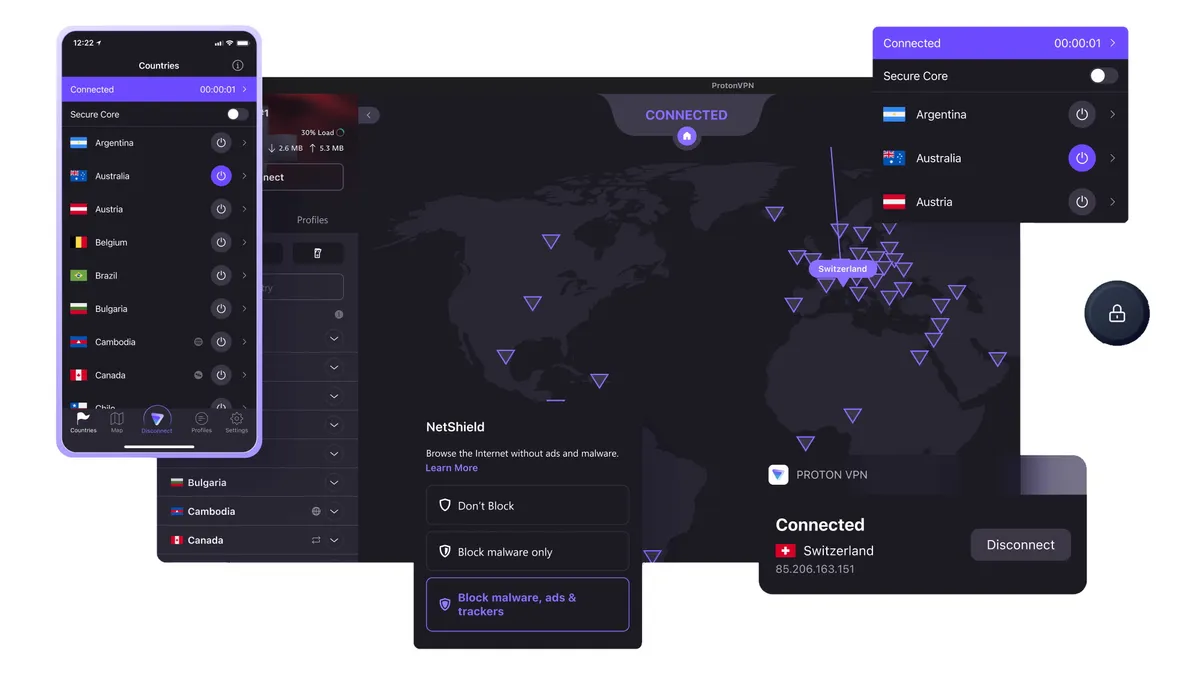
Proton VPN has always performed consistently well in our speed tests. However, its most recent results have cemented it as the very fastest VPN overall.
In our previous speed tests on a 1 Gbps line, Proton VPN achieved maximum speeds of 950 Mbps using the WireGuard protocol. However, on a 10 Gbps line these speeds have increased to an impressive 1,548 Mbps – and that was over or long distance test! It was actually slightly slower on the local connection (1,475 Mbps). It was the only VPN speed tested that managed this, and just goes to show the consistency of speeds you get.
It's unlikely your connection is this fast, but Proton VPN also performs very well on slower connections. In my own speed tests on my home Wi-Fi network, Proton VPN achieved 51 Mbps which was right up there with the best.
This is even more impressive considering my own Wi-Fi clocked in at 32 Mbps when not connected to Proton VPN. Of course, a VPN itself can't increase your base internet connection. Instead, it can reduce throttling from your internet service provider, which I believe is the case here.
As one of the most secure VPNs, Proton VPN offers an obfuscated encryption protocol called Stealth that aims to help users bypass internet censorship and conceal their VPN use.
Of all the obfuscated encryption protocols we tested, Proton VPN's Stealth was the fastest, with peak speeds of 479 Mbps. This can't match Proton VPN's WireGuard speeds, but when you take into account the fact that Stealth makes your VPN use practically undetectable, it's an excellent performance.
These speeds are likely due to a feature called VPN Accelerator. This ensures users get the fastest speeds possible automatically, no matter where they are. Proton VPN claims that VPN Accelerator can boost speeds by up to 400%.
Elsewhere, Proton VPN has impressive privacy credentials. Its Secure Core servers are the most privacy-hardened multi-hop servers of any VPN, and its no-logs policy has been proven by an independent audit.
What's more, if you fancy putting these speeds to work, Proton VPN is one of the best streaming VPNs. In our tests, it was able to unblock every streaming site we tested it with, and suffered from very few hiccups in the process.
What could improve:
OpenVPN is known for being a significantly slower encryption protocol to use, so it's unsurprising that Proton VPN's OpenVPN speeds are slower than its WireGuard speeds.
However, with peak speeds of 449 Mbps, Proton VPN's OpenVPN speeds do leave a bit to be desired. That's an improvement on scores from our last speed test (240 Mbps) but still a way off the likes of ExpressVPN (1,038 Mbps), Surfshark (825 Mbps)and NordVPN (688 Mbps).
While the security offered by WireGuard is more than enough to keep you safe online, I'd like to see another uptick in OpenVPN speeds.
If OpenVPN is your preferred VPN protocol and you want the absolute fastest speeds possible while using it, I'd suggest going for ExpressVPN or Surfshark.
Proton isn't a cheap VPN, at $2.99 per month on the 24-month contract, but it does have a free version if you don't want to shell out. Proton VPN Free is one of the best free VPNs we've tested, although you should keep in mind that its speeds will not be as fast as its premium version.
With peak speeds of 335 Mbps, Proton VPN Free is not necessarily slow, but it doesn't match up to the top speeds of the premium version. If you want a cheaper VPN with fast speeds (although not as fast as Proton VPN), go for Surfshark.
🔒 Read our in-depth Proton VPN review for all the details.
Buy Proton VPN if:
✅ You want the most consistent, fastest VPN. With speeds of 1,548 Mbps, Proton VPN is the most consistently fast VPN we've tested.
✅ You want the fastest obscured VPN. Proton VPN's Stealth protocol was the fastest obscured protocol we tested, with peak speeds of 479 Mbps.
✅ You want the fastest connection speed automatically. With its VPN Accelerator, Proton VPN will automatically connect you to the fastest possible connection, no matter where you are.
Don't buy Proton VPN if:
❌ You're on a tight budget. At around $2.99 per month for a two-year subscription, Proton VPN isn't the cheapest VPN provider around.
❌ You exclusively use OpenVPN. In our tests, when using OpenVPN, Proton VPN couldn't quite match the competition.
Fastest VPN for Windows and OpenVPN: ExpressVPN

What we like:
If you're part of the Windows faithful, ExpressVPN is one of the fastest VPN you can download. When using Lightway Turbo, we saw peak speeds of 1,177 Mbps. That's down a little on our last test but still very good and, as with Proton VPN, long distance server connection speeds are very comparable with 1,117 Mbps recorded between East USA and the UK.
However, there's a downside that we'll explore in a moment – Lightway Turbo is only available on Windows, and isn't compatible with some specific apps and games.
All the same, ExpressVPN did top the charts for OpenVPN, and that's a protocol that you can use on any platform. Peak speeds were 1,038 Mbps.
This performance is particularly good when you consider the fact that OpenVPN is known for being slower but more secure. This means ExpressVPN offers a very rare mix of great speeds and the rock-solid privacy offered by OpenVPN. This has been achieved by the use of OpenVPN DCO, which allows part of OpenVPN to work in the kernel, rather than the application, reducing load and increasing speeds.
ExpressVPN is also very fast to connect, thanks to its Parallel Connections feature. This sees the app try all available connection methods simultaneously when connecting to a server, making its connection time the fastest of any VPN I've tested. This means you can get connected and protected incredibly quickly.
ExpressVPN has had more independent audits than any other VPN, ranging from its apps, its no-logs policy, and even its server infrastructure. This gives excellent affirmation that it's safe to use, and genuinely protects your data.
What could improve:
While ExpressVPN Lightway Turbo did have some of the fastest speeds recorded in our tests, ExpressVPN's performance in other speed tests wasn't consistent enough to rank it as the very fastest VPN overall.
For a start, the version of its proprietary protocol available on devices other than Windows (ExpressVPN Lightway) only hit peak speeds of 428 Mbps, which is disappointingly slow when compared to Turbo's performance – and very surprisingly far slower than OpenVPN.
Additionally, in mobile-based speed tests, ExpressVPN had one of the slowest performance of all the VPNs on this list at 36 Mbps.
What this essentially means is that while Windows users will benefit from its super-fast speeds, if you use other devices you won't.
While largely very reliable for streaming, in our testing ExpressVPN did have a couple more hiccups than other providers. I failed once when trying to unblock Netflix in Australia and Japan.
However, it was very reliable for most other services, including Disney Plus, and other regional sites like BBC iPlayer.
🔒 Read our in-depth ExpressVPN review for all the details.
Buy ExpressVPN if:
✅ You want the fastest VPN for Windows. As the fastest provider in our last round of speed testing, ExpressVPN will protect you without slowing you down.
✅ You prefer using OpenVPN to other VPN encryption protocols. With peak speeds of 1,038 Mbps, ExpressVPN was the fastest VPN using OpenVPN on this list.
✅ You want a VPN with super-fast connection speeds. ExpressVPN's Parallel Connections will get you up and running super-fast.
Don't buy ExpressVPN if:
❌ You're not a Windows user and need ultra-fast speeds. Lightway Turbo, ExpressVPN's fastest protocol, is not available on iOS, Android, Linux or macOS.
❌ You want a fast VPN for streaming. While it was generally able to unblock everything I tested it with, ExpressVPN did have some minor issues during streaming testing.
Fastest VPN and excellent streaming: NordVPN

What we like:
NordVPN clocked in as the third fastest VPN for peak speeds in our most recent tests. At 1,249 Mbps over the WireGuard-based NordLynx protocol, it's still very much in touch with Proton VPN, though.
It was also the third fastest VPN using the OpenVPN protocol with super consistent speeds over local server connection (688 Mbps) and long distance too (689 Mbps). That makes it a great choice for speed no matter the level of protocol security that you're looking to use.
What really cements it as third-placed on this list, though, is how consistently well it performs in our streaming service unblocking tests. Almost every time, NordVPN comes out on top. Most recently, it was only with unblocking some US YouTube videos where it struggled.
What could improve:
NordVPN didn't do so well over longer distance connections while using NordLynx. It only averaged 688 Mbps, which is no great shakes at all. I'd like to see some improvements here next time.
The only other criticism to level at NordVPN is that it's on the expensive side compared to others on this list. Right now, it starts at $3.09 per month. That's for the 2-year plan. If you do sign, please make sure to cancel at the end rather than let it auto-renew.
Both NordVPN and Surfshark have famously high auto-renew prices. Please don't become a statistic.
🔒 Read our in-depth NordVPN review for all the details.
Buy NordVPN if:
✅ You want a super-fast VPN. With speeds of over 1,249 Mbps using NordLynx, NordVPN has the third-fastest peak speeds on this list.
✅ You want a VPN that offers consistent speeds when using OpenVPN. With peak speeds of 688 Mbps, NordVPN is third only to ExpressVPN and Surfshark.
✅ You want a VPN that offers excellent stream unblocking. NordVPN is consistently rated as the best streaming VPN available.
Don't buy NordVPN if:
❌ You want top speeds connections to servers around the world. Maybe you want to access gaming servers or other services in far flung places – well, NordVPN didn't perform very well over long distances compared to the other fastest VPNs.
❌ You want a super-cheap VPN. At over $3.09 per month for a two-year subscription, there are some services cheaper than NordVPN on this list.
Fastest peak speeds: PrivadoVPN

What we like:
PrivadoVPN is a new addition to our list of the fastest VPNs, thanks to its incredible performance in our latest round of speed tests.
On a 10 Gbps line, PrivadoVPN achieved amazing peak speeds of 2,334 Mbps on WireGuard, making it faster than any other VPN on this list.
Speeds dropped to 1,389 Mbps over WireGuard connections to long distance servers but that's faster than best of any other VPN, apart from Proton VPN.
What's more PrivadoVPN is seriously cheap. At just over $24 for your entire 2-year contract ($1.11 per month), it's incredibly affordable. You'll spend more money on a trip to the coffee shop in some places, and get a lot less in return.
So, if it's speed, speed, speed and more speed that you want from your VPN, then it's PrivadoVPN all the way.
What could improve:
Well, quite a lot, otherwise PrivadoVPN would surely top this list.
Firstly, PrivadoVPN's OpenVPN speeds were the slowest of all. At 405 Mbps (local) and 196 Mbps (East US to UK), it's not really in the same league as the competition if you want to use a more secure protocol most of the time.
It's also not great when it comes to streaming. PrivadoVPN struggled to unblock many different streaming platforms in our most recent tests. While it did well with Netflix in all locations, it couldn't manage with Amazon Prime, Disney+ and BBC iPlayer.
That's disappointing when compared to the performance of all the other VPNs on this list, which did not have any issues unblocking streaming services like these.
Lastly, PrivadoVPN is the only one on this list that doesn't get regular audits. So, you'll just have to trust that the company is true to its no-logs policy.
🔒 Read our in-depth PrivadoVPN review for all the details.
Buy PrivadoVPN if:
✅ You want the absolute fastest VPN. At over 2,000 Mbps, PrivadoVPNs speeds were the fastest out of all the VPNs on this list.
✅ You want a very affordable VPN. PrivadoVPN is the cheapest VPN on this list, and, at $1.11 per month, one of the cheapest VPNs you'll find anywhere.
Don't buy PrivadoVPN if:
❌ You want to unblock streaming sites. PrivadoVPN is significantly behind the best streaming VPNs we've tested.
❌ You mostly use OpenVPN. PrivadoVPN was quick over WireGuard but one of the slowest we recorded on OpenVPN.
The cheapest fast VPN: Surfshark

What we like:
Surfshark may have fallen from its #1 spot on this list, but that doesn't mean it's not worth considering – especially as a cheap fast VPN.
In testing, Surfshark's peak WireGuard speeds were very good at 1,021 Mbps. Its OpenVPN speeds were also impressive in testing, with peak speeds of 851 Mbps. This makes it second only to ExpressVPN when using this encryption protocol.
Surfshark did perform well on my very slow domestic Wi-Fi connection, with speeds of 48 Mbps. That figure puts it in second when using domestic Wi-Fi, coming in after Proton VPN.
Anecdotally, Surfshark offers some of the smoothest connections I've experienced during testing. When checking its unblocking ability for my best streaming VPN ranking, Surfshark was the only VPN that didn't experience even slight lag or buffering while streaming.
A great thing about Surfshark is that it offers unlimited simultaneous connections, a much more generous offer than all the other VPNs on this list.
With its speeds, you should be able to use Surfshark across as many devices as you like without experiencing any slowdown.
What could improve:
While Surfshark's speeds of 1,021 Mbps are certainly nothing to be sniffed at, its speeds have varied wildly during our previous testing, occasionally dropping below 900 Mbps, while other VPNs have been more consistent.
With this being said, in my own personal use and experience, Surfshark's connections have felt fast, strong, and stable. It's one of the few VPNs that I haven't experienced any lag or buffer whatsoever during streaming testing.
You should also keep in mind that while Surfshark is definitely great value for your first two years, just like with NordVPN, you will be subject to price hikes once your subscription renews.
If you want to avoid this, you'll have to cancel your subscription before it ends, then sign up for a brand new one.
🔒 Read our in-depth Surfshark review for all the details.
Buy Surfshark if:
✅ You want a cheap fast VPN. At under $2 per month, Surfshark is the cheapest VPN provider on this list.
✅ You prefer to use OpenVPN. At 851 Mbps, Surfshark's OpenVPN speeds were the second fastest we tested.
✅ You want to cover a lot of different devices. With unlimited simultaneous connections, you can cover as many devices as you want, with no restrictions.
Don't buy Surfshark if:
❌ You want the absolute fastest VPN. Surfshark's speeds are good, but not the absolute fastest. They also fluctuate wildly based on our testing.
❌ You want to avoid price hikes. While Surfshark's initial prices are excellent value, you will be subject to price hikes upon renewal.
Which VPN is the fastest?
While PrivadoVPN did achieve the fastest speed in our tests of over 2,000 Mbps while using WireGuard, Proton VPN takes the #1 spot as the fastest VPN.
This is due to the fact that it is stronger in other areas that PrivadoVPN isn't (for example, OpenVPN speeds and streaming support).
Additionally, Proton VPN has consistently achieved speeds of over 950 Mbps in previous tests, giving it a good track record in terms of performance.
When it comes to the OpenVPN protocol, ExpressVPN is the fastest, with speeds of 1,038 Mbps. This is especially impressive considering the fact that OpenVPN tends to be significantly slower than other encryption protocols due to its age and large code.
Is a VPN faster than Wi-Fi?
The speeds a VPN can reach is dictated by how fast your Wi-Fi is. A VPN can't go faster than your connection allows, and generally it will slow peak speeds down a little because your traffic has to travel through an extra server between your device and the website you're visiting.
However, a VPN can sometimes make your base connection appear faster if you're experiencing throttling from your ISP.
This is because your ISP can choose to throttle your connection if you're using too much bandwidth, or undertaking activities that might compromise other users. When using a VPN, your internet traffic is hidden from your ISP. This means it can't make the decision to throttle your connection based on online activity, and you may see better speeds with it connected.
How does a VPN work?
Using a VPN creates a secure, encrypted tunnel between your device and the internet, which all of your internet traffic is routed through. This means that your data is kept safe from anyone who may be trying to intercept it, for instance your internet service provider (ISP) or the government.
If you're experiencing throttling from your ISP then using a VPN can increase your connection speed, as your ISP cannot see your internet traffic. This means it cannot limit your bandwidth based on online activity.
When you use a VPN, you connect to a VPN server before connecting to the internet. This assigns you a different IP address from your home IP address, and means your online activity cannot be traced back to you.
This also means that you'll virtually appear to be within a country if you connect to a server within that country, giving you access to any geo-restricted content within that country (e.g. on streaming platforms).
How to choose the right fast VPN
While you might think this is as easy as checking to see which VPN got the fastest possible result in our testing (it was ExpressVPN, by the way), there are a few things to take into consideration when looking for the fastest VPN.
You'll need to look at the speeds achieved on different protocols, and where these protocols are available. It's no good going for a VPN which offers top speeds but only on an encryption protocol that isn't available on any of the devices you use (like ExpressVPN's Lightway Turbo only being available on Windows).
If obfuscation is important to you, it's also a good idea to check out the top speeds of your chosen VPN while using more secure protocols that are designed to be undetected.
Price might also be a factor for you, and you'll have to decide if you want to go for the absolute maximum speeds possible no matter the cost, or go for a slightly slower, less expensive VPN.
The experts that test VPNs at Tom's Guide

Mo has written about VPNs for Tom's Guide, day-in, day-out, for five years. He's an expert when it comes to what makes a VPN truly usable, and loves it when a VPN makes staying safe online as easy as possible. He is also a contributor to TechRadar, T3, and What Hi-Fi?.
We test and review VPN services in the context of legal recreational uses. For example: 1. Accessing a service from another country (subject to the terms and conditions of that service). 2. Protecting your online security and strengthening your online privacy when abroad. We do not support or condone the illegal or malicious use of VPN services. Consuming pirated content that is paid-for is neither endorsed nor approved by Future Publishing.

