One of the more interesting questions I got after seeing both the Snap Specs and Xreal Aura is “which one is better for me?” Because in one way, it’s a question that misses the point — they’re both very different devices with very different missions.
But on the other hand, they’re both spatial computing platforms squashed into a pair of glasses, so it’s a very fair one to ask. I’ll try answering it a slightly different way, though, because it’s not necessarily a “which one is best” kind of thing, but rather “which one is right for you.”
So let’s get into it.
Snap Specs vs Xreal Aura: Specs
Specification |
Snap Specs |
Xreal Aura |
|---|---|---|
Weight |
132 grams (47mm), 136 grams (52mm) |
>95 grams (glasses) |
Form factor |
Standalone AR glasses |
AR glasses and compute puck |
Chip |
2x Snapdragon chips |
Snapdragon Reality Elite |
Display |
Waveguide lenses - 57-degree FOV |
Prism-based Micro-OLED display - 70-degree FOV |
Tracking |
6DoF and hand tracking via cameras and sensors |
6DoF spatial and hand tracking via 2x world-facing cameras |
OS |
Snap OS |
Android XR |
Where Snap Specs win
- A standalone pair of glasses — no compute puck required
- Software advantage — AR computing platform with over 5 million lenses to download and use
- Less VR headset in a pair of glasses, and more a full rethink of spatial computing

Standalone smart glasses are rather limited in capability at the moment — either display-free AI glasses like the Ray-Ban Metas or ambient computing options with subtle screens like Even Realities G2.
Snap Specs is on a whole different level, as the company has thrown everything and the kitchen sink at them to reinvent spatial computing in something the size of a pair of chunky Prada shades.
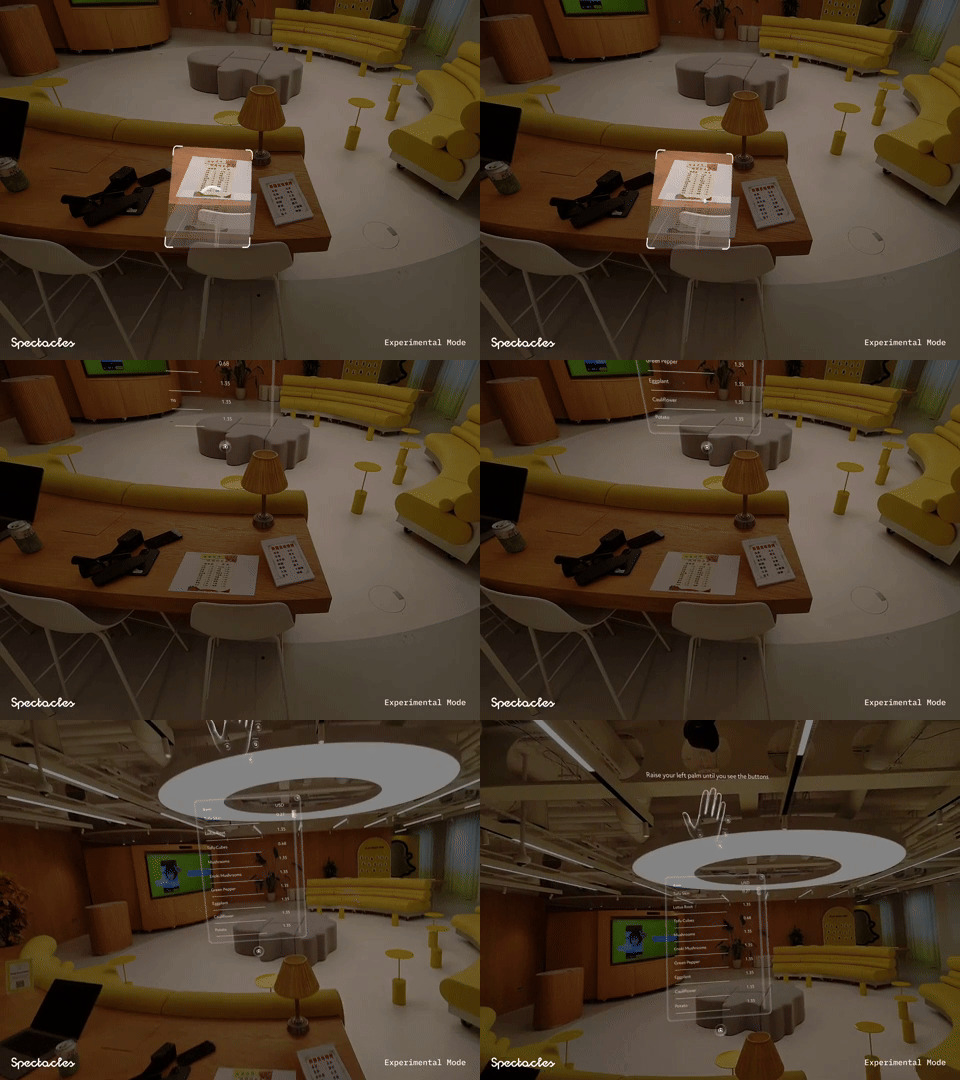
It’s the result of a multi-year experiment, and developers have been busy on early hardware. Rather than a small selection of XR apps alongside a bunch of phone apps blown up for the big screen, you’ve got 450k developers who’ve made over 5 million lenses.
And the experiences are a cut above the rest in terms of giving me the future I see for smart glasses — advanced tracking that is able to suspend content in free space without taking over your whole screen space. I’ve seen demos like labeling everything on a shelf, giving me a visual guide on how to to an ollie on a skateboard and more.
It’s unlike anything else you can try right now.
Where Snap Specs lose
- Design is rather bulky
- Field of view not as wide
- $2,195 is a steep price to pay

There’s a reason why out of all the photos I took of Snap Specs, this one of Evan’s ear struggling at the back went viral. Compared to previous developer hardware, you can see how hard the company’s worked to reduce the size and weight, but it’s clearly still a bulky pair of glasses.
Yes, Snap has designed around that — designed around the challenges of squishing that much tech into the stems of the specs themselves. But that makes a chunky aesthetic unavoidable. I kind of dig it, but can completely appreciate it’s not everyone’s cup of tea.

Then there’s the price of it all, which I get is a lower starting cost than the $10,000 to make Meta’s Project Orion (or $3,500 for Apple Vision Pro), but $2,195 in this economy is still a hefty number.
Where Xreal Aura win
- Lighter, more comfortable glasses
- Android XR brings a more VR headset-like experience to AR glasses
- Anticipating a cheaper price

The Auras answer the “future of spatial computing” question in a more traditional way — take some AR glasses, pack a puck full of compute power, and make a VR headset experience out of it.
Snapdragon Reality Elite does a lot of the driving here alongside the X1S spatial coprocessor and those world-facing cameras to track the free space around you and give you the Samsung Galaxy XR in tethered specs.

And what surprised me every time I’ve tried these is the critical difference moving from an isolating headset experience with a virtual see-through display to optical see-through can bring.
Tabletop gaming in Demeo feels more accurately merged with the world around you, Gemini Live feels like real-time advice in the real world rather than a camera-driven guide, and more. Throw in a 70-degree field of view for immersion and you’re off to a strong start.
Where Xreal Aura lose
- But will still be expensive
- Compute puck makes them awkward to use in public
- A different, more limited type of spatial computing

So like I said above, I’m anticipating these will be cheaper than the Snap Specs. However, just because something is cheaper doesn't mean it’ll be a good price.
I’d love for this to be sub-$1,000, but we’re not in that kind of universe for a while (hi, RAMageddon). I’m thinking it’ll be more like $1,300 or more.

That’s a tough pill to swallow — especially when you think about the use cases of these. Given they’re AR glasses with a puck, you won’t be wearing these out in any public situations outside of flights and public transport.
And of course there’s that difference in vision. Snap Specs wants to reinvent spatial computing, whereas Xreal Aura brings VR to a smaller device.
Outlook

Of course, this is way too early to call, as I’m basing this on the hands-on time I’ve had with both (for Snap Specs, I went eyes-on with the new glasses, and hands-on with Snap OS via the developer hardware). But it paints a clearer picture of what to expect from each.
I’d get the Xreal Auras if I was looking for a more traditional VR headset experience compressed down to something the size of AR glasses.

I can imagine this being a great experience on long haul flights or around home, but that compute puck does limit where you’re going to feel comfortable using it.
However, if you want to take a real big step into the future of spatial computing — AR infused with AI and a massive OS platform atop standalone specs, then Snap Specs is the way to go (provided you got deep pockets).

Follow Tom's Guide on Google News and add us as a preferred source to get our up-to-date news, analysis, and reviews in your feeds. Alternatively, you can read our content on the Tom's Guide app available now for iOS and Android. Subscribe to Tom's Guide on YouTube and follow us on TikTok. Finally, you can visit our dedicated Tom's Guide Savings Squad hub for expert help on getting the best products for less.
More from Tom's Guide
- '136 grams is not for all-day wearing' — Even Realities CTO sounds off on Snap Specs, and gives details on the future roadmap
- Best of AWE 2026: 7 top gadgets that show us the future of XR
- Tested: Xreal Aura DOES work with Nintendo Switch over USB-C — they won’t tell me how they did it, but I think Snapdragon Reality Elite and Android XR is the way