So there I was — Nvidia giving me a full breakdown of what DLSS 5 is and how it works, alongside a chance to play NBA 2K27 on multiple systems to show how it’s evolved from the controversial AI slop filter that divided opinions in the office to something much more refined.
I thought things were heading in the right direction. But then, modders extracted the leaked DLSS 5 files from 2K27 and stuffed it into unsupported games. The online reaction was immediate and fracturing: half praising the added detail while the other half declared it the AI-filtered destroyer of frame rates.
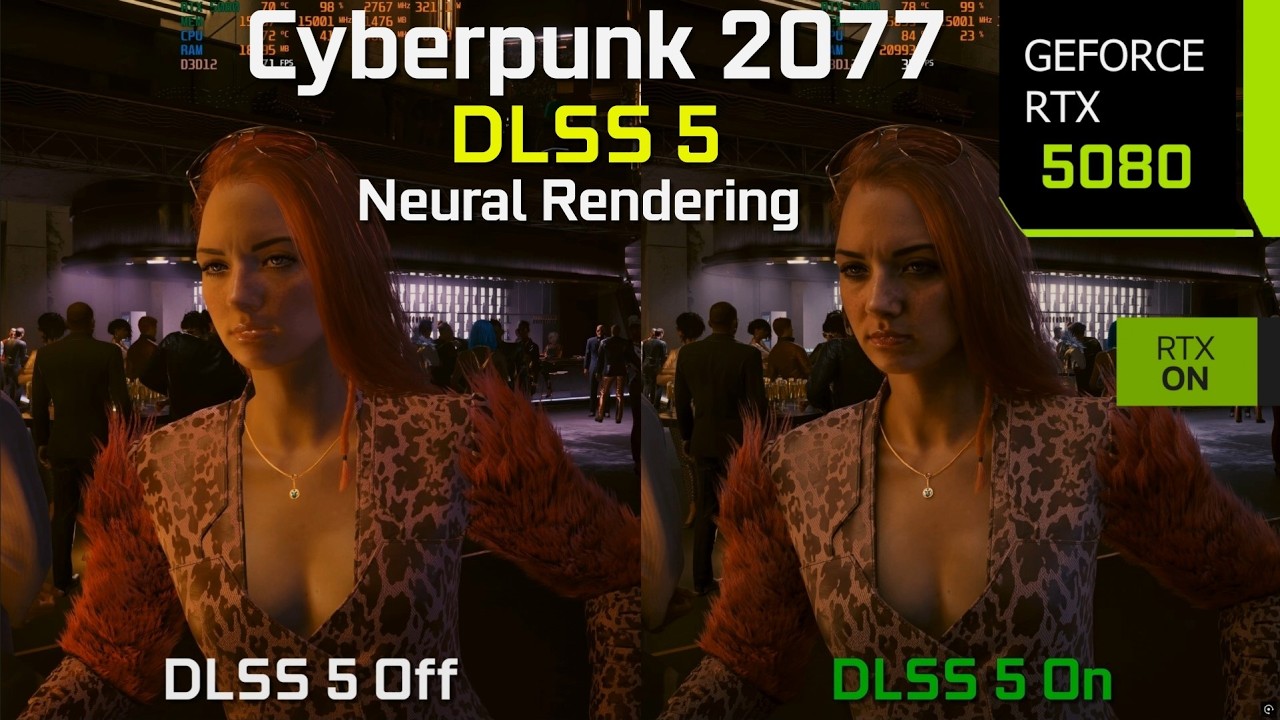
Now that the embargo has lifted and I can (finally) talk about DLSS 5 (coming September 3 to NBA 2K27 first), as someone who spent time with the official integration, these mods are missing the point. Brute forcing a neural rendering file into a game without engine-level hooks is like judging a luxury car after hot-wiring it with missing spark plugs.
The big question: is DLSS 5 just an AI filter?


So the answer, technically, is no. But there’s a lot to it. When you think about AI filters, they slap a 2D post-processing effect over a completed image. As I quickly learnt when talking to the team behind DLSS 5, this is so much more.
This is a 3D-guided neural rendering pipeline — ingesting all that vital 3D geometry data, such as surface normals, semantics of lighting, motion vectors and scene depth, to work within the physical rules of the game engine rather than hallucinating.

And with all that information, it does something Nvidia calls real-time determinism. Think of it like the neural equivalent of when a bar is full — the rendering queue has a one-in/one-out policy.

Unlike offline video gen models that process chunks of video and take a guess at what it’ll look like (probabilistically), DLSS 5 processes every single frame in real-time to maintain stability between each one (deterministically).


This means that instead of seeing somebody’s face change with every scene change in AI-generated video, the neural rendering on offer here doesn’t just imagine something new out of nowhere.
What’s new since we saw DLSS 5?
When the next generation DLSS was announced earlier this year, the reaction across Tom’s Guide’s gaming Slack channel was swift and severe. The AI beautification of characters felt weird, and Digital Foundry’s test was combed over to see how much of the lighting and atmosphere had changed for the worse.
Of course, this was an extremely early build, and a lot has changed since then. Nvidia was quick to tell me they should’ve communicated DLSS 5 better at GTC, and Team Green is laying everything out about this new upscaler to us.
It’s now a lot smaller (and more efficient)

You may remember old demos of this needing two RTX 5090s to run. Now, just a few months later, I’ve seen it run on a single desktop GPU, GeForce Now and even an RTX 5060 laptop.
You’ve got a choice of three models

Models A, B and C all do the same thing, but are trained in slightly different ways to provide different looks. Model A seems to be more contrasty with its lighting, Model C looks to brighten faces and objects more, and B lands right in the middle.
Structure and tone sliders

Developers have the tools to adjust details with sliders. These can be both from a high level dial that turns everything up and down to specific details separate of color tones and lighting.
Automasking

On top of that, masks for neural enhancement can be applied exclusively to specific character models without touching a single thing around them.
Put simply, Nvidia’s providing some very strong tools here, but ensuring artistic intent remains at the heart of how you work with them — rather than having them replace the artistry.
Performance reality check


If you were to look at the DLSS 5-injected modding over the weekend, it’d be fair to believe that frame rate takes a huge hit when doing this frame-by-frame neural rendering.
However, that’s not the experience I had across multiple tiers of systems playing the official DLSS 5 integration on NBA 2K27. Now, it’s worth noting that these demos I tried all had multi-frame generation turned on and ramped up too.
Frame counts were not turned on, so I can’t give you anything more numbers-wise than what Nvidia has given me here. But what I can confirm is gameplay felt silky smooth with no noticeable latency.


The RTX 5090 desktop rig was of course the star of the show, with frame rates so high that it completely saturated the refresh rate of the gaming monitor. And when played using GeForce Now, it looked like a flawless 120 FPS frame rate.
But the real star of the show to me is that RTX 5060 laptop. This goes to show the huge work Nvidia’s done to shrink DLSS 5 down and optimize it to run across the entire breadth of its GPUs, and the smoothness felt like it was around the 90-100 FPS mark in play.
How does it look?


Visuals-wise, in a game like this that is actively pursuing photorealistic quality in its graphics, DLSS 5 really sings. Whether its the massive improvement in facial textures and definition in hair, the deeper contrast in and more realistic lighting, and the upgrades made to the crowd watching too, everything comes together nicely here.
If this were to placed on a game that’s more artistically stylized, it would look weird (and you’re seeing that on some of the modded work). Nvidia themselves are clear in saying that developers can just choose not to use it if that is what developers are aiming for.


But in the case of NBA 2K27, the updates made to DLSS 5 since we last saw the super filtered looks from previous are really evident. The changes are more nuanced, and with the granular levels of control, they make a big positive difference to my eyes.
A specialized weapon
So let’s get down to brass tacks. DLSS 5 is built specifically to bridge the uncanny valley in photorealistic titles. It won’t make sense for cel-shared or heavily stylized indie games. But for sports sims, cinematic shooters and immersive open worlds, to my eyes and early impressions, this feels like a generational leap.
Of course, I want to test it more to be definitive about it, which is what I’ll absolutely do when it officially drops on September 3rd with NBA 2K27 across RTX 50-series systems and GeForce Now.
One thing is clear: this isn’t an AI filter — it’s the start of real-time neural rendering. I'm looking forward to seeing how it develops, and how the people will respond to it.

Follow Tom's Guide on Google News and add us as a preferred source to get our up-to-date news, analysis, and reviews in your feeds.
More from Tom's Guide
- I tested 6 RTX Spark laptops for gaming — and the winner completely shocked me
- As a PC snob, I wanted to catch GTA 6 making console compromises. Instead, I’m in awe of the trickery
- I tested NVIDIA’s new DLSS 4.5 Ray Reconstruction — it finally fixes path tracing’s biggest flaw, but here’s the reality check