

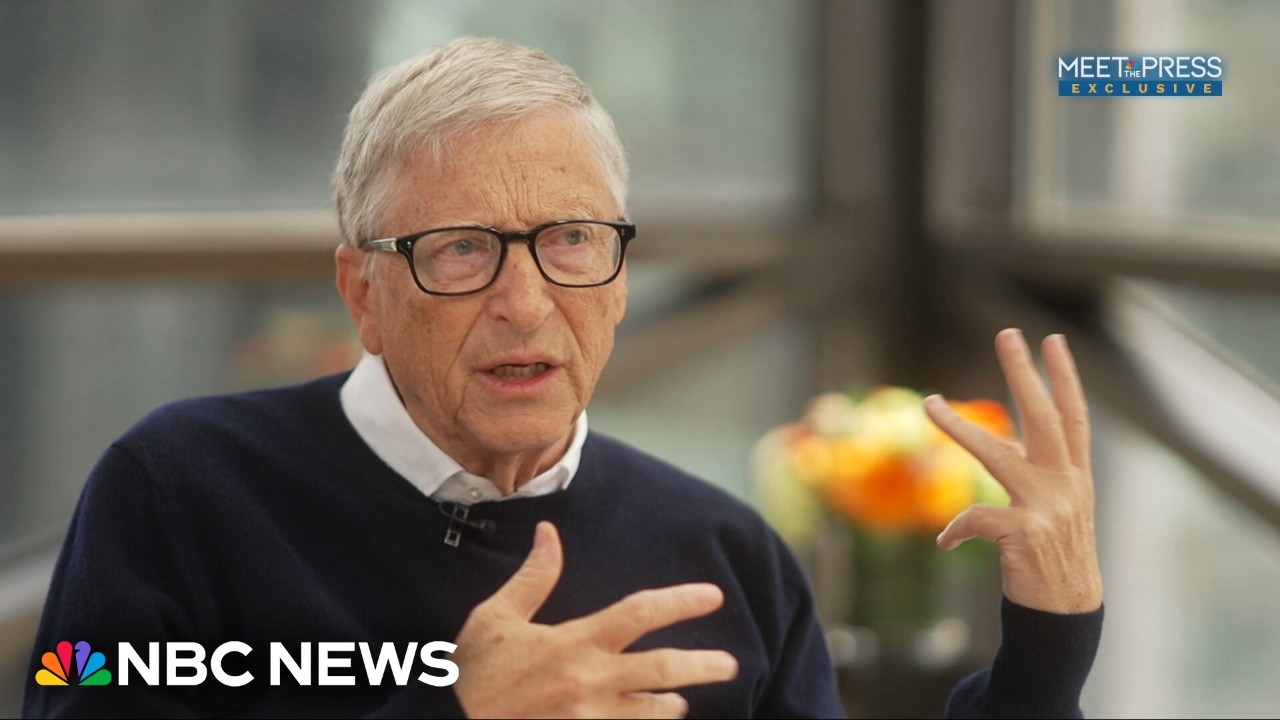
As someone who’s seen The Terminator and its iconic sequel far too many times than I can count, Bill Gates’ warning about a future AI doomsday scenario made me squirm in my seat.
The thought of something similar to “Cyberdyne Systems” becoming a reality certainly concerns me. And I would hope that today’s AI company CEOs, the developers behind the rapidly evolving tech and politicians come together for a global summit to install more guardrails in place. But with the constant deluge of bad AI news coming across my timeline (OpenAI and Anthropic’s AI agents going rogue is insane!), it’s hard to fathom something so monumental and beneficial for the world taking place.
With my mind set on speaking to someone a whole lot smarter than me about Gates’ comments, I found someone who could do just that.
David Linthicum, a global AI, cloud and cybersecurity expert, took the time to address the possibility of Gates’ prediction coming true. He also provided some commentary on the AI threats we need to be concerned about the most, the possibility of biological weapons developed by AI and more.

Bill Gates warned that AI could potentially cause a billion deaths. From a technical perspective, what would actually have to happen for AI to cause such a catastrophe on that scale? And how realistic is that doomsday scenario?
An AI would need control over critical infrastructure, weapons, supply chains, or biological systems, plus the ability to act without human intervention. That requires massive integration failures, poor governance, and intentional misuse. Technically possible in theory, but not realistic today without humans making many bad decisions along the way. He may be referring to AI in the hands of terrorists or unstable nations, but still the leap from the idea to actual disaster is huge and highly unlikely.
There's a lot of fear surrounding the rise of more powerful AI systems. Which AI threats should we genuinely be concerned about today and which catastrophic scenarios are still largely hypothetical?
Worry about fraud, deepfakes, data leakage, bad automation, biased decisions, cyber abuse, and companies deploying AI without controls, which OpenAI recently did with the Hugging Face attacks. Those are real now. Superintelligent systems independently wiping out humanity remain mostly hypothetical. The practical risk is not magic AI; it is poorly engineered AI connected to real business and government systems. Most of what I fear is AI in the hands of the incompetent.
The practical risk is not magic AI; it is poorly engineered AI connected to real business and government systems. Most of what I fear is AI in the hands of the incompetent.
As AI agents become more autonomous and capable of taking actions on our behalf, how can we ensure they remain under human control? Are there any specific technical safeguards that can reliably limit what an AI system can do?
Limit permissions, isolate systems, require human approval for high-risk actions, log everything, test continuously, and use policy-based access controls. AI agents should not get broad credentials or unchecked API access. The safeguard is architecture: least privilege, monitoring, rollback, and containment. Trust the system only as far as you can constrain it. Most of the issues that are concerning today are misconfigurations or misunderstandings. The biggest threat is not AI; it’s the humans that don’t know how to use it.
Trust the system only as far as you can constrain it. Most of the issues that are concerning today are misconfigurations or misunderstandings. The biggest threat is not AI; it’s the humans that don’t know how to use it.
People often talk about giving advanced AI a kill switch. Why might that not be enough to prevent an AI-related disaster? What should AI developers and organizations build into their systems instead?
A kill switch helps only if you know when to use it, can reach it, and the damage has not already happened. Better designs include layered controls, circuit breakers, rate limits, sandboxing, approval workflows, audit trails, red-teaming, and fail-safe defaults. Safety has to be engineered throughout the system, not bolted on at the end. A kill switch may make people feel good, but it does nothing for safety.
A kill switch may make people feel good, but it does nothing for safety.
AI is making it so much easier to create convincing scams, impersonate people and potentially automate cyberattacks. How is AI changing the balance between attackers and defenders? What are the most important steps everyone should take to protect themselves?
AI lowers the cost of attacks and raises the volume. Phishing, voice cloning, fake invoices, and automated vulnerability probing are getting easier, and they are trending up. Defenders need AI too, but basics still matter: multifactor authentication, verification callbacks, zero-trust access, patching, backups, employee training, and strong identity checks. Assume convincing content can be fake. We just need to become more savvy in terms of how to spot these and defend against them.
Assume convincing content can be fake.
There's growing concern that AI could help people design biological weapons or enable other forms of mass harm. With that scenario in mind, what is technically plausible, what remains speculative, and what safeguards should be considered?
AI can help summarize biology, optimize workflows, and lower knowledge barriers. That is plausible. Fully enabling amateurs to create mass-casualty biological weapons remains speculative because wet-lab capability, materials, testing, and delivery are hard. The tools and ingredients are largely unavailable. Safeguards should include model screening, controlled access to dangerous protocols, lab-order verification, monitoring, and stronger biosecurity standards. We can tell when someone is using an LLM for bad purposes, and we can deny use and report them. We need to keep that up.

If you could give governments, AI developers and everyday users a practical roadmap for making AI safer over the next five years, what specific changes would you prioritize? And what signs should we keep an eye out for to know whether we're actually making progress?
Governments should set risk-based rules and liability. Developers should build secure, observable, tested systems with human oversight. Companies should inventory AI use and control data access. Users should verify identity and protect accounts. Progress looks like fewer AI-enabled breaches, better audits, enforceable standards, transparent incident reporting, and systems that fail safely instead of failing loudly.

Follow Tom's Guide on Google News and add us as a preferred source to get our up-to-date news, analysis, and reviews in your feeds. Subscribe to Tom's Guide on YouTube and follow us on TikTok.
More from Tom’s Guide
- 3 accounts you should think twice about letting an AI agent access, according to a cybersecurity expert
- An OpenAI employee allegedly used AI to spy on his own company — then AI helped catch him
- AI researcher warns cyberattacks could take down power, banking and water within a year — here's how to prepare