The AI space is competitive. While companies like OpenAI and Anthropic have dominated, Microsoft is coming out swinging right now. With the yearly Microsoft Build event now wrapped up, we can officially say Microsoft is going all in on the next phase of AI: agents.
Agentic AI is a term you’ve likely heard thrown around a lot, and while it is often talked up with marketing buzzwords, the idea is fairly simple. Whilst AI of the past often worked in a Q&A format, answering your prompts with detailed explanations, agentic AI looks to skip the middleman and do your tasks for you.
It could find all of the best restaurants in your city, but then go the extra step and book a table for you. Or it could read through all of your financial documents and do your taxes for you, or even analyze data and create spreadsheets before sending them off to your colleagues.
In other words, agentic AI is less assistant and more fully fledged employee. While there have been concerns in the past with this kind of technology occasionally going rogue, major improvements are being made every week.
So with Build now wrapped up, here is everything you need to know about how Windows is adopting agentic AI like never before.
Scout and Autoagents
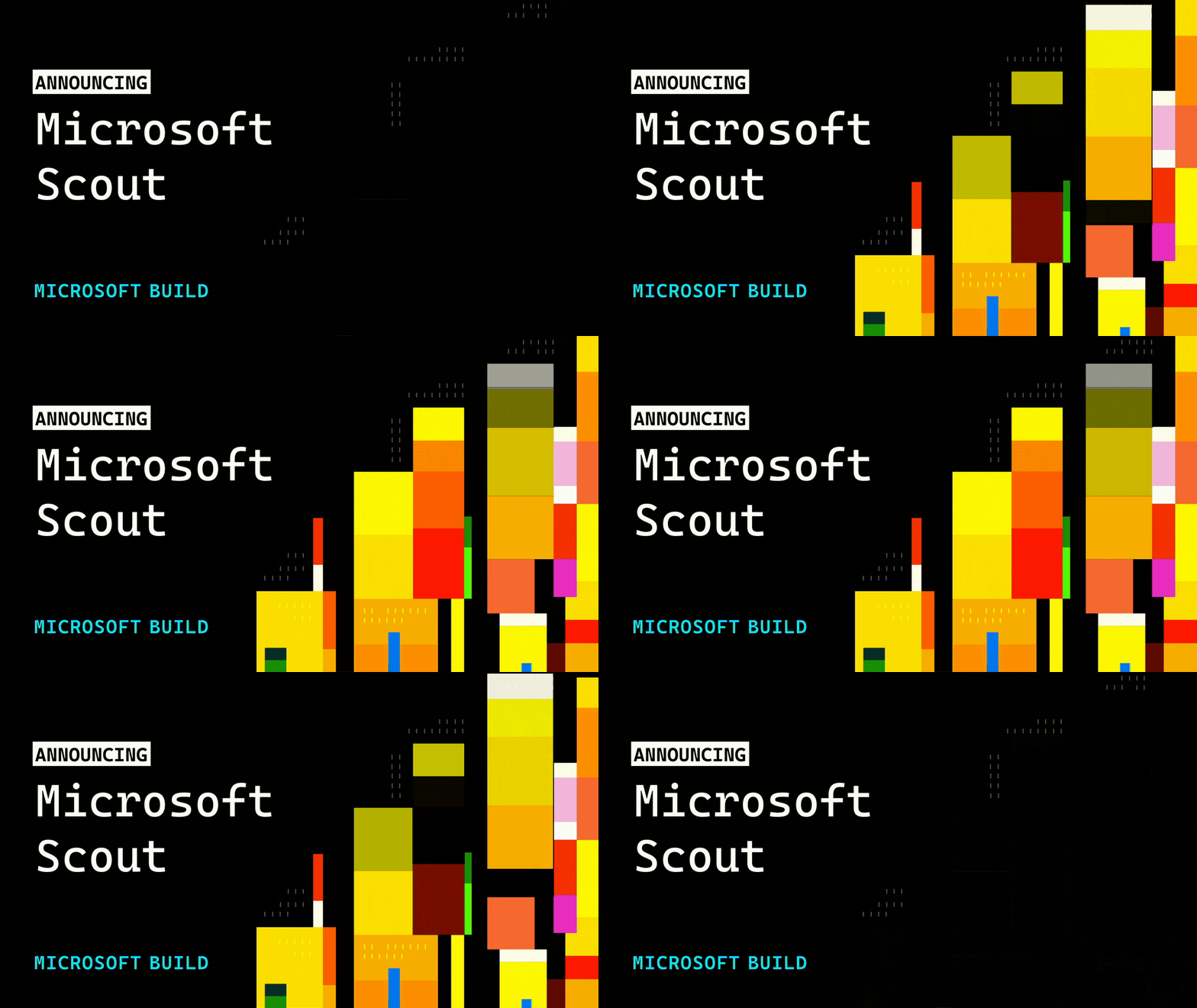
One of the more interesting announcements from Microsoft was what it called ‘autoagents’. These are AI agents that are always on, working autonomously in the background on your behalf.
The first of these to be revealed is Scout, the company’s first Autopilot agent. It will be available across the suite of Microsoft 365 apps, working in the background across your most-used Microsoft apps.
This includes Teams, Outlook, OneDrive and SharePoint, accessing your chats, email, calendar and more.
In some example demos of the tool, Microsoft showed Scout keeping an eye on a user’s inbox and Teams, looking for any outstanding decisions that need to be made. Microsoft has stated that the tool is powered by OpenClaw open-source technology.
While the details of Scout are still very sparse, the idea is clear. Scout will be able to do tasks like monitoring your emails to notify you of urgent responses, scan through documents sent by your colleagues to provide overviews and even block out time in your calendar for a task you keep putting off.
Over time, these autonomous agents will learn and develop. This could mean completing tasks before you even ask, knowing how you would respond to emails or becoming aware of your working patterns, adapting to your workflow.

For now, Scout is being rolled out to select users and Frontier organizations, but it will likely see a wider release in the near future. From the way that Microsoft has been teasing Scout, it also seems likely that this is only the first of its agentic models to be released.
If, like any reasonable person, you saw this and thought there is no way any company will allow it, Microsoft is way ahead of you. Scout has been designed to be safe for a work environment, and has even been tested at Microsoft beforehand.
Every agent operates under its own governed Entra identity, not a shared anonymous account. In other words, every single action is tracked and instantly identifiable. Not only that, but all data is redacted, stopping sensitive data from leaking.
Accountability is one thing, but it would be better to just avoid the mistakes entirely. Scout can only access resources that users give it access to. You can decide what actions need sign-off and where the agent can go.
In theory, you could avoid sensitive data entirely, or require the agent to check with you before it does anything that might concern you. Microsoft made it clear multiple times throughout the Build event that Scout is completely unable to bypass these rules.
This might all sound like the bare minimum, but it is a step that is surprisingly unheard of in the world of autonomous AI. Right now, this is a Microsoft exclusive concept, but expect the competition to follow in its footsteps here.
Safer AI agents
As we mentioned above, agentic AI hasn’t had the best track record for safety. Recently, a Claude-powered agent deleted a company’s entire production database in just nine seconds. So, obviously, safety is paramount here.
As part of this, Microsoft has announced Execution Containers. These are less intense than they sound. Simply, it’s a policy layer that lets developers declare what an agent can access. This can limit certain files or networks for an agent.
As part of this new layer, Microsoft’s defence tools will be integrated with any developed local agents. This includes Defender, Entra, Intune and Purview protections, allowing IT teams to adjust restrictions on agentic tools. While mistakes will still be possible, this will limit the damage, stopping AI from accidentally deleting your entire database.

This news will be especially exciting to fans of OpenClaw, the free and open-source AI agent that has been growing rapidly in popularity.
While many users have found success in using OpenClaw in their own lives, things get a bit more complicated when trying to use it for work. Giving it access to files and sensitive work documents is an idea that will make any HR manager crumble, which is why Execution Containers will work so well with it.
In theory, this could allow OpenClaw to help at the office, while being given a very strict set of parameters. Think of it a bit like giving a child training wheels, but in this instance, you’re putting the training wheels on a highly intelligent and expensive AI software.
In a busy market, Microsoft seems to be trying to position itself as the safe name in autonomous AI agents. This could be a big payoff if it works successfully. While far-reaching and impressive abilities are great, they mean nothing if the AI tool randomly deletes your entire company on a whim.
Based on the traditional models of AI, it would be no surprise to see Microsoft later release multiple agents, all with different abilities. As this safety advances, a highly specialised model, focused on safety above all else, will especially appeal to companies that want to try agentic AI, but need to adhere to certain levels of security.
Microsoft Discovery

Another of Microsoft’s announcements at Build was Discovery. While it could arguably be one of the biggest gamechangers from Microsoft, it is also likely to be the one that affects you the least.
That’s because Discovery is all about breakthroughs in science and engineering. Officially announced at last year’s build event, Discovery is a tool for scientists to blend in with their own tools. Highly flexible, Microsoft wants this to be the AI tool that is winning Nobel prizes and curing diseases.
In its initial announcement at last year’s event, Discovery was only available to a select list, including some of the biggest companies in science and development. This year, it was announced that the tool would be available for all organizations.
Along with widening its availability, Microsoft has also released the Discovery app. This is designed more like a chatbot, allowing researchers to get the full benefits of the tool without needing to learn how to use advanced AI.
While AI has long had a place in science, rarely are the tools as accessible as this. Microsoft put a lot of focus on real-life case studies of researchers using Discovery, shouting out how useful it will be.
Making vibe coding smarter with Rayfin
Much of the agentic announcements at Build are surprisingly consumer friendly, or at least focused on improving productivity for the average company. For the not so technologically minded, this next update won’t be as exciting to hear.
Announced at Build, Rayfin is Microsoft’s answer to the final hurdle of vibe coding. AI allows yo to make your own app, website or digital tool from scratch, but the aftermath is still a pain.
Rayfin lets users and coding agents define backends entirely in code and deploy them directly to Microsoft Fabric. In other words, you can make a tool that arrives already security compliant and fully integrated without the need for configuration.
If all that sounds rather dull to you, think of it this way. With vibe coding, anyone can now build a company, including a website, app and inventory dashboard in hours. With this update, AI will go a step further: building a security system, database and all of the more confusing backend parts that require tech savviness.
Of course, like vibe coding, this will probably take some time before it is actually an effective tool to use, but it could soon make starting your own company quicker, cheaper, and much easier.
What does this all mean?
With Microsoft's Build now wrapped up, Microsoft has laid down its cards, showing its plan for agentic AI, many of which will manifest across Windows and the company's software products.
Clearly, Microsoft wants two things: it wants to be safe and it wants to focus on workplace AI. These are two areas Microsoft has thrived in the past, and clearly this is the best choice for the company.
The biggest concern that is frequently voiced with this technology is safety. Agentic AI needs freedom to perform, but this is where it tends to also cause some pretty big issues.
While it is still too early to tell, this era of Microsoft could be exactly what agentic AI needed to finally step up.

Follow Tom's Guide on Google News and add us as a preferred source to get our up-to-date news, analysis, and reviews in your feeds. Subscribe to Tom's Guide on YouTube and follow us on TikTok.
More from Tom’s Guide