




If you're looking for the best Samsung TVs, it might be because you've already owned a model and like the design, the remote or the software and want to stick in the brand's universe, or because you've heard they make some of the best TVs.
Fortunately, you have a lot of choice. Almost too much, in fact. Which is why I've narrowed it down to just three options for you, including the Samsung S90F, which I recommend as the best Samsung TV for most people right now.
We knew it was a fantastic TV from the moment we tested it, but as last year's model, the price has also dropped, making it even better value. But if you want to keep the cost down more, the best budget Samsung TV worth your money is the Samsung S90D, 2024's version of the same TV which is upgradeable to the latest software too.
The best Samsung TVs you can buy right now
Why you can trust Tom's Guide Our writers and editors spend hours analyzing and reviewing products, services, and apps to help find what's best for you. Find out more about how we test, analyze, and rate.
Best Samsung TV overall


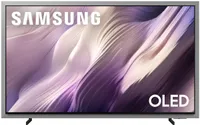
The Samsung S90F isn't the brand's flagship TV and it's last year's model, but I rate it as the best Samsung TV for most people right now as it is one of the most incredible value TVs in the lineup, expertly balancing performance and price to make a TV that can handle almost anything you throw at it without draining your bank balance.
By almost every metric, the S90F is a fantastic TV, but during testing it was the way it handled contrast that really set it apart from others in Samsung's range. Whether we were watching "The Batman," "Superman" or "The Terminal List: Dark Wolf," every scene looked bright and vibrant, and you could pick out details in the dark too.
These are the same reasons I ranked the Samsung S90F as the best gaming TV, along with Samsung's dedicated Gaming Hub, which is a...hub for all your consoles plugged in on one of the TV's HDMI 2.1 ports. It remembers what you've been playing, and if you dive back in from the hub menu, the TV automatically activates its gaming mode.
The reason I said it was a fantastic TV by almost every metric is that it's not actually the brightest in the range. The more expensive Samsung S95F is twice as bright, which can be useful in some rooms, but we found that the real world performance of the S90F was bright enough that there were only brief moments of glare.
The main downside to the S90F is that you take part in the panel lottery, where the performance of the TV changes depending on which size you buy. We tested the 65-inch model, which uses the quantum dot panel. These absorb some of the backlight and re-emit it as red and green light to improve the contrast and vibrancy.
If you opt for one of the 42, 48, or 83-inch models, the brightness isn't quite as good as those three use a WOLED panel in place of the quantum dot OLED panel. While there are some technical differences between WOLED and QD-OLED displays, the upshot is that the 42, 48 and 83-inch TVs aren't as bright as the others.
- Read our full Samsung S90F OLED TV review
Best budget Samsung TV

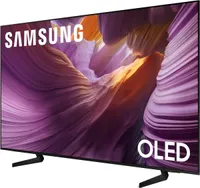
Samsung makes some incredible TVs, but they're usually pretty expensive. Equally the brand does have some more affordable models, but they're often not very good. So, instead of recommending one of those, I'd point you in the direction of 2024's Samsung S90D, an older OLED TV with great performance that's now even cheaper.
Most TVs launch at eye-watering prices and then drop once a new model is out. The S90D has gone through that cycle twice, bringing it down to almost a third of a its original retail price. But that's not the only reason I think it's the best budget Samsung TV right now; it's bright, colorful and revels in the deepest blacks too.
In fact, this was one of the highlights while testing the S90D. Lots of recent films and TV shows exist in shadowy and dark spaces, and we were impressed with how the TV handled these scenes in shows like "The Penguin" and "Star Wars: Skelton Crew," which looked particularly jaw-dropping, especially the show's second episode.
We tested the 65-inch version of the S90D which uses quantum dots to make the colors pop even more than they usually would on an OLED TV. It was really evident how much of a difference this makes when we watched the anime "Delicious in Dungeon," where the animated food looked so vibrant you could almost smell it.
While the S90D ranges from 42 inches up to 83 inches, there's a slight snag in how Samsung approached the sizes. In North America, only the 55, 65 and 77-inch models use the quantum dot OLED panel, while the 42, 48 and 83-inch versions use WOLED panels, which aren't as bright or colorful.
I can't vouch for the performance of the WOLED versions, as we haven't tried those, but if you're worried about how those sets perform, I'd recommend checking out the Samsung S85F. It has similar performance at a slightly higher price, but also doesn't suffer from the size-based panel lottery you get with the S90D.
- Read our full Samsung S90D review
Best Samsung TV for bright rooms

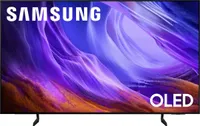
You might be wondering why I'm again recommending an older version of a TV with the Samsung S95F. We've even tested the 2026 S95H, and thought it was fantastic, but I'd still pick the S95F right now. It's an incredible TV in its own right, but it's also $800 cheaper than the new model, and almost matches its performance.
Our lab tests showed that the S95H is about 25% brighter, but has slightly higher input lag and lower color accuracy. Even though the 2026 model is brighter, the S95F isn't going to struggle in a light-drenched room, as it's twice as bright as the S90F, which is also easily bright enough for most rooms.
So while the S95H is technically a better TV metrics-wise, it's not worth the extra money when the S95F was already an exceptional set. We watched a huge range of films, including "The Fall Guy" from 2024, and 1959's "Rio Bravo," and everything looked incredible, with vibrant colors and depth in the blacks so you could pick out details.
This was especially true while watching Stanley Kubrick's "2001: A Space Odyssey," where we could pick out all the individual stars set against the infinite black of space. And that depth of black really highlighted the bold colors in the scene, like the bright, glowing blue/green of planet Earth.
There's an AI mode picture setting, which we thought was effective, but didn't enjoy using. The feature guides you through all sorts of tweaks, which can really make the image you see on screen pop, but it means you can significantly deviate from the creator's vision. Whether this worries you is likely a matter of preference and outlook.
Like the S90F and S90D, there's some panel lottery going on with the S95F, but only on the 83-inch model. The other sizes use quantum dots, but the largest edition has a WOLED panel. In theory, that'd make it not as bright or colorful, but we actually tested it alongside the 77-inch model and didn't notice any difference to our eye.
- Read our full Samsung S95F review
Also tested
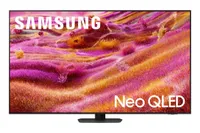
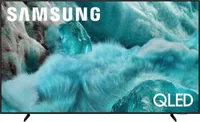
How we test the best Samsung TVs
The way we test the best Samsung TVs is the same as how we test TVs generally — we use them. Okay, it's a bit more complicated than that, in case you think our job is to just sit back and watch TV all day (what a life that'd be, right?).
Once we earmark a Samsung set for review, it gets delivered to our testing lab. Manufacturers make a lot of claims about their latest devices, so we like to actually check whether the specs hold up in real life or if they're in 'optimal conditions' only.
We use industry-grade equipment to measure the TV's brightness, input lag, color accuracy, contrast and other performance metrics. Partly this is to check the brand's claims, but it's mostly to make our recommendations more consistent and objective.
It means we can more readily compare an upgraded model against it's older sibling to see what's changed and make recommendations for specific use cases, like the best TVs for gaming or the best budget TVs to get the most for your money.
Once all the data is safely tucked into our spreadsheets, it's time for the more subjective tests where we do, in fact, get to watch TV. Our reviewers use media they know well to make it easier to highlight the performance of the specific test set.
This lets them take a critical eye to the performance in a real world setting. After all, metrics are great, but only paint one part of the picture. You can't tell if an anti-glare coating is actually going to work in direct light until you actually try it.
How to choose the best Samsung TVs
The first step to choosing the best Samsung TV is to decide if you really want a Samsung TV.
I'm not here to dissuade you from buying a Samsung TV, but before you go too far in your research, you want to be sure that is really what you want. As good as Samsung's sets are, they do carry a premium, so I don't want you to spend more than you need to.
Once you're settled on a Samsung-branded TV, the process is quite a lot like choosing any TV. You need to work out your budget and make decisions based on how you plan to use the TV and in what spaces. You'll need different things if you want your new TV in a bright living room or a darker bedroom for nighttime viewing.
There was a time when Samsung stepped away from OLED TVs, preferring to focus on Mini-LED sets instead. These are brighter and usually cheaper, but OLEDs excel at color accuracy, vibrancy and handling of deeper shades of black. Most of the Samsung TVs we recommend are OLEDs, but it's worth focusing on what you need.
If you watch shadowy films, TV shows, or pretty much anything by director Christopher Nolan, you'll need a set that can handle all the deep blacks so you can pick out details in the darkness. For casual viewing or to keep costs down, you can pick up a Mini-LED set, or choose one with quantum for a mix of OLED and Mini-LED performance.
Samsung also produces the best 8K TV, the QN990F, but I don't recommend buying that as nothing is filmed in 8K, and it is immensely expensive. Though the option is there if you need it. Ultimately, the goal is to pay for only the features you need, and don't worry about whether the set is a flagship model.

