There's a lot that goes into choosing a golf simulator. You need to pick where the launch monitor will sit, which model you want, the enclosure, the impact screen, the projector and more. And those purchases will set you back thousands of dollars — in my case, my golf simulator setup costs just under $10,000.
But with all those purchases, one of the cheaper things you'll buy might be the most important — the little hitting strip that goes into your mat. This is where you'll hit the ball, and the feel of different strip materials completely changes the way your club interacts with the turf.
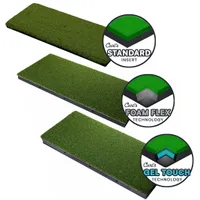
I tested three different materials from Carl's Place to see which is right for me, and something I thought was a trivial detail of building my simulator ended up completely changing the way I practice and how well I hit my woods, irons and wedges.
The different types of hitting strips

There are three primary hitting strip materials, and each has its own benefits and drawbacks.
I asked Carl Markestad, Founder and President of Carl’s Place, about choosing a hitting strip. "When selecting the right hitting strip, [it's] one of the most critical and often overlooked parts of the simulator buying process," he said. "It’s important to think about the type of feel you want, whether that’s forgiveness, realism or something in the middle. You also need to consider who will be using it, because the right choice can make a real difference in joint comfort and how long someone can practice in a single session."
For Carl's Place models, which I used with the Carl's HotShot Golf Mat System, the most affordable is the Standard model at $79. It offers a mix of softness to help keep your joints from taking too much impact and firmness to properly punish chunked shots.
The next model is Foam, and it's all about providing more softness that won't punish your body on missed shots and chunks. The foam material is designed for longer practice sessions, playing around with family and inexperienced golfers and entertainment-focused setups. Anyone who's worried about overtraining. If you're dealing with injuries or other chronic conditions, you will benefit from this strip.
The foam mat costs quite a bit more than the Standard at $229. Of course, in the grand scheme of what you'll spend on a golf simulator, the extra money is pretty negligible.
When selecting the right hitting strip, one of the most critical and often overlooked parts of the simulator buying process, it’s important to think about the type of feel you want
Carl Markestad, Founder and President of Carl’s Place
Finally, we have the most expensive golf mat of the bunch, and it's the most realistic. It sells for $279, but it offers the benefit of a closer feel to real turf and will punish chunked shots, just like on the course.
The drawbacks here are that this realism does a number on your joints. It's also a bit less durable if you're known to chunk the ball often, since the gel material will wear out. At least, that's what Carl's Place says. I've been using mine daily for more than eight months, and it hasn't shown a bit of wear.
If you really need to work on consistent ball-first contact, this mat will suit your needs.
At the end of the day, personal preference is important. "There’s no one-size-fits-all when it comes to hitting strips, and that’s exactly why we developed multiple options. Some golfers want maximum forgiveness to save their joints, others want that true fairway interaction, and some prefer a more traditional, feedback-driven feel. Understanding those differences is key to getting the most out of your simulator," said Markestad.
Which leads me to the one I ultimately like best.
Which one am I choosing?

For me, the answer is a no-brainer: I love the gel mat, and it's helped me improve my ball striking faster than anything else in my golf simulator setup. I'm relatively young and healthy at 39, so the extra impact on the joints isn't a significant drawback for me at this time.
Will it be eventually? Almost certainly, but as someone who's only been golfing for around four years, the ability to closely simulate the real thing is priceless.
I do like the standard mat primarily because it's so affordable and feels relatively authentic.
For my needs, I don't like hitting off the foam mat. The idea that I'm making practice "easier" on my body at the expense of realism isn't for me, but I think it's incredible that the mat exists for those who need the extra softness on their joints.
Sure, it costs more, but for me, there's nothing better than practicing with conditions that feel as close to real as possible. And it really has translated to my on-course game. Between PathPal helping me fix my slice and the hitting strip improving my ball striking, I'll be well on my way to breaking 80 this year, and I couldn't be more excited about where my golf game is heading, even after taking it up so late in life.


Follow Tom's Guide on Google News and add us as a preferred source to get our up-to-date news, analysis, and reviews in your feeds. Subscribe to Tom's Guide on YouTube and follow us on TikTok.
More from Tom's Guide
- You haven't used a golf launch monitor until you've tried Foresight GC3 — here's my thoughts after 6 months of testing
- I replaced my TV with a 4K projector — and it was the best thing for my golf swing
- 'I noticed how much farther and straighter it was flying': PGA Tour pro Ben Griffin on playing a cheaper golf ball at The Masters