Owning one of the best action cameras is crucial if you want to capture your daring exploits. After all, you probably can't take your $2,500 mirrorless camera diving with sharks, and I doubt many people would want to use their brand new iPhone to film themselves diving off a cliff into the ocean.
You need a specialized camera to keep up with specialized activities, and that's where action cameras come in. The best action cameras pack beautiful 4K, 5.3K and even 8K footage that's worthy not just of YouTube, but television screens. They're also rugged, meaning they can stand up to the abuse of the elements, and should pack excellent battery life so that you can film your entire adventure. Of course, they also need to be compact enough to mount anywhere, whether it's the peak of your cap or the handlebars of your motorcycle.
They aren't just for daring doers though: action cameras are also perfect for vloggers and content creators, and many of the best action cameras come with those users also in mind. Take our favorite action camera, for example, the DJI Osmo Action 5 Pro, which can hook up wirelessly with DJI's vlogging microphones.
After testing dozens of models all the latest and greatest cameras, I know which ones are worth your money. Read on for my pick of the best action cameras you can buy.

Pete heads up Tom's Guides cameras coverage, as well as leading the site's reviews team. Pete is Tom's Guide's main action camera tester, and goes hands on with every action camera release, from budget cams all the way up to flagship models from GoPro, DJI and Insta360. As reviews editor, Pete is a highly experienced tester, and puts action cameras through their paces, testing them in a variety of settings to evaluate their features. Pete's favorite action camera right now is the DJI Osmo Action 5 Pro. He says: "DJI has really knocked it out the park with this one, packing loads of pro features and fixing many of the Osmo Action 4's issues while undercutting the GoPro Hero13 Black by $50!"
The best action cameras in 2026
Why you can trust Tom's Guide Our writers and editors spend hours analyzing and reviewing products, services, and apps to help find what's best for you. Find out more about how we test, analyze, and rate.
Here are my picks of the best action cameras you can buy. Each one of these cameras has been thoroughly tested by us, and you can find the links to our full reviews after each entry. That means you can rest assured all of these action cameras come with the Tom's Guide stamp of approval.
The best action camera overall

The DJI Osmo Action 6 makes me feel kinda bad for other action cameras, as it has them all beat in pretty much every single regard. Its maximum resolution has been stepped up to 8K from 4K in its predecessor, the Osmo Action 5 Pro (OA5 Pro). That'll give people who edit their footage more space with cropping in post, while maintaining the ability to export in full 4K.
It has joint-best-in-class waterproofing (the other being the OA5 Pro) at 65 feet, best-in-class battery life at 120 minutes (in my testing) at 4K/60fps or 93 minutes at 8K/30fps — that 93-minute 8K figure is longer than either the GoPro Hero13 Black or Insta360 Ace Pro 2 can shoot at 4K.
The OA6 also packs effortlessly smooth stabilization; strong low light performance thanks to its (comparatively large) 1.1-inch sensor; strong internal audio (the best of any DJI camera yet); plus the usual DJI ecosystem compatibility. If you own other DJI gear, like the OA5 Pro, DJI Osmo 360 or DJI Nano, you can share mounts, while the OA5 Pro and Osmo 360 also share the OA6's fantastic 1,950mAh batteries. And of course, you can hook up wirelessly to DJI mics with complete ease.
Given all the above, footage looks and sounds fantastic. But DJI didn't stop there. To match the GoPro Hero13, DJI fitted the OA6 with an interchangeable lens mount so you can swap to either a macro or ultra wide lens and get creative with your footage. And there are now color filters for in-camer grading, plus the usual D-Log M for high dynamic range capture.
Best of all? The OA6 launched only $20 pricier than its predecessor, and still undercuts GoPro by a decent margin. The only issue U.S. customers may have is that DJI doesn't currently support its camera first party in the States. You can buy it from third party retailers, but you'll lack DJI support if anything goes wrong. Take it from a long-time DJI user, though, that things very rarely go wrong.
Find out more in my full DJI Osmo Action 6 review.
The best value for money action camera

The DJI Osmo Action 5 Pro has been succeeded by the Osmo Action 6 above, but I think the older model is probably the best value for money camera right now. Simply put, the OA6 launch has pushed prices of the OA5 Pro down. If you don't need 8K, the OA5 Pro offers many of the same features as the OA6 but at a lower price (and with first party DJI support in the U.S.)
The OA5 Pro shoots 4K at up to 120fps. The GoPro Hero13 Black's 5.3K max res, and OA6 / Insta360 Ace Pro's 8K are useful if you need to crop video and maintain 4K, or if you're going to output oversampled 4K in post for marginally sharper footage — something most casual users won't need to do. But if you're just a casual video shooter or a content creator, 4K should be fine, maning this camera pips the GoPro to the post and will save you some money over the OA6.
It isn't all about resolutions though. I put the OA5 Pro through its paces during testing and was mightily impressed with the performance. DJI has fixed the issues that held the Osmo Action 4 back: stabilization is improved thanks to an upgraded imaging sensor which allows for faster shutter speeds; and the janky DJI Mimo smartphone app has had some polish applied to bring it up to spec.
Meanwhile, the camera has loads of genuinely useful features, especially for content creators, including bright OLED displays, subject detection AF for vlogging, and 47GB of internal storage for over an hour of 4K without a microSD card — none of which the Hero13 Black has. There's now HDR HLG and SDR Log recording to maximise dynamic range capture, too. The OA5 Pro offers the same 65 feet / 20 meter waterproofing as the OA6, plus the same 1,950mAh battery resulting in 112 minutes of 4K/60p in my testing. That's double the waterproof rating and over 30 minutes more recording time than the GoPro Hero13 Black.
And of course, being a DJI product, the OA5 Pro benefits from DJI's best-in-class internal audio capture, plus wireless hookup with the fantastic DJI Mic 2 microphone — already a very popular mic with content creators.
What didn't I like in testing? Pro shooters might want the extra res of rivals and, well, that's really about it. Given you can now buy this camera below the original MSRP, it's fantastic value for money.
Find out more in my full DJI Osmo Action 5 Pro review.
The best action camera for pros

Despite the launch of the phenomenal DJI Osmo Action 6, I think the GoPro Hero13 Black is still the best action camera for professionals and serious shooters for a few reasons. Firstly, there's the 5.3K maximum resolution, which is higher than the Osmo Action 5 Pro's 4K (although lower than the OA6's 8K). This will allow you to oversample footage in post for sharper 4K. Naturally, as this is a GoPro, the Hero13 Black also brings fantastic image quality straight out of the box.
Secondly, there are the Hero13 Black's Lens Mods. The OA6 also has these but, importantly, GoPro gives you one that DJI doesn't (at the time of writing): an anamorphic mod for cinematic widescreen video at native resolutions. As with the OA6, the Hero13 Black also sports HDR HLG and SDR Log profiles for wider dynamic range capture in HDR and SDR, plus 10-bit color.
The Hero13 Black supports GoPro Labs, which allows users to run custom open source firmware that tailors the camera to their specific needs. In general, then, the support for professionals that GoPro provides is still class-leading.
In testing, I absolutely loved how well the Hero13 Black footage looked. DJI has caught up now in regards to stabilization, but the GoPro still performs in exemplary fashion. I really enjoyed using the GoPro's awesome long-exposure modes to shoot time-lapse and light-trail content. There's also the GoPro Quik app to consider, which is a solid performer, if not quite as innovative or feature-packed as Insta360's smartphone app. The Hero13 Black also finally sees magnetic mounting coming to the GoPro lineup, which has been sorely missed for a while now given rivals have been implementing similar systems for some time.
There are a few areas where the Hero13 Black disappoints versus the competition. Its battery life is weaker than the OA6 and OA5 Pro, as is its waterproofing. The Hero13 Black's LED displays are smaller and lower-res than DJI OLED screens, and the menu feels more cluttered. Then there's the price — GoPros are still more expensive than DJI cameras, although if you need the pro features, it's worth the investment.
- Find out more in my full GoPro Hero13 Black review
The best small action camera

If you're after something small, you can't really beat the Insta360 Go 3S — a tiny, thumb-sized action camera that builds upon the great reputation of its predecessor, the Go 3. This action camera is perfect for people who want an unobtrusive camera to capture beautiful 4K footage. It's ideal for casual shooters who are trekking, cycling or playing sports, as it'll sit easily on a cap peak or attach effortlessly to your shorts without sagging (that's how light it is). Its size and loop-recording mode also make it ideal if you want an action cam that can double as a dashcam.
I tested the Go 3S extensively, and its older sibling, the original Go 3, and loved them both — although the Go 3S comes out easily on top. The Go 3S offers up to 4K video at 30fps, as well as FreeFrame video, where you can change the aspect ratio of your footage after shooting. This is a step up over the original Go 3, which could only shoot up to 2.7K (or 1440p in FreeFrame mode). It's water-resistant down to 33 feet without its Action Pod (which is only splash-proof), and small enough to take pretty much everywhere. What's more, Insta360 offers a range of awesome accessories to allow you to use the tiny Go 3S in pretty much any scenario you can imagine. It's truly designed to go on any adventure with you.
Thanks to the Action Pod, the Go 3 is a bona fide vlogging tool — featuring a flip-up screen and up to 120 minutes of battery life at 4K.
However, the size of the Go 3S means some sacrifices have had to be made. There's no removable storage and no external microphone support. As such, if you're looking to shoot professional-grade video, you'd be better off looking at the DJI Osmo Action 5 Pro, which costs a similar amount of money at the expense of size.
- Find out more in my full Insta360 Go 3S review
The best older GoPro
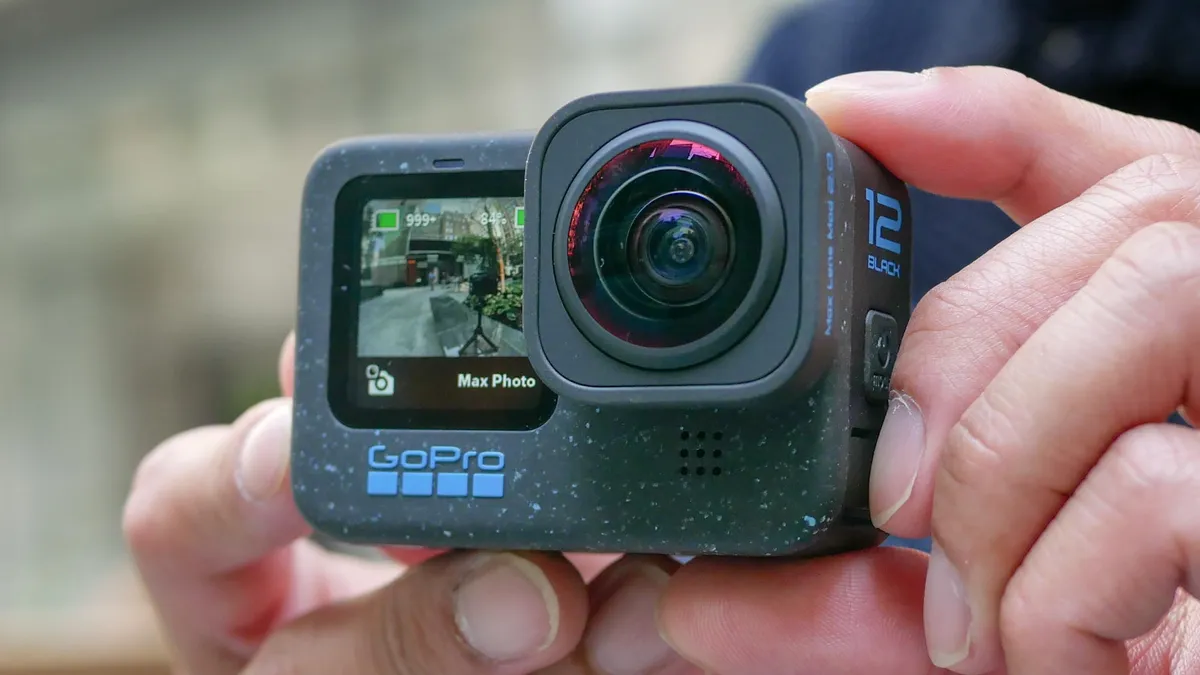
With the launch of the Hero13 Black, the outgoing GoPro Hero12 Black becomes the best older GoPro, even though it was only launched in 2023. Thanks to the new model, though, you can now pick up a Hero13 Black for well under $300, making this a real steal. That's because the Hero13 Black is essentially the same camera, using the same sensor, the same stabilization system, and essentially the same body, except for a minor facelift around the front screen. That means you still get 5.3K/60p video, HyperSmooth 6.0 and GoPro's generally outstanding video performance, all for way less than the Hero13 Black.
The Hero12 Black also utilizes the same battery and shell as many older GoPros, like the Hero10 Black. While certain accessories will fit the new GoPro Hero13 Black, some won't, so if you're upgrading from an older model, this is the one to go for.
In our testing, we loved the Hero12 Black's phenomenal image quality and stabilization — de rigueur for GoPro. We also loved the minor updates over the prior model, the Hero11 Black, including 5.3K/60p versus 5.3K/30p, and the introduction of Bluetooth headphone support for audio recording.
Water resistance is the same as the new Hero13 Black at 33ft (10m), as are the screens and dimensions. The only things you're missing out on over the newer model are the magnetic mounting system, new Lens Mods and some pro features like HDR HLG recording. This is still a totally relevant action camera, with plenty of support from GoPro for years to come in regards to firmware and accessories. So, if you want a GoPro but want to save some cash, this is where your money should go.
- Find out more in our full GoPro Hero12 Black review
The best budget action camera

With the release of the Osmo Action 5 Pro and now the Osmo Action 6, the DJI Osmo Action 4 is my pick of the best budget action cameras thanks to prices dropping. You can now pick up an Osmo Action 4 for under $200 at the right times. The OA5 Pro offers more features than the OA4, and the price gap between them has dropped, so I think the OA5 Pro is better value for money. However, if budget is your primary concern and you want beautiful 4K video, this is the action camera to opt for.
I tested the Osmo Action 4 thoroughly when it launched, and absolutely loved its beautiful image quality, not to mention its surprisingly strong internal audio quality. This camera can also be hooked up wirelessly to DJI microphones, making it a great choice for content creators who want to avoid lots of cables or are already invested in DJI gear.
While its waterproofing isn't quite as good as the OA5 Pro and OA6, the Osmo Action 4 is still rated down to 59 feet, which beats everything else from GoPro and Insta360, making it great for rugged adventures in challenging conditions. If you edit your footage in post, the OA4 also offers D-Log recording for wide dynamic range capture, and there's 120fps recording for slow motion footage too.
In testing, I wasn't so keen on the stabilization, which performed a little worse than GoPro and Insta360 cameras, resulting in some shaky footage. If you're a serious shooter, you might also be put off by the max res of 4K, as this means you can't oversample 4K footage in post as you can with the 5.3K GoPro cameras. All in all, though, this is a lot of camera for your money, and the price is only going to drop further.
- Find out more in my full DJI Osmo Action 4 review
The best 360 camera

The Insta360 X5 was a camera the Chinese action cam manufacturer Insta360 didn't need to make. See, the X4 was already the best 360 camera out there and it wasn't even a close contest. No other camera could reframe in 4K as is possible with the X5 and older X4, and that's thanks to the 8K/30p capabilities of both.
I spent a good chunk of time putting the X5 through its paces, and believe me, it doesn't disappoint. There's the 8K maximum 360 resolution, which allows you to reframe in up to 4K/30p, pls 4K/60p standard single-lens recording, which produces footage akin to a traditional action camera. There are the awesome effects and easy editing via the Insta360 smartphone or desktop apps. And Insta360's usual fantastic stabilization.
What was seriously impressive about this camera, though, was how many useful changes Insta360 made versus the X4 — the brand was not happy to rest on its laurels. The X5's microphone is a huge step up over the X4, thanks to a new physical wind guard and better wind reduction algorithms. In testing, motorcycle footage audio was astoundingly clean and free of wind buffeting — better even than some standalone microphones.
Insta360 also boosted the sensor size over the X4, and again I was super impressed with how well the X5 performed when shooting some footage after dark. The sky was brightened, and the picture remained acceptably sharp despite in-camera noise reduction being applied.
Insta360 also moved to a modular lens system with the X5. Nothing like the Hero13 Black's creative style modular lenses. Rather, you can simply replace the X5's lenses with an affordable kit if they take a stone to the glass. This is a big issue with these cameras, which is why the brand previously sold lens guards, which always affected image quality. Well, no more, as you can just buy a new lens if the worst should happen.
Battery life has also been improved in 8K versus the X4, although single lens battery life decreased versus the previous model in my testing. As this is a 360 cam though, 360 performance is what matters most.
The downsides? The same as the X4 really: the X5 is hella pricey compared to a standard action camera but, well, it isn't a standard action camera, so that makes sense. If you need a 360 camera and have the budget, this is the only one to go for.
- Find out more in my full Insta360 X5 review
Also tested
How to choose the best action camera for you
When it comes to action cameras, GoPro is the dominant brand, and with good reason: It makes the best action cameras around, and has been for a number of years. With few exceptions, if you're thinking of buying an action camera, you should look to GoPro first, and look for the camera that best fits your budget.
In the past, we've tested a number of sub-$100 action cameras, but have found them to be average to middling at best. It's worth spending a little bit more for a reputable brand.
After that, it's a matter of choosing the specs that you want. Most action cameras will record 4K video, but only the newer models will support frame rates of more than 30 fps.
Another feature that's becoming standard is electronic image stabilization—key for when you're filming bumpy exploits, like mountain biking. However, the newer the model, the more sophisticated its motion stabilization will be, which means smoother video for you.
Action camera design has progressed to the point where most are water-resistant to around 33 feet; if you want to go any deeper, though, you'll need to get a case.
Because of the popularity of GoPros, most competing action cameras and third-party accessory makers have adopted the GoPro-style mount, two semicircular tabs that slot into add-ons such as selfie sticks, waterproof cases, and helmet mounts.
Due to their nature, some of the best action cameras are also among the best cameras for vlogging, so if that's something that interests you then they're well worth bearing in mind. How to use your GoPro as a webcam
How we test action cameras
We've got to be honest: It's a lot of fun testing action cameras, because it lets us get outdoors and go biking, skiing, swimming, and more. While we're out enjoying what Mother Nature has to offer, we put the action camera through its paces. We see how well it records video in a variety of lighting conditions; if it has features such as HDR, we see how it handles both light and dark areas in the frame. If the camera has motion stabilization, we take it over bumpy terrain to see how well it smooths things out.
During the review process, we also take a look at the camera's ease of use. As you're going to be using it in less-than-ideal environments, it should be easy to turn on and off, and start recording, even when you're wearing gloves. And, while an intuitive on-screen interface is important for any device, it's even more crucial with an action camera, as it has such a small display.
Best action cameras: FAQs
What's the difference between an action camera and a dashcam?
They're very similar, and many action cameras have dashcam modes to allow them to operate as one. Dashcams are designed specifically to be fixed in one place and record constantly while you drive or ride. This means they don't often have stabilization, and they often can't manage the same maximum resolutions as action cameras, or else they'd overheat. Dashcams also usually record over footage by default.
Action cameras are designed for content creation, and feature better quality video and optics, stabilization, and a variety of features to get creative with your video. You don't really want to use a dashcam for an action camera's role, as they aren't designed for it. As I mentioned above, though, many action cameras feature a dashcam mode where they will record on a loop.
Why are action cameras so expensive?
Firstly, the flagships are packing the latest and greatest tech that GoPro, DJI and Insta360 have to offer, so the latest models are always going to cost more than older models. As of 2026, the U.S. trade tariffs haven't helped either.
Not all action cameras are as expensive as flagships though, and there are some great budget options out there such as the DJI Osmo Action 4 and GoPro Hero (2024).
Is an action camera better than a DLSR/mirrorless camera?
That depends what you're doing. If you want to take photography seriously or shoot high quality cinematic video with different lenses, then one of the best mirrorless cameras is the right shout. Mirrorless cameras (which have replaced DSLRs) have bigger sensors, more controls and the ability to switch lenses (if you buy an interchangeable lens mirrorless camera), giving you lots more control and creative options.
If you're shooting high octane footage, especially in wet or extreme conditions, an action camera is what you need. They are rugged, waterproof and compact, so they can be mounted on a helmet or on handlebars. They also often feature stabilization deliberately designed for very bumpy footage.