







I'll be honest: the best smart display will be the one that works with your other devices. If you already use Amazon's Alexa, then your top choice is the Amazon Echo Show 8, which we found has the most impressive performance-to-price ratio of all the Echo devices.
These tablet-style devices let you interact with your smart home products and are designed to sit on a tabletop or be mounted to the wall. But since Apple doesn't make one, if you're an iPhone owner or have HomeKit devices, then I recommend the entry-level Apple iPad (2025) as your best smart display.
And, not to be left out, if Gemini is your preferred platform of choice, then go for the Google Nest Hub (2nd Gen). It's one of the most budget-friendly smart displays and Google has upgraded it from Google Assistant to Gemini for conversational voice commands. Plus, for the privacy-conscious, there's no camera.
But these are not your only choices. So whether you're after a larger Alexa display or need a few more options, then check out all the other smart displays that we've tested and still recommend.
The best smart displays you can buy today
Why you can trust Tom's Guide Our writers and editors spend hours analyzing and reviewing products, services, and apps to help find what's best for you. Find out more about how we test, analyze, and rate.
Best smart display overall


The fourth generation of the Amazon Echo Show launched in late 2025 as part of the first wave of devices to natively support Alexa+, Amazon's AI-powered, subscription-based voice assistant.
It has a new processor compared to its predecessor, thinner bezels and a sleeker speaker housing. From our testing, a lot of these are nice upgrades, but it's not substantially different to the third-generation, except for Alexa+.
The one exception is the new Omnisense feature which detects when you're in the room, and can be used to create more specific or detailed smart home routines that react to when you're in a particular part of your home.
Although the big marketing focus of the new Echo Show is its Alexa+ capabilities, these will be rolling out to other Echo devices too, so it's not a unique feature. We've tested Alexa+ and it's a decent upgrade, but probably not worth $20 per month.
We loved the audio output of the Echo Show 8's speakers, which are a bit larger than that of the Echo Dot Max, and delivered more than enough oomph for our bedroom and kitchen. We just wish it had Fire TV support, like the larger Echo Show 15 and 21.
However, the 4th-gen model lacks a physical camera shutter, a feature we wish Amazon hadn't scrapped in the name of design; there's an electronic button instead. We also wish that Amazon had included the optional swivel stand, which you have to purchase separately for $40.
As before, the Echo Show 8 also has built-in support for the Thread, Matter, and Zigbee wireless protocols, which makes it one of the best smart home hubs you can grab. However, it does not have an eero satellite, so you can't use it to extend your Wi-Fi network, as you can with some of Amazon's other smart speakers.
- Read our full Amazon Echo Show 8 (4th Gen) review
Best Apple smart display


The iPad (2025) is not a traditional smart display, but I've included it here for a few reasons. Primarily, because it's an easy way to access Apple's Home app, which is the hub of all your HomeKit (Apple's smart home protocol) or Matter devices.
But also because a smart display is a slightly different device than one of the best smart hubs. The lines between these two categories are a bit blurred, but I'd separate it into smart hubs allow you to connect smart home devices directly to them.
Meanwhile, smart displays are tablet-like devices that let you interact with your smart home devices, which is exactly what you can do with the entry-level iPad. It's also a budget-friendly way to add a smart display to your home, as it's the cheapest iPad.
Much like the Google Pixel Tablet (which we discuss later), the iPad is more multi-functional, though less specialized, than Amazon's Echo devices or the Google Nest Hub. These are primarily for managing your smart home.
But the iPad has access to Apple's App Store, so you can install all your various smart home apps, and connect everything (well, everything supported) to Apple Home via HomeKit, and manage it all on the device, while also being able to use the iPad for regular iPad things, like watching TV shows or browsing the internet.
And while Siri is a pale imitation of Amazon's Alexa (and Alexa+) and Google Assistant/Gemini, using the iPad means you can still control or set actions with voice commands. Plus, if you use the Guided Access accessibility setting, you can lock the iPad to a single app, like Home, if that's all you want it to do.
It doesn't come with a base or a mount, but you can find loads of options as the iPad is so widely available there a plenty of accessories and mounts out there to suit it. Plus, it doesn't come with Apple Intelligence, which are currently a fairly mediocre set of features that weigh down the system and don't add much to the experience.
- Read our full Apple iPad (2025) review
Best Google smart home display
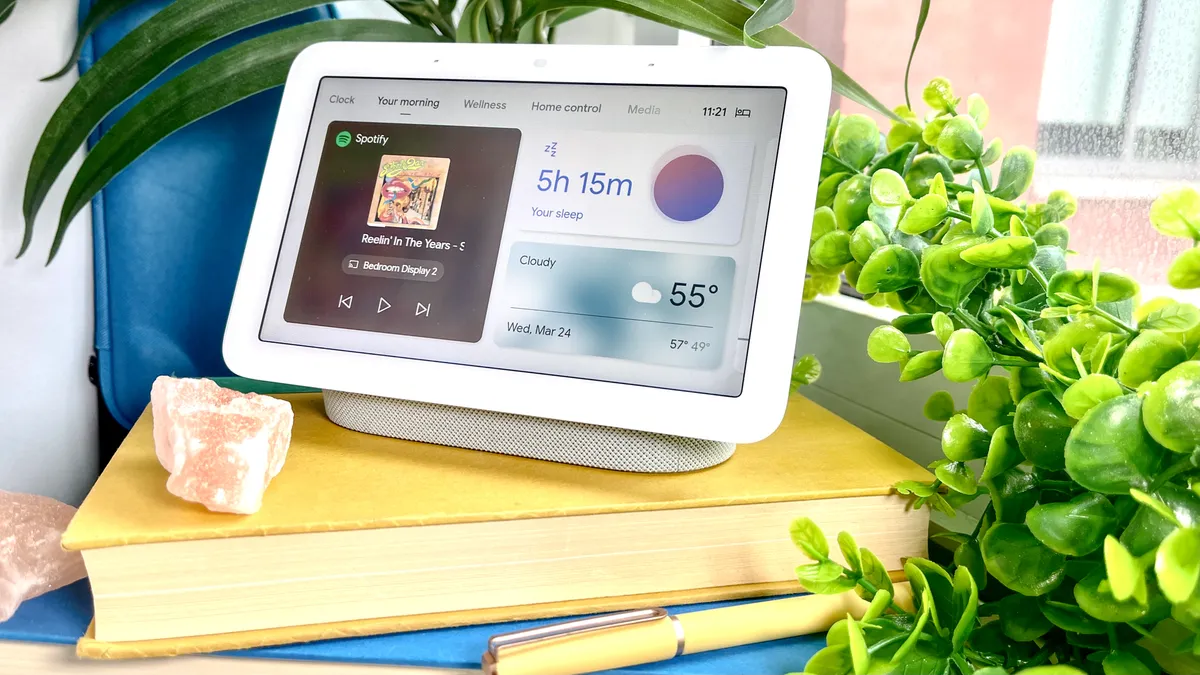
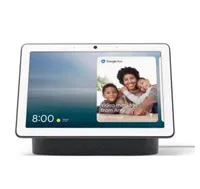
The Google Nest Hub (2nd Gen) is currently one of the best value smart displays, offering a compact but useable device that you can place anywhere in your home to control your devices and interact with Gemini for under $100.
It's a few years old at this point (it launched in 2021) but it's still the most recent version of Google's smart display. Instead of releasing an upgrade, Google has focused on improving the software side in the half decade since, including switching Google Assistant for Gemini.
If you've not been tracking all the AI apps closely: Gemini is Google's alternative to ChatGPT, Alexa+ and Claude, and the company has been slowly phasing out the older Google Assistant (on many, but not all devices), so you can buy this older hub but still benefit from Gemini's more conversational approach to smart home management.
Although the hardware might not be as recent as Amazon's on the Echo Show 8, there's one major aspect that's better — the camera. And by that, I mean it doesn't have one. This makes the device more private than the iPad, and a lot more reassuring than Amazon's software-based camera controls.
But the built-in Soli radar sensors mean that it can still tell when someone walks in the room, and if you place it in your bedroom, track how well you sleep at night. That's verging on creepy, but if you're after a device that can do it, the Google Nest Hub (2nd Genn) is the smart display to go for.
If you read our contemporary review from the launch, you'll see references to the ability to Chromecast. In the years since, Google retired Chromecast dongles, and has renamed the casting tech as Google Cast. So you can still send video and audio to the Nest Hub, just with a different name/command.
It's a great, budget-friendly option if you're in Google's ecosystem or use an Android phone, but if you're after something multi-functional like the Apple iPad, it's worth checking out the Google Pixel Tablet. It's an Android tablet (so you can access all of your apps) but can be used in a docked state as a smart display too.
- Read our full Google Nest Hub (2nd Gen) review
Also tested
How we test the best smart displays
We rate the best smart displays based on ease of setup, performance, voice assistant features, speaker quality and value. When the smart displays have a camera for video calls, we review the camera quality. We see how well each display’s auto-framing abilities work as well.
Since the best smart displays are a window into your smart home, and not nesscarily the way you piece everything together, like with the best smart hubs, the main thing we're looking for is whether they're easy to use. Each smart display should make it convenient and quick to give voice commands and set or engage routines.
We check to see how well the speakers perform (since most smart displays can also stream music, video and doorbell feeds) and if you can see the display in bright rooms. Plus, since these sit right in the middle of your home, we assess any privacy-focused features like mic off options or camera shutters.
FAQs
Are smart displays worth it?
The best smart displays are a great way to visually interact with the devices and services connected around your home. But whether they're worth the money depends on what you plan to do with it.
The way you interact with them most of the time is not that different than with many of the best smart speakers, as you're most likely going to give commands by voice to your chosen assistant that'll then action a task for you.
So if that's what you're after, you can save yourself money and stick with the speaker. But if you want a hub-like device that'll give you information at a glance, or show footage from your video doorbell or security camera, a smart display is what you need.
Ideally, you'd find a good central location in your home for the display; if it's somewhere out of the way, you'll barely look at it, so then you may as well have a speaker. Most smart displays can be moved around though, but need a power source.
The exception is if you use a tablet like the iPad or the Google Pixel Tablet, which can be carried around anywhere in the house. You may find a folio case or stand useful for the iPad, but the Pixel Tablet comes with a charging dock that doubles as a stand.
And although up until this point, I've mentioned new things you can buy to interact with your smart devices, if you have a tablet already, you can pretty much do all the same things on that — you just won't get the unified 'dashboard'-style experience.

