




Virtual reality is no longer just for enthusiasts with expensive gaming PCs. Whether you want an easy way to play immersive games, add virtual screens to your workspace or get more from a PS5, there is now a headset to suit a range of budgets and setups.
Virtual reality (VR) has reached new heights, especially when you throw augmented reality (AR) and mixed reality (MR) into the mix. And in the six years I've spent testing VR headsets, I've used a combination of those realities to learn how to draw, find new ways to work and yes, even have the satisfaction of fighting off zombies and becoming the one and only Batman (along with Iron Man, Deadpool and so on).
The Meta Quest 3S is our top pick for most people, combining standalone convenience with strong gaming and mixed-reality features at an accessible price. There are far more options to consider, as we also recommend the Meta Quest 3 for a more polished standalone experience, PlayStation VR2 for PlayStation gamers, the Pimax Dream Air for premium PC VR and, for something different, the Viture Beast for portable virtual screens. For our hands-on testing and in-depth reviews, our guide is here to help you find the VR headset to suit your needs.

Yes, that is me lying in bed with a Meta Quest 3. That's sometimes how I spend my evenings, as I'm a VR fan who has been testing and checking out all the latest features for over six years. From PC VR gaming to standalone VR experiences, my team and I know what makes these machines worth your money, so whether you're just getting started with your first headset or you're in need of an upgrade, we've got just the recommendations.
We saw all at the Meta Connect 2026 event, including getting hands-on time with the all-new Meta VR Glasses. Meanwhile, Valve's Steam Frame has hit shelves, and it's looking to be an excellent VR headset with a sky-high price tag. For more, check out the latest news.
The best VR headset overall


The Meta Quest 3S is everything you could ever want from a VR headset — great color passthrough and speedy performance, a ton of apps to use and games to play, and all at a seriously affordable price. This is why Tony Polanco has called it "the best VR headset for the money."
Are there cutbacks? Of course. This is a cheaper entry-level headset from Meta, but the team has been carefully strategic in its compromises, so as not to massively impact the experience. For example, you get cheaper Fresnel lenses over pancake, along with a lower resolution display with a narrower viewing angle inside. I'd be lying if I didn't say you'd be hard-pressed to notice these mid-action (except for the occasional bit of glare from those lenses).
Without a 3.5mm audio jack, you're left using the speakers on here. Don't get me wrong, they are good, but you're missing some of that bass emphasis through them.
Besides these, you're still getting that same Snapdragon XR2 Gen 2 processor that keeps all the latest and greatest experiences (such as Batman: Arkham Shadow) running smoothly, the mixed reality experience is mightily impressive, but continues to get better over time, and you'll be hard pushed to really notice that reduced display quality.
Oh, and if you wanted to dip into gaming, all your favorite cloud gaming services work so well on here (to the point that I'd choose this over an actual Xbox). For PC VR, that's just one Meta Quest Link cable away. Starting at $299, this is the best bang for your buck when it comes to getting started with the world of virtual reality.
- Read our full Meta Quest 3S review
The best standalone VR headset

The Meta Quest 3 is the step up over its Quest 3S sibling, and is undoubtedly the best standalone VR headset today. However, the reasons to pick one over a Quest 3S come down to small improvements.
You're getting the same Snapdragon XR2 Gen 2 processor in here, the same breadth of app and game support, so why pick this one? Well, it comes down to whether you're willing to pay a little extra for the best standalone experience you can get in VR.
For example, there's a higher 2K resolution per eye for a combined 4K, thanks to its pancake optics. Combine that with a wider 110-degree field of view and you're getting a more detailed picture that can be seen further into your peripheral vision.
Not only that, but there is also a depth sensor that the Quest 3S lacks, which lends itself to better fixed tracking of app windows in mid-air in front of you, pancake lenses that make for sharper optics without any light glare, a smooth IPD adjustment so you can tune it just right to your vision, and let's not forget the 3.5mm headphone jack.
That said, it's still not perfect. The battery life did not impress us — we managed to kill the battery in just under two hours. But that's what battery headstraps like the Kiwi Design H4 Boost (among others) are made for.
But despite this shortcoming, the Quest 3 is still a top choice. It's just an ultimate question you have to ask yourself. You will see and feel the spec bumps of this headset over the 3S, but is that worth an additional $200 to you? Whatever you choose, expect the finest VR experiences for the price.
- Read our full Meta Quest 3 review
The best gaming VR headset
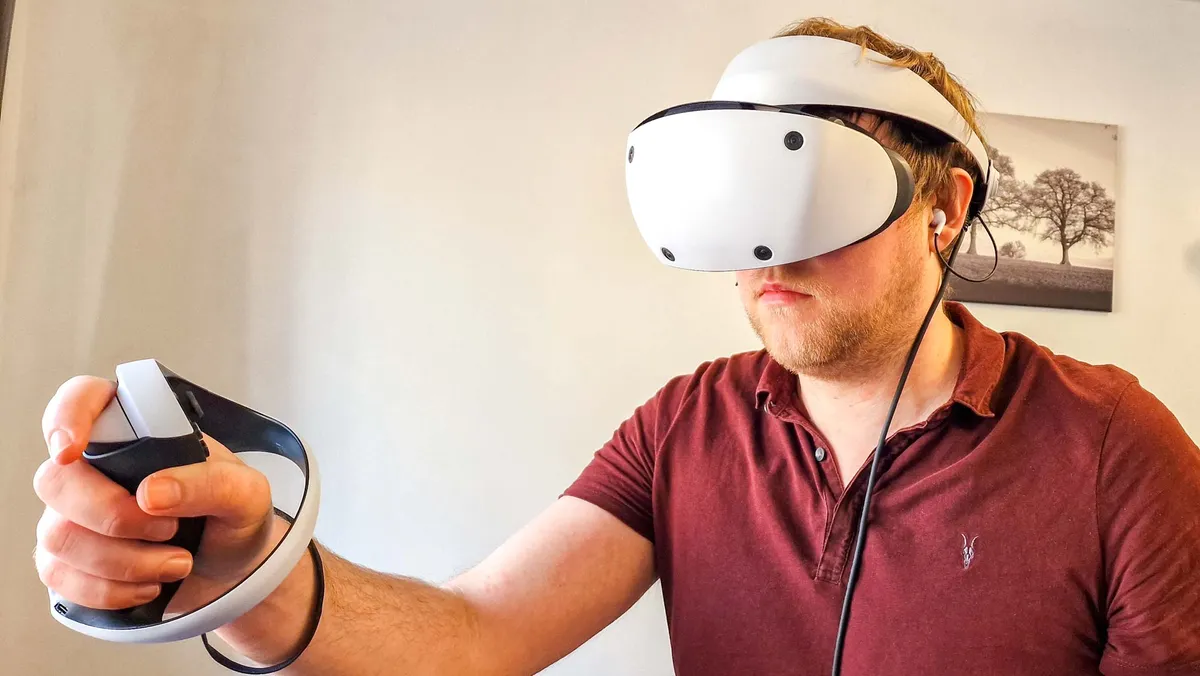
Sony's new PSVR 2 is arguably the best wired VR headset, given it has a plethora of high-end specs, including a brilliant OLED display. But it sits behind the Quest 3 because it requires a PS5 to work and is limited to the PlayStation ecosystem. Plus, the gap between the Quest 3 and PSVR 2 is much smaller than the gap between the Quest 2 and the PSVR 2, thanks to a new processor and display on the Quest 3.
Still, the PSVR 2 is excellent, especially for gaming. The headset is comfortable with just a relatively slim but sturdy cable that connects it to the PS5, the screen is excellent with impressive passthrough capabilities and 4K resolution. Plus, there's 3D audio support and easy buttons for adjustment.
But the real ace-in-the-hole is the Sense controllers. These are not only comfortable and good at tracking, but they also have excellent haptic feedback, an area where other VR headsets are lacking.
And thanks to being in the PlayStation ecosystem, there are exclusive games like Horizon Call of the Mountain and the ability to play Gran Turismo 7 in VR. Combined with the VR tech, the PSVR 2 is one of the very best virtual reality systems you can buy today.
- Read our full PlayStation VR2 review
The best PC VR headset


The Pimax Dream Air is the PC VR headset we recommend for serious enthusiasts. Not just for its featherweight design, easy setup and impressive specs, but also for that steep price tag.
This amazingly compact VR headset packs an ultra-sharp 8K display into a remarkably lightweight 0.6-pound frame, which is quite the change from the heavy, cumbersome headsets that used to dominate this category. If you care about visual fidelity and don’t want a brick on your face, this is the biggest leap we've tested.
What will seal the deal for many is the Dream Air’s 110-degree field of view and all-day wearability. Our reviewer, Jason, completed a 12-hour race session without any discomfort, which you won't come by often in high-powered PC VR. For anyone planning marathon gaming or productivity sessions, that comfort is a game-changer.
Add in full 120Hz eye tracking and you’ve got a headset that doesn’t just keep up with your head movements, it actually anticipates them, making interactions feel more natural than what you’d get with most standalone options. Compared to the Meta Quest 3, you’re trading features like color passthrough for raw fidelity and PC-focused enhancements.
Of course, this level of quality comes at a price. The Dream Air obviously outclasses the Meta Quest 3S in resolution, but it’s significantly more expensive and doesn’t offer the same standalone app ecosystem. What's also annoying is the Pimax Play app can be janky at times, like settings not actually applying when you want them to.
If you’re building a high-end PC VR setup and want the absolute best visuals and comfort, no matter the price, this is the headset you’ve been waiting for.
- Read our full Pimax Dream Air review
The best AR Glasses alternative

Prefer a more subtle, lightweight wearable that puts all its focus on the finest AR tech we've seen? The Viture Beast are a fantastic alternative to a bulky headset, being the best AR glasses on the market right now.
These smart specs are for those who prefer to make use of virtual screens rather than immerse themselves in virtual worlds, as there's no onboard chip to make use of VR apps or games. But it still delivers an exceptional virtual experience on the device of your choosing. Smartphones, laptops, gaming consoles — you name it, and the Beast will unleash an absolutely gorgeous screen straight to your eyes.
With the Sony Micro-OLEDs the glasses pack, it offers up a massive 174-inch virtual screen with 1200p resolution and a peak brightness of 1,250 nits, meaning you can even see screens in direct sunlight. From a Steam Deck to an iPhone, the visuals it reflects in the lenses are filled with rich colors and crisp details. To top it off, the specs also boast a 120Hz refresh rate, making them ideal for gaming.
Through the SpaceWalker app, you'll be able to customize multi-screen setups (including a 32:9 ultrawide screen) and even real-time 2D to 3D content conversion. Plus, the dual Harman speakers offer great spatial audio, even though it's still too quiet in outdoor spaces.
The color accuracy isn't the best around, and our reviewer, Jason England, noticed bluriness around the edges when pushing its wide 58-degree field of view. But if you're looking to boost your workflow with multiple screens, play games on a massive screen or watch shows like you're in the cinema, all in a subtle pair of smart specs, the Viture Beast will do the trick.
- Read our full Viture Beast review
Also tested
What's coming next?

VR headsets are evolving, from the way we use them right down to their entire design. So, what's coming next? Here's a look at the latest news in the VR world, from all-new VR systems to upcoming features we can expect.
- At Meta Connect 2026, we got a hands-on look at the all-new Meta VR Glasses. These are the lenses of a VR headset combined with the frame of AR glasses, using Micro OLED 5K pancake lenses and a puck with a Snapdragon Reality Elite chip, and the glasses only weigh 1.1 pounds. Plus, it will come with 75 hands-only VR games, but this is more for entertainment and work rather than gaming (considering its 70° FOV). Still, with just our impressions, we called them "the future of VR headsets." Not quite the Meta Quest 4 we were expecting, but still a major VR advancement we're keen to get more time with, so watch this space for further updates. The Meta VR Glasses will ship in spring 2027 with a starting price of $1,299.
- The Steam Frame is here, Valve's latest standalone and PC VR headset. It can seamlessly stream 2D, 3D, mixed reality and VR games straight from a PC, while also having enough power to play standalone titles. Starting at $1,059 for 256GB of storage or $1,299 for the 1TB model, this is one pricey VR headset that missed the mark for taking on the Meta Quest (thanks, RAM crisis). Still, as with the Steam Machine, we're looking forward to going hands-on and testing this out, so stay tuned.
Best VR Headsets: Frequently Asked Questions

Is VR worth it in 2026?
VR is still a major platform worth checking out in 2026, especially for anyone who hasn't experienced virtual reality before. While VR headsets and VR gaming may not get as much attention as console or PC gaming these days, there are still all-new games and apps that continue to arrive on the Meta Store, PlayStation Store and SteamVR.
Now, we have Valve's Steam Frame, showcasing more ways to take advantage of VR. That includes a dedicated wireless link for both VR and non-VR streaming straight from a PC, and with one of the best gaming PCs, that means amazing immersive visuals. Plus, these headsets can be used for more than just virtual reality, as many offer mixed reality experiences that allow for multiple virtual screens via a PC to boost productivity.
As the VR space continues to evolve, with products like the Snap Specs showcasing true AR experiences in a smaller frame, we're sure to see the next step in VR headsets, too.
Should I buy a standalone VR headset or a PC VR headset?
Choose a standalone headset if you want the simplest route into VR, while a PC VR headset is better if you already have a powerful gaming PC and prioritize visual fidelity. Standalone models such as the Meta Quest 3S and Meta Quest 3 run their own apps and games without a console or computer, and both can also connect to a PC for PC VR.
The Pimax Dream Air is our premium PC VR pick for enthusiasts who want sharper visuals and can accept the higher cost and PC setup. For most first-time buyers, though, a Quest is the more flexible starting point.
Can I use a Meta Quest headset for PC VR gaming?
Yes, Meta Quest 3 and Quest 3S can be used for PC VR gaming as well as their own standalone apps and games. You will need a VR-capable PC and a supported connection method, such as a compatible Link cable or wireless connection, to access PC VR content.
That makes a Quest a practical option if you want to start with a simpler standalone setup but keep the option to use a gaming PC later. For a dedicated high-end PC VR system, the Pimax Dream Air is an excellent shout.
What can I use a VR headset for besides gaming?
Beyond gaming, a VR headset can be used for virtual workspaces, media viewing, fitness, social experiences and mixed-reality apps that place digital windows in your room. The Meta Quest 3 and Quest 3S offer a broad mix of apps, while the Quest 3’s sharper optics and depth sensor are particularly useful for productivity-oriented use.
If you mainly want a large private screen for a laptop, phone or console rather than immersive apps, AR glasses may be a better fit. As an example, we recommend the Viture Beast for its massive virtual screen.
Should I buy AR glasses?
We cover the best smart glasses, too, and the display tech is reaching a whole new level that's blurring the line between AR glasses and VR headsets. We're not at that crossover point yet, but that hasn't stopped the likes of the Viture Beast from giving you a similar big-screen spatial experience you'd find in a VR headset.
If portability is important, then this is a great way to go for watching movies, playing games or social experiences.
How much space do I need to use a VR headset safely?
You need a clear area large enough for the VR experiences you plan to use, with furniture, pets, and other trip hazards moved out of reach. Seated and stationary apps need less room than active games or fitness sessions, but any headset can lead you to move more than expected when you are immersed. Meta recommends a 6.5 ft x 6.5 ft / 2 m x 2 m clear space for VR use.
Follow the current setup guidance from the headset maker, define the available play boundary carefully and take regular breaks so you don't get too dizzy.
How to choose the best VR headset

When choosing a VR headset, ask yourself what you'll use the VR headset for? From there, you can figure out what best suits your needs. To help you, think about these key factors:
- Gaming: This is probably the most popular reason for buying a headset. If you're going down this route, the PSVR 2 is incredible for console VR experiences with a side order of PC VR (thanks to the adaptor), or if you're PC-specific, the Pimax Dream Air is a good shout. However, the Meta Quest 3 and Quest 3S are also versatile machines with their own library of exclusive games, along with a link to PC VR (best used with a wired connection over Air Link).
- Work and productivity: Spatial computing may not be quite ready for prime time yet, but that doesn't mean it isn't an amazing way to get stuff done. For this, the Meta Quest 3 has all the capabilities, but if you're looking for something more lightweight that is specifically AR-driven, grab the Viture Beast.
- Fitness: Fancy working out at home instead of going to the gym? Workout VR apps are incredible, and you'll need something with the ecosystem and lightweight construction for it. Go for the Meta Quest 3S.
- All of the above: Maybe you don't fall into one camp. So for this, you need a good blend of everything — including a comfortable fit, a wide field of view and display quality. And in terms of hitting all the categories, the Meta Quest 3 or Quest 3S are your best bets.
How we test VR headsets

Finding the best VR headsets takes a suite of things to consider, from the hardware itself to the software the headsets will work with. We test and consider how easy it is to set up a VR headset and system, how well-designed and comfortable the headset is, how well its interface works, and we take a look at the accessories the VR headset can use.
A major part of initial testing involves evaluating how much space is needed to set up one of our picks for the best VR headsets to get the most out of them.
A product can look great but still be uncomfortable to use. Aside from testing out all the various content, we spend hours wearing each headset. We test to make sure any embedded air vents are keeping things cool. And if it does get sweaty, we see how well the face guard wicks away moisture. We also weigh the headsets, because even the lightest gadget can feel heavy after long periods of use. Finally, we test how adjustable the head straps are and how secure they feel.
As the de facto face of your virtual experience, the interface is vitally important. We test how responsive and intuitive the home page and subsequent menus are, as well as test special features, like voice commands and gesture control.
Whether it's a traditional gamepad or something more elaborate, like Meta's controllers, we're checking to see if the input devices are ergonomically designed; after all, no one wants hand cramps. We also test tracking and responsiveness in the best VR games.
Hardware without great software is just an expensive paperweight. We not only examine the size of a device's library but also scour the listings and test out some of the higher-end apps and titles. At this point, a good library should feature many games, apps, movies and other experiences.

