




The best TV antennas are a great way to keep costs down and still get a huge amount of sports, TV shows, movies and news straight to your home without a monthly subscription to a streaming service.
You don't need an internet connection to make them work; just find the right spot, connect the cable to your TV and you're ready to go. For most people, an indoor antenna like the Mohu Gateway Plus is going to be the most convenient choice.
It's our favorite multi-directional indoor antenna that picked up 41 channels with a 60-mile range from inside our home during testing. Or if you need to keep costs down more, the Channel Master FLATenna 35 is the best budget TV antenna right now.
Best TV antennas available right now
Why you can trust Tom's Guide Our writers and editors spend hours analyzing and reviewing products, services, and apps to help find what's best for you. Find out more about how we test, analyze, and rate.
Best TV antenna overall


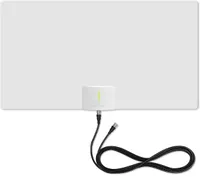
The Mohu Gateway Plus is an amplified indoor antenna that is such fantastic value, it's hard to recommend anything else. During our testing, it pulled in 41 channels, with 34 hitting the near-flawless image mark.
The multi-directional design means that it doesn't just pick up signal from a single direction, but can search a 60-mile radius, which is one of the reasons it can pick up so many high-quality channels.
But it's also helped by the included USB-powered amplifier which boosts the signal. Combine the Gateway Plus' slimline design, with it's amplifier and ease of set up and you get easily the best indoor TV antenna for an incredible price.
It loses a few marks because the coaxial cable isn't detachable. So if it gets damaged, you can't just plug in a new cable, you'll need to replace the unit. Sometimes, brands make decisions like this for good reasons, but it's hard to see why in this case.
- Read our full Mohu Gateway Plus review
Best budget TV antenna

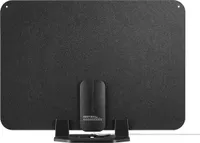
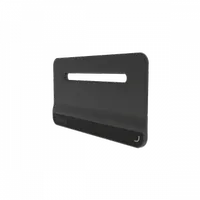
Like the Mohu Gateway Plus, the Channel Master FLATenna 35 is a thin and flat indoor antenna. There are two differences, though: the FLATenna isn't amplified and it is almost half the price of the Gateway Plus.
It doesn't quite match the Mohu model, but it's surprisingly good considering the sub-$50 price tag, which is why I rate it as the best budget TV antenna. It's not the cheapest we've tested, but it offers the best performance-to-price ratio.
There's one colorway to choose from — one side is white and one is black — so you can choose the side that fits your room best to have on show. Some budget antennas have the cable built-in, but the FLATenna's 12-foot coaxial is detachable.
This is a pro-consumer move as it means you can change the cable if you need to (like if it gets damaged), but the included one is quite stiff, making it harder to move out of sight. But the great thing is you can just buy a different one if that's a problem.
All we had to do was choose a position, then plug the coaxial cable into our TV. It picked up 83 channels, which is a huge range for an indoor antenna, and most of them were entirely watchable, and many were near-flawless.
- Read our full Channel Master FLATenna 35 review
Best outdoor TV antenna

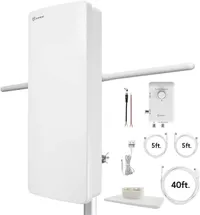
The Antennas Direct Goliath looks like an old-school TV antenna, the kind mounted to the top of houses around the country, which is exactly how you install this outdoor antenna. It's not amplified, but it is generally sold as a bundle with the company's Juice Plus pre-amp, which does the legwork.
It's big (87 inches long, 27.5 inches high, and 24 inches wide) without the mounting posts, and the nine-pound antenna wasn't too hard to move around during installation. Though, it's not multi-directional, so you need to be sure which way you're going to point it before you lock it into place.
The range is the best part of the antenna, reaching 70 miles, but it has quite a small 24-degree reception pattern, which means you're generally not going to get the largest selection of channels. Often, it's around 70, though our tester's previous roof-mounted antenna hit 100 in the same location.
With installation and channel selection out of the way, you can focus on the actual performance of the antenna. We found that it worked really well, achieving a crisp 480p image, and the antenna filters out interference from LTE and 5G towers.
- Read our full Antennas Direct Goliath TV antenna review
Test results
Antenna |
Price |
Range |
Channels Received |
Amplified |
$79 |
60 miles |
41 |
Yes |
|
$35 |
35 miles |
83 |
No |
|
$229 |
70 miles |
60 |
No |
As you can see, our pick for the best TV antenna you can buy, the Mohu Gateway Plus, is a reasonably (especially compared to our pick for the best outdoor antenna, the Antennas Direct Goliath).
Despite its mid-range price, the Mohu features a decent range of 60 miles and pulls in 41 channels, making it great value for money. But your choice may largely be dictated by the environment you're in, and whether you need that additional range or outdoor connection.
Also tested
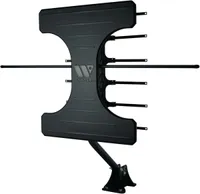
How we test the best TV antennas
The way we test TV antennas is pretty straightforward; we use them. Whether we have a staff reviewer or contributor take on the testing, the aim is always to use them just like you would do, so you know what you're buying before you spend your money.
For indoor antennas, we position then in relatively clear spaces, but don't create a dedicated area just for testing, as that's not how you'd have them in your home. For outdoor models, we install them on the roof and see how they perform.
We look at how easy the installation process is, and whether you need any extra tools or supplies, like cabling, to get the job done. Then, we plug the coaxial cable into our TV and let the antenna do it's work and see how many channels (and in what quality) it can discover.
The results will always vary compared to your home. The performance can be effected by the density of buildings, the environment around you and even the amount of hills or trees near you, as even the best TV antennas will struggle if there are obstacles.
We try to control for this; most of our testers are based on the outskirts of a city, where the buildings are slightly more spaced apart, but still pretty dense in the direction of the urban area, which is sometimes where the broadcasts originate.
How to choose the best TV antenna
If you're after the best TV antenna, it's likely you're either looking for local broadcast stations or want to cut costs and watch shows without a monthly subscription. Most antennas can help with that, but often, the more you pay, the better performance.
That's not always the case, though. Some models are expensive because they work inside or out, or have amplifiers built-in to boost the signal. Whether you need this largely depends on what the coverage is like near your home.
So the most essential part of buying a new TV antenna is to consider the environment you're in. If you live near a broadcast tower, a model with shorter range will do you. But if you're in the middle of a dense city, you'll need something with a longer range and probably an amplifier.
Outdoor antennas generally have the best range, as they're elevated above the buildings (mostly) and so there are fewer obstacles blocking the signal. Indoor antennas are more convenient and quick to install, but aren't ideal if there are a lot of buildings or hills nearby.
Of course, it's hard for you to know what stands between your home and the tower. Fortunately, AntennaWeb.org lets you plug in your ZIP code and find out which stations broadcast near you, how far they are, and the type of antenna you'd need to recieve them.
FAQs
Can you use a TV antenna with smart TVs?
Smart TVs connect to the internet so you can stream TV shows, movies and sports online. But these TVs also come with a coaxial input, so you can plug an antenna directly into the set and watch over-the-air (OTA) broadcasts.
Some smart TVs have built-in tuners to scan for channels and create channel guides. So you can happily use a smart TV to watch live TV with an antenna, or take our a Netflix subscription and binge-watch shows. It's really up to you.

