With summer not yet over, it might seem too early to be thinking about spring color in your yard. While you’re still enjoying the last of summer blooms, it seems as if there’s no time to catch your breath before it starts all over again.
However, according to the experts at Dobbies, September and October are the optimal months to plant spring flowering bulbs to give them plenty of time to take root, although November is the best month to plant tulips. And if you're like me, I always look forward to the color that spring flowering bulbs bring to my yard, as it’s a sign of brighter and longer days to come after winter.
And there’s so much to choose from — alliums, crocuses, daffodils, fritillaries, hyacinths, irises, lilies, snowdrops and tulips — everyone has their favorites.
Whatever the size of your yard, bulbs can be tricky to plant. Unlike other plants, bulbs are planted in multiples, which can take time. To make life easier, it’s best to use a specific tool designed for the job, such as a bulb planter.
So, to discover if using a bulb planter really helps, I tested Kent & Stowe’s hand bulb planter to see how easy it was to use.
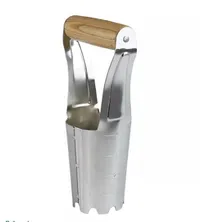
It's small and nifty

The Kent & Stowe hand bulb planter looks very much like any other bulb planter, except that it has a certain rustic quality about it. I put this down to the overall design, which uses carbon steel for the main planting component, combined with an attractive ash handle that is stamped with the company’s name. The majority of hand bulb planters have plastic handles.
Although you expect a tool to do the job it’s intended for, there’s no reason why it can’t be aesthetically pleasing to the eye.

The hand bulb planter measures 9 inches tall, with the wooden handle measuring 4.5 inches across. The lower part of the planter measures 2.4 inches, and the upper part measures 2.7 inches. The reason for the difference in width is to enable the soil to be displaced more easily without getting stuck. However, unlike, some hand bulb planters, this tool doesn’t have a spring-loaded handle that can help release the contents. (More on this later.)
To act as a guide, the outer side of the bulb planter is marked in one-inch increments, up to 4 inches, to give you a clear indication of how far down in the soil you are going.
Plus, the lower edge is serrated to help ease the bulb planter into the soil. Here, the edge is smooth rather than sharp, ensuring there’s no chance of injury.
Ease of use


There’s not much you need to know about using the tool, as it’s very intuitive. You won’t find any instructions with your purchase, but you’re unlikely to need them.
All you'll need to know is the best time to plant bulbs, which will depend on your climate. Shawna Coronada, author of No Waste Organic Gardening, says planting your bulbs 6-8 weeks before the first frost will give them the best chance of rooting.
I’d chosen some of my favorite bulbs to plant: Snake Head Fritillary, perfect for wild gardens, rockeries, and grass, and the soft cream and pink-tinged Albion Star tulips.
I started by inserting the bulb planter in the soil and using the guide measurement on the side to judge how deep I needed to go. In this case, I went down 4 inches, which is the required depth to plant the fritillary bulbs. I had to give the tool a bit of a wiggle, but other than that it was easy.
Once I’d reached the required depth, I lifted the bulb planter, and the soil remained inside. This allowed me to place the bulb in position before replacing the soil. Again, I had to give the tool a little wiggle for the soil to drop back into position. I didn't find it an issue that the tool doesn't have a spring-loaded handle to help release the soil.
If the soil is particularly wet and mucky, I recommend wearing your best gardening gloves to protect your hands from dirt and friction, especially if you are using the tool to plant more than just a few bulbs.
Is Kent & Stowe’s bulb planter a good tool?
If you don’t mind getting down on your hands and knees, this Kent & Stowe hand bulb planter makes a good tool. However, if you have problems with hand discomfort, you may prefer to opt for a bulb planter with a more ergonomic handle, such as Fiskar’s bulb transplanter, $13 at Amazon. I’d also suggest it’s best for planting small quantities of bulbs unless you’ve got a sturdy pair of knees or a good kneeling mat!
If you tend to go all-out when planting bulbs, a long-handled tool is probably more suitable. Jardinner’s Bulb Planter Tool, which also comes with a small bulb planter and dirt-proof gloves, is available for $32 at Amazon.
However, the Kent & Stowe hand bulb planter certainly does what it’s designed to do, and it can also be used to plant potatoes and bedding plants, making it a versatile and multifunctional tool.
Although a bulb planter isn't one of the 7 essentials tools every gardener needs, it certainly makes life easier. However, you might also want to consider using a hori hori knife as a multi-functional garden tool.
More from Tom's Guide
- Discover how to grow garlic
- And 5 ways to get rid of rust stains and look after your garden tools
- Plus, I'm a gardening writer, and these $11 gardening gloves are my new go-to