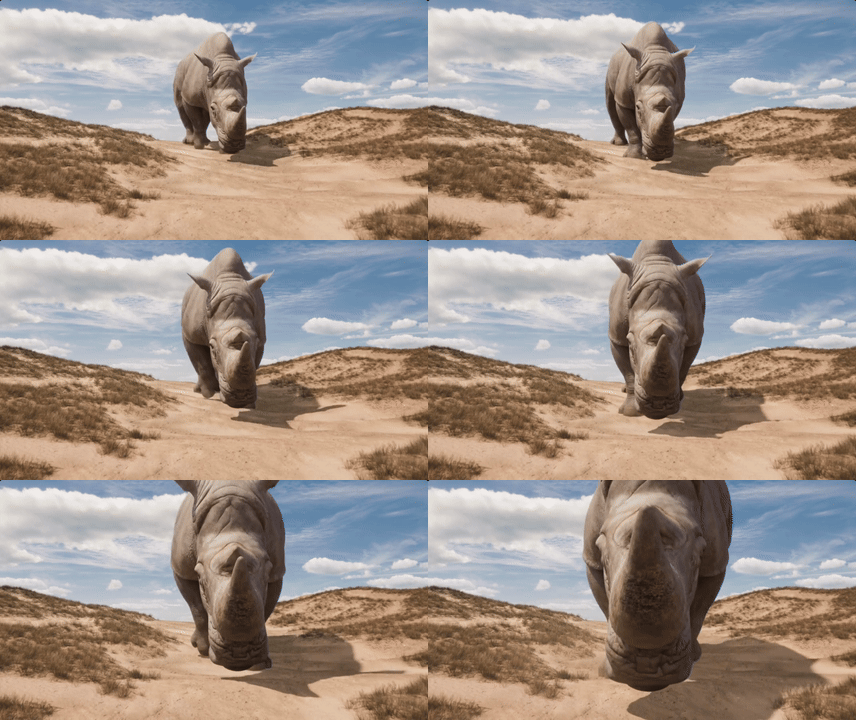
Odyssey, a startup that’s around a year old, announced it’s building Hollywood-grade visual AI that should be able to generate cinematic scenery, characters, and lighting.
What Odyssey promises to do differently than other text-to-video tools is to give you full, fine-tuned control over every element in your scene.
Odyssey co-founder Jeff Hawke argued that if ChatGPT produced text that users couldn’t edit, they wouldn’t use it.
“But that’s how text-to-video works today, where the model output is a fully-baked video file that you can’t edit,” he wrote on X. “If any of the scenery, characters, lighting, or motion is off, you have to start again.”
Creating a new type of model
Super excited to share what I’ve been working on: @odysseyml! We’re building Hollywood-grade visual AI, to enable storytellers to create new, amazing movies, TV shows, and video games. We believe this technology is what comes after text-to-video. More below.👇 pic.twitter.com/XYr1Dcxo9rJuly 8, 2024
The way Odyssey overcame this limitation is to train four generative models that allows users to have fine-tune control over different layers of the video.
These models can generate high-quality geometry, photorealistic materials, stunning lighting, and controllable motion. If it all works as expected, you should be able to rapidly generate videos exactly as you envisioned them.
Odyssey co-founder and CEO Oliver Cameron lamented that at the moment we’re surrounded by “low-quality AI-generated text and imagery”. He said that for AI to work for Hollywood, it has to create “glitch-free and mind-blowing visuals”.
To deliver these goods to film makers, Cameron revealed they’ve secured $9 million from investors to fund their startup. He explained their models are harder to build than text-to-video tools but believes it will result in a better end product that can be used in movies, TV shows, and even video games.
Inspired by driverless cars
The approach for this AI video generator that could challenge the likes of Sora, Luma Labs Dream Machine, and Runway actually came mostly from autonomous vehicles according to Hawke.
This is because autonomous vehicles had to push state-of-the-art technologies in visual AI to actually ship and they helped scale performance with real-world data. The driverless cars also necessitated simulations that had accurate physics.
Cameron co-founded Voyage, a company that developed and deployed self-driving cars designed for senior citizens who struggled to drive.
Hawke was a founding researcher at Wayve, a UK-based company which is testing autonomous vehicles in cities across the UK.
More from Tom's Guide
- 5 Best AI video generators — tested and compared
- OpenAI just released a Sora generated music video — and it’s like something out of a fever dream
- AI may be able to make real-time video in a year — this is huge