Audio Playback, Continued
- 1. Introduction
- 2. Battery Life Under Heavy Graphics Load
- 3. Battery Lifetime As A Function Of Graphics Card Clock Rates
- 4. 3D Games Drain The Battery Dry
- 5. Mobile CPUs Are Always Faster, But Not Noticeably More Energy-efficient
- 6. Persuading Mobile CPUs To Conserve Energy
- 7. Best Practice: How Power Scheme Selection Affects Battery Lifetime
- 8. Effects Of Display Brightness On Battery Lifetime
- 9. Repeated Data Copies To An External Hard Drive
- 10. Continuous File Reads From An Internal Hard Drive
- 11. Discussion
- 12. Working With An Optical Mouse
- 13. Discussion
- 14. DVD Video: The Right Player Software Extends Battery Lifetime
- 15. Discussion
- 16. Use Of The Optical Drive For Data Storage
- 17. Bad-quality Optical Media Shortens Battery Lifetime
- 18. Mobile TV Cuts Battery Lifetime In Half
- 19. Use Of WLAN, LAN, And PAN Components
- 20. Use Of WLAN, LAN, And PAN Components, Continued
- 21. LAN And WLAN: Which One Consumes More Power?
- 22. Bluetooth
- 23. Audio Playback: Best On A Headset Or On The Built-in Speakers?
- 24. Audio Playback, Continued
- 25. Webcam
- 26. USB Devices: Power Consumption Levels Depend Mostly On The Application Is Use
- 27. USB Devices, Continued
- 28. MobilityGuru's 10 Tips To Extend Battery Life
24. Audio Playback, Continued
Incidentally, many audio codecs such as the Sigmatel STAC 975X in the Latitude D 610 support their own energy saving functions. These "recognize" when audio signals need to be processed and when none are present. In the latter case, the audio chip automatically falls into a type of sleep mode in which it consumes noticeably less energy. This function only comes into play, however, when the chipset supports such capability, as it does on our Dell test unit.

Sigmatel's audio codec STAC 975X supports energy saving functions.
Discussion
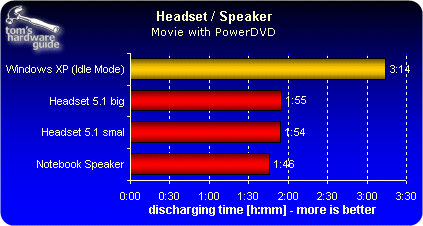
Using a USB headset with an external soundchip has no impact on battery lifetime - in fact, by comparison with audio output from the internal audio chip and speakers battery lifetime actually increases by 10 minutes. The 25-30% reduction in battery lifetime by comparison with our office usage scenario (2:43) is attributable to power demands from the DVD player and those components in the PC involved in decoding video (CPU, GPU, chipset and RAM).
However, the headset consumes 500 mW of power in standby mode. If the internal audio chip inside the notebook isn't in actual use, its power consumption shrinks to just a few microamperes. If sound output isn't continuous and ongoing, an onboard audio solution has a definite advantage.
- Previous page Audio Playback: Best On A Headset Or...
- Next page Webcam